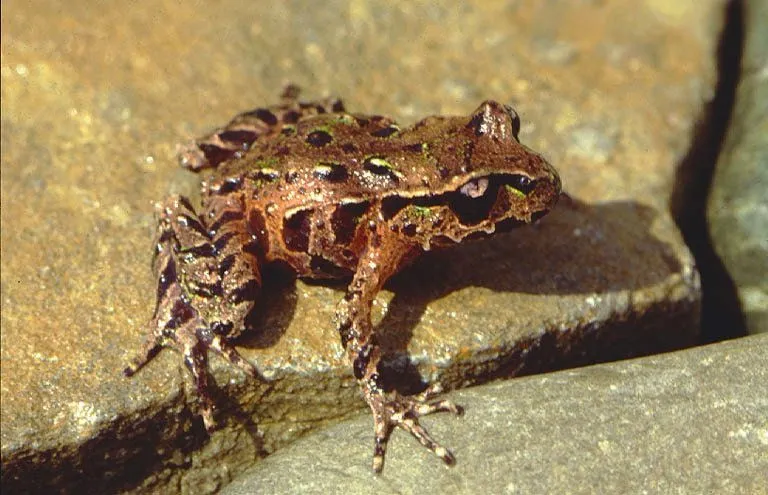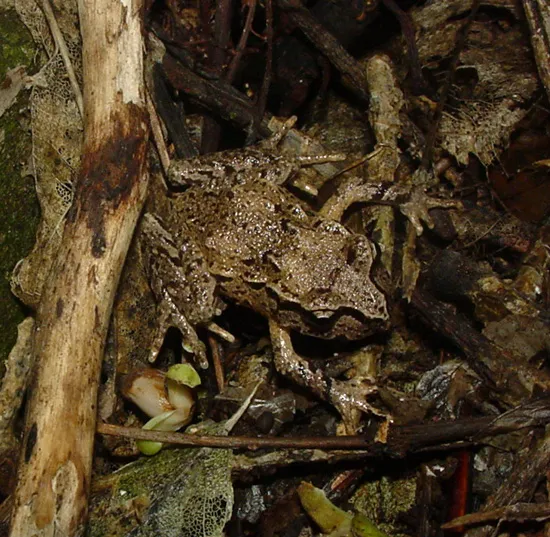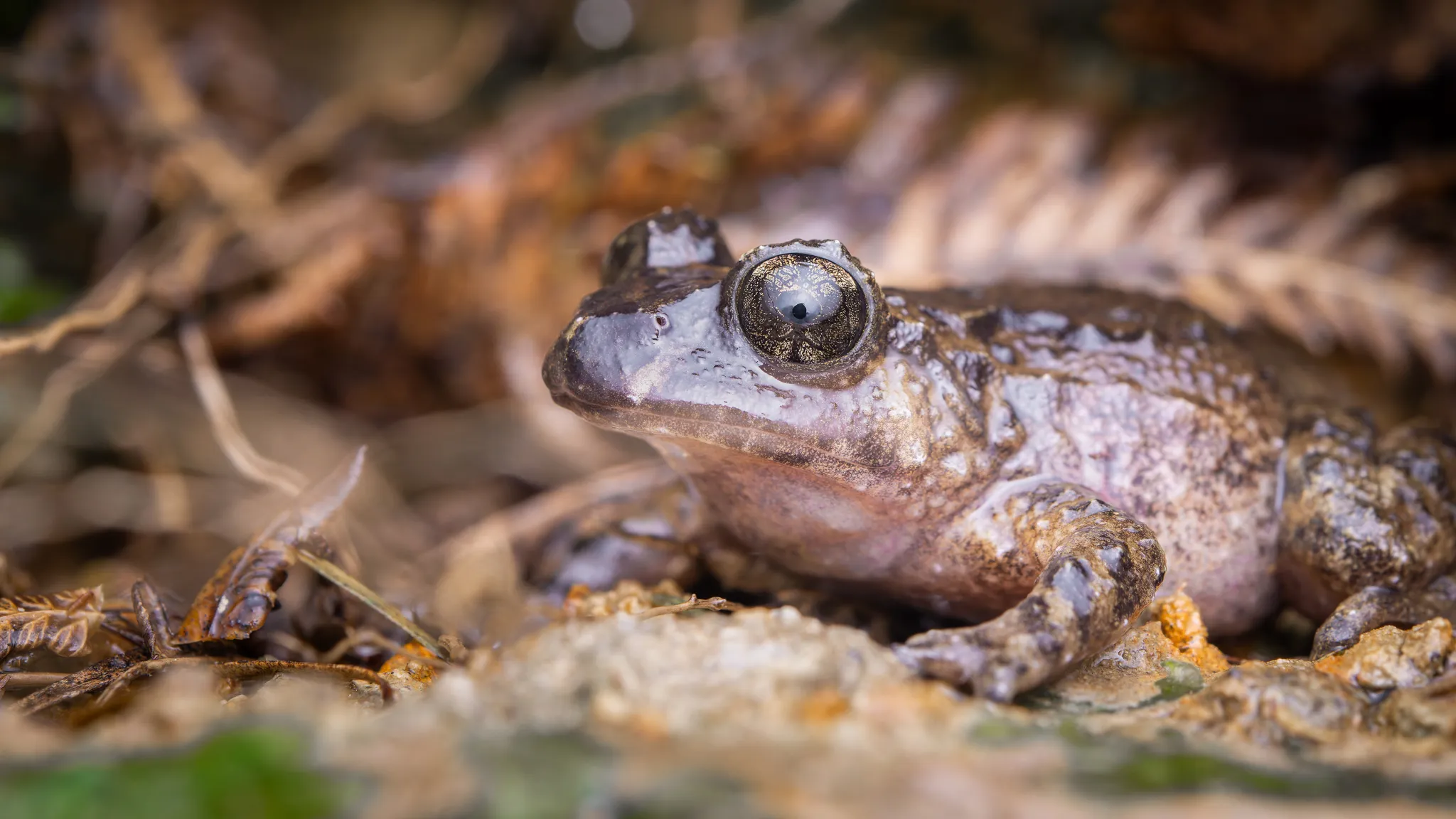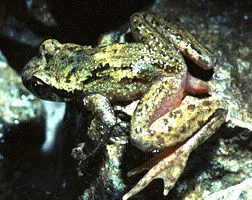
Ascaphus truei, the coastal tailed frog, is a small frog of cold, clear, rocky streams in mature forests2. Its range runs from northwestern California north to the Portland Canal and Nass River of British Columbia. The “tail” that gives the frog its name is a short, tail-like copulatory organ1 of the males, used for internal fertilization. The species is also listed under the English name Bell’s Toad3.
Until 2001 the genus Ascaphus was thought to hold a single species. That year the Rocky Mountain tailed frog, Ascaphus montanus, was promoted from a subspecies to its own species, and the remaining species has since been formally called the coastal tailed frog4.
Identification
Juveniles and adults are small, typically 2.2 to 5.1 cm in snout-vent length; the Washington Department of Fish and Wildlife gives 1.5 to 2 inches. The frog is slender-bodied with rough skin, and its colour is usually comparable to its substrate, from tan to chocolate brown or olive green1. The head is relatively large, flattened and slightly broader than long, and a pale triangle often exists between the eyes and the snout. The pupil is vertical, and an eye-stripe extends from the snout to the shoulder2.
The toes are slightly webbed and the outer two hind toes are flattened. The toe tips are hard and keratinized, which helps the frog crawl among rocks on the stream bottom, and the lungs are greatly reduced. The frog has no eardrums, and no vocalizations have been documented2. Males are smaller than females, and in the mating season they develop black, horny pads on the insides of their thighs1 that help them grip the female.
Tadpoles average little more than 11 mm after hatching and may reach 65 mm before metamorphosis1. The tip of the tail is broadly rounded and typically has a white spot bordered by black. A large, sucker-like mouth on the underside lets the tadpole adhere to rocks in fast-flowing streams; this oral disc covers about 1/3 to 1/2 of the lower body surface2.
The skin secretes a series of antimicrobial peptides called ascaphins, which act against bacteria such as E. coli and S. aureus4.
Habitat and range
This range is bordered by the Cascade Mountains to the east and the Pacific coast to the west1. Populations in the Blue Mountains were split into a new species, the Rocky Mountain tailed frog, which also lives in southeastern British Columbia4. In Washington the coastal tailed frog occurs in the Willapa Hills, the Black Hills, and the Cascade and Olympic Mountains, at elevations from near sea level to 6804 feet2.
Its habitat is clear, cold swift-moving mountain streams with coarse substrates, primarily in older forest. Stream temperatures must stay cool even in summer, as the species is known to have narrow temperature tolerances. Juveniles and adults also need a mature or old growth forest alongside their stream habitat1, and use the streamside vegetation for food and refuge. In wet weather the frog may be found on land near water; in dry weather it stays on moist stream-banks5.
Behaviour and breeding
Juveniles and adults are often active nocturnally, though tadpoles and frogs can also be observed during the day. The frogs are most active from April to October2, varying by locality. Activity dramatically decreases during winter, but the frogs do not hibernate. Adults eat a wide variety of insects and other invertebrates, while the larvae feed mostly on diatoms5. In some streams the tadpoles can act as the dominant herbivore1.
Courtship takes place in the water between September and October. In mating, copulation can follow amplexus, with the male’s “tail” inserted into the female’s cloaca; the “tail” is used to prevent sperm from being washed away. Females store the sperm and do not deposit eggs until June or July, when they attach a dual strand of 44 to 85 small-sized eggs1 to the base of a rock or boulder in the stream. The Washington account gives strings of 40 to 80. The eggs hatch in approximately six weeks2.
The larval stage may last one to four years: 1 to 3 years in coastal populations and 3 to 4 years in montane or inland ones. In Washington it lasts two to five years2, depending on location and elevation. Females have been shown to reproduce biennially, while males may mate annually. Animal Diversity Web gives a maximum lifespan of at least fourteen years1, a figure it lists under captivity.
Conservation
The species is rated least concern in the 2022.2 edition3 of the IUCN Red List. Logging and construction may affect the species, as they can raise stream temperatures and cause siltation1. In Canada, COSEWIC assessed it as Special Concern in November 2011, and British Columbia places it on its Yellow5 list. In Washington its state status is “apparently secure”, and the department notes it is vulnerable to practices that increase stream temperature, increase sediment load2 or alter streamside zones.
Similar species
- Pacific treefrog, Pseudacris regilla: it has horizontal pupils, circular discs at the tips of its fingers and toes2 and rounded 4th and 5th hind toes, where the coastal tailed frog has vertical pupils and flattened outer toes.
- Great Basin spadefoot: it also has vertical pupils, but it is typically found only in arid habitats and has black spades on the underside of its rear feet2.
- Rocky Mountain tailed frog, Ascaphus montanus: the two are told apart by range, with the Rocky Mountain species in southeastern British Columbia4 and the coastal species in coastal British Columbia.