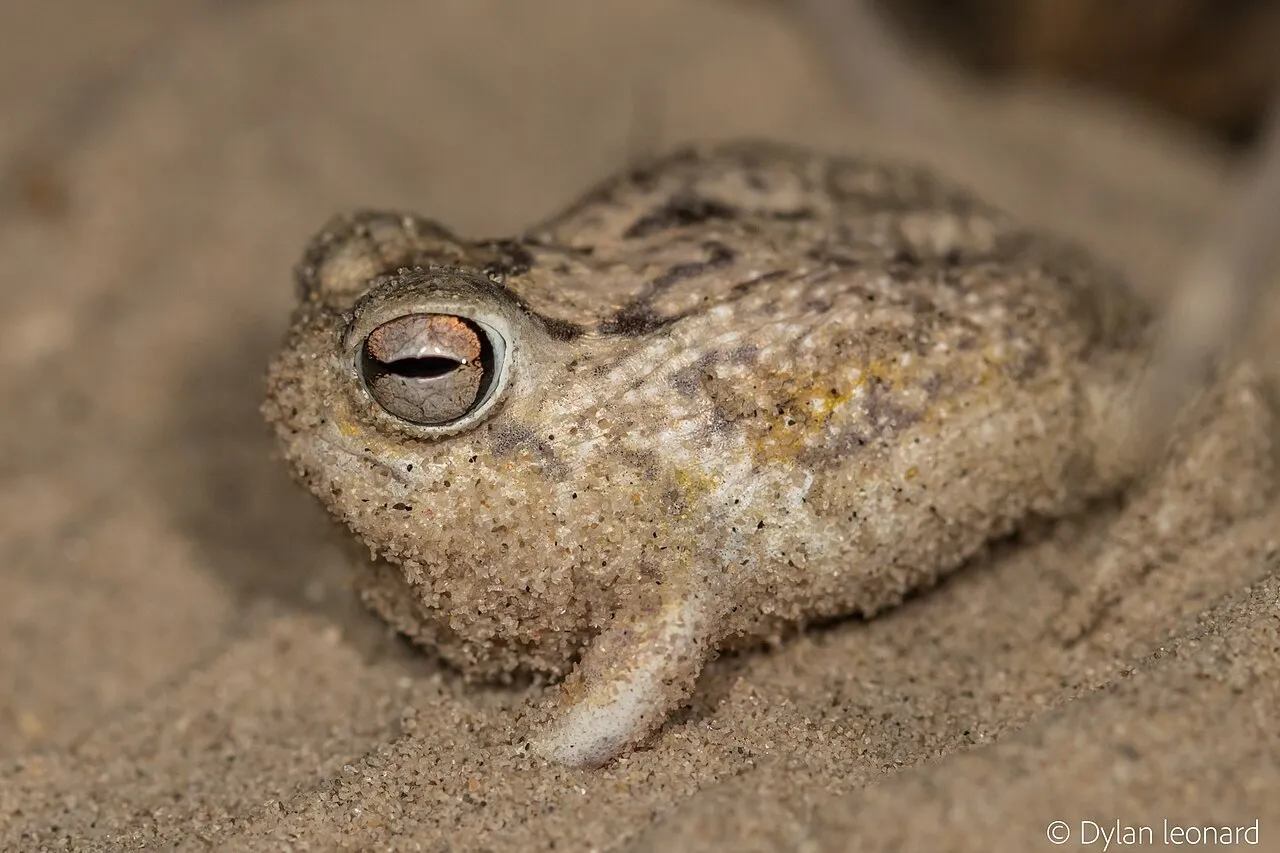
The desert rain frog, Breviceps macrops, is a small, round-bodied amphibian confined to a narrow coastal strip of Namibia and South Africa, roughly a 10 km wide band along the southwestern African coast. It is one of the few frogs in the world adapted to live on open sand dunes rather than near standing water.
Identification
B. macrops grows to about 40–60 mm snout-vent length, a stout size consistent with other members of the genus Breviceps; the facts box carries the exact range. Like its relatives, it has a rounded body and short limbs instead of the long legs of a jumping frog, built for burrowing in loose sand, not leaping.
Habitat and range
The species lives on coastal sandy shores and dunes with loose sand, strong winds and about 60 mm annual rainfall. With almost no rain and no surface water, fog is the main moisture source for the frog, which absorbs it through its skin while buried just beneath the sand surface. This narrow, fog-fed strip of coastline is the only place the species is known to occur.
Behaviour and breeding
Like other rain frogs, B. macrops spends most of its time buried in sand and is active mainly at night, when cooler, moister air reaches the surface. It is a terrestrial breeder: during the June–October breeding season, males emerge from their burrows at night and attract females with a distinctive squeaking call. The female lays a clutch of 12–40 eggs in a burrow, where one of the adults stays near the nest; the eggs develop directly into froglets, skipping the free-living tadpole stage most other frogs pass through.
Conservation
The species’ facts box carries its current IUCN Red List category, Near Threatened, reflecting how its entire range is confined to a thin coastal strip exposed to diamond mining and other coastal development. Its population trend is not covered in the available sources.
Similar species
B. macrops belongs to the same genus as the bushveld rain frog, Breviceps adspersus, but the two differ sharply in range: while B. adspersus is widespread across southern Africa’s bushveld and grassland, B. macrops is restricted to the narrow, fog-bound dunes of the Namib coast.