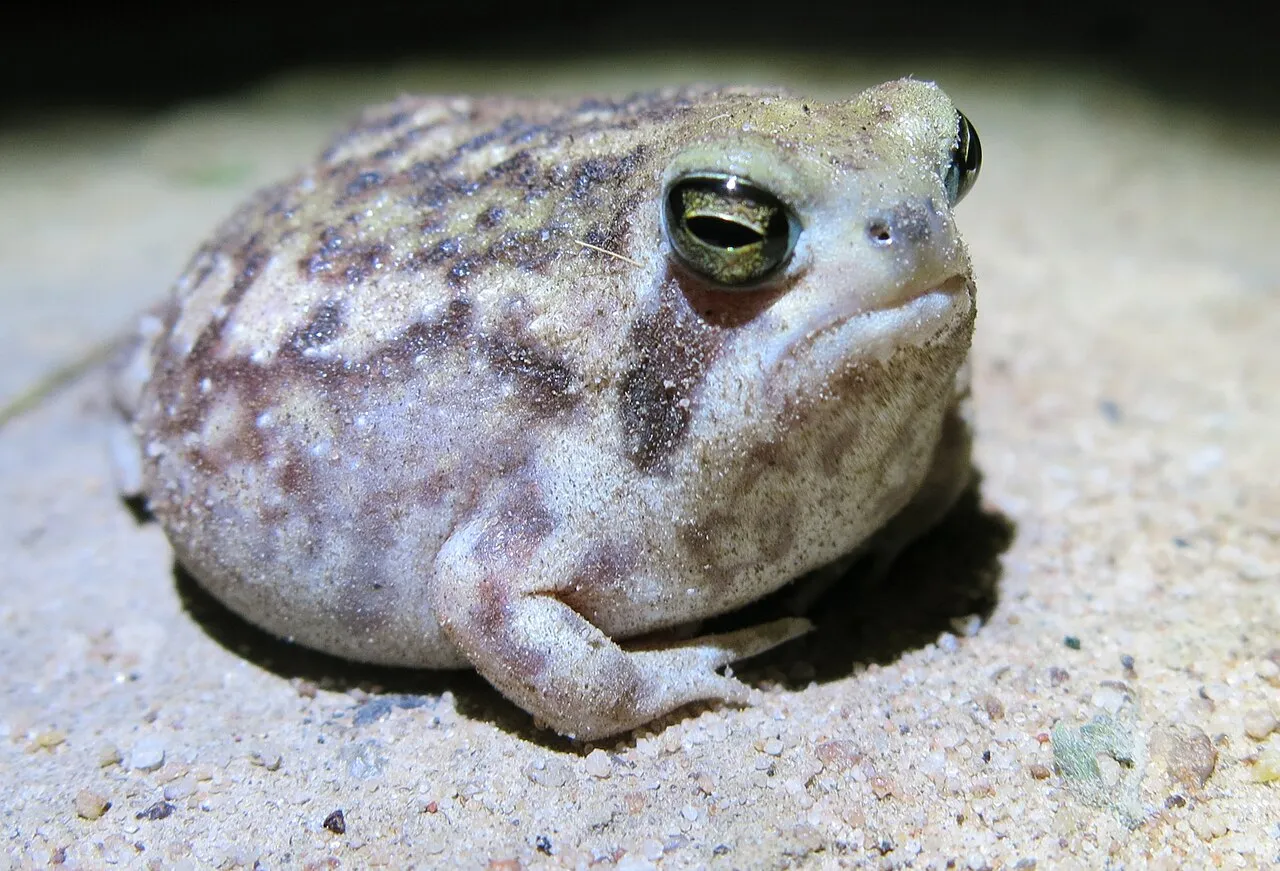
The bushveld rain frog, Breviceps adspersus, is a stout, burrowing amphibian of southern Africa that spends most of its life underground and surfaces mainly after rain. It is found across Angola, the Democratic Republic of the Congo, Zambia, Namibia, Botswana, Zimbabwe, South Africa, Eswatini and Mozambique.
Identification
The species is brownish-green with a round body and stumpy legs, a shape typical of the genus Breviceps. Males measure about 30–47 mm and females about 40–60 mm in snout-vent length, with females notably larger and rounder than males; the facts box carries the full range. Unlike most frogs, it cannot jump or swim, and its sharply rigid metatarsal tubercles — hardened projections on the hind feet — are built for digging rather than leaping.
Habitat and range
B. adspersus lives in temperate forest and open grassland (bushveld) across southeastern Africa. It spends dry periods in burrows below the surface and emerges to feed and breed once rain softens the soil. When active, it feeds mainly on termites, ants and other invertebrates.
Behaviour and breeding
Because males are too small to grip a female the way most frogs do during mating, the male secretes a glue-like substance that keeps the mating pair stuck together. The glued pair then burrows backwards into the soil until they reach a chamber the female has dug about 30 cm (12 in) below the surface, where the eggs are laid underground rather than in water. From there, the eggs hatch directly into froglets instead of passing through a free-swimming tadpole stage.
Conservation
The species’ facts box carries its current IUCN Red List category, Least Concern, reflecting its wide range across southern Africa. No further detail on population trend or specific threats is available from the sources checked for this profile.
Similar species
B. adspersus is recognised as two subspecies, B. a. adspersus and B. a. pentheri, which are distinguished mainly by geographic range and by differences in colouration and markings rather than by size or shape.