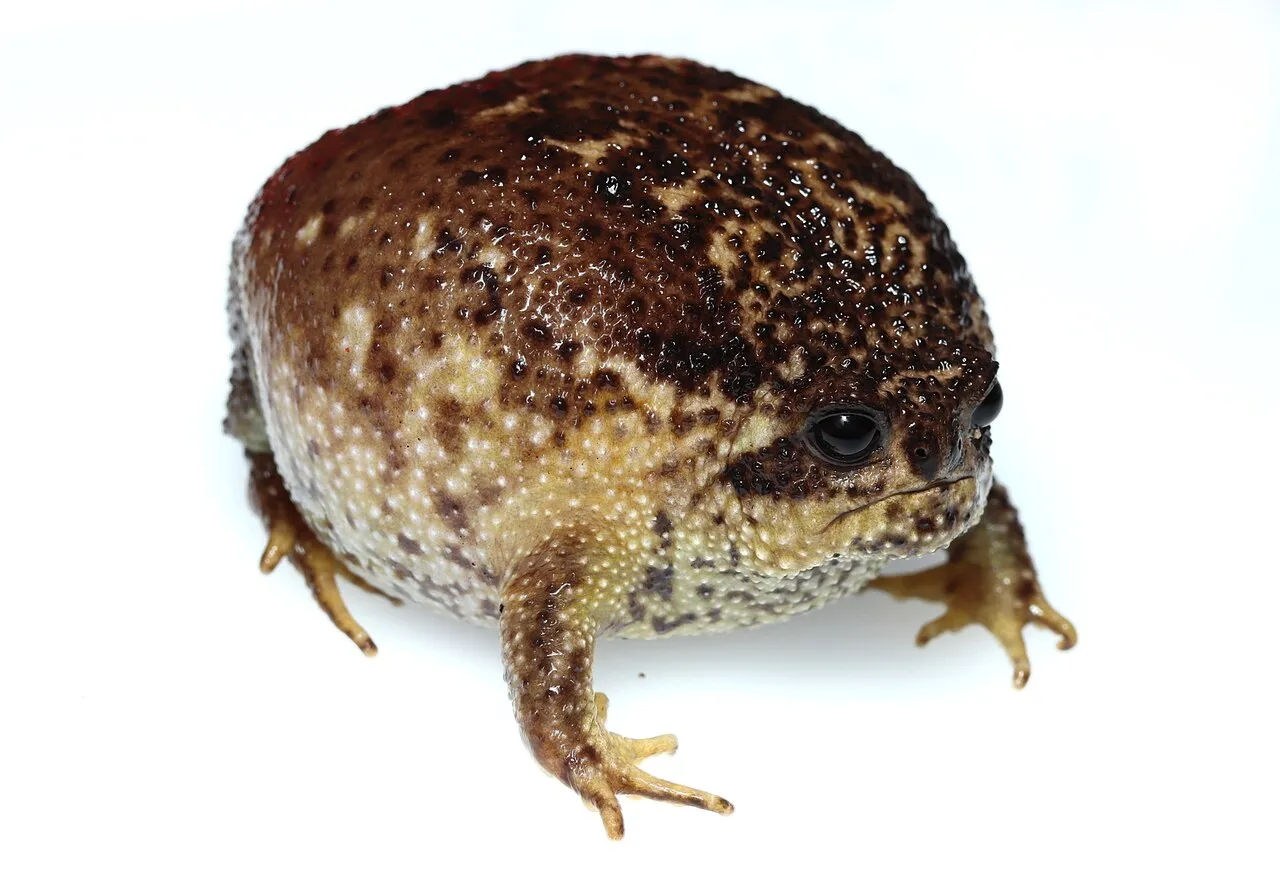
The Cape rain frog, Breviceps gibbosus, is a stout, burrowing amphibian endemic to the southwestern Cape of South Africa, from the Cape Peninsula and Cape Town northwards to around Citrusdal. It is the largest and most familiar member of its genus. Its rounded body and grumpy-looking face are as recognisable as its squeaky defensive call.
Identification
B. gibbosus has a rounded shape with short arms, brown skin and a white dotted pattern on its stomach. Adults reach up to about 45 mm in body length, with females noticeably larger than males. Its forward-facing eyes and lack of webbing between its toes are typical of the genus, and together with its inflated outline they give rise to the common nickname “narrow mouth toad” in some sources. When threatened, it inflates its body to look larger and emits a high-pitched chirp before retreating to its burrow.
Habitat and range
The species lives in Mediterranean-type shrubby vegetation (fynbos and renosterveld), as well as farm pastureland, rural gardens and urban areas, where it burrows into sandy soil. Unlike most frogs, it has no need for standing water: it spends most of the year underground and surfaces mainly after rain, which is also how it gets its common name.
Behaviour and breeding
Active frogs feed on worms, termites and other insects, foraging mostly at night or after rain when the soil is soft and prey is moving near the surface. Breeding also follows the rains: males call from their burrows to attract mates, and because the species cannot grip in the usual frog mating position, the female secretes a sticky liquid that glues the male to her back. The pair then digs underground, where the female lays around 22 eggs inside jelly capsules that keep them moist. There is no free-swimming tadpole stage: the eggs develop directly into froglets inside the burrow, an adaptation well suited to a species that rarely encounters open water.
Conservation
The species’ facts box carries its current IUCN Red List category, Vulnerable. Its restricted range along South Africa’s Western Cape coast, combined with ongoing habitat loss from urban expansion and agriculture in and around the fynbos, is the main pressure on the population.
Similar species
Within the genus Breviceps, B. gibbosus is recognised as the largest and most common rain frog, a useful point of comparison with its smaller relatives such as the bushveld rain frog (B. adspersus).