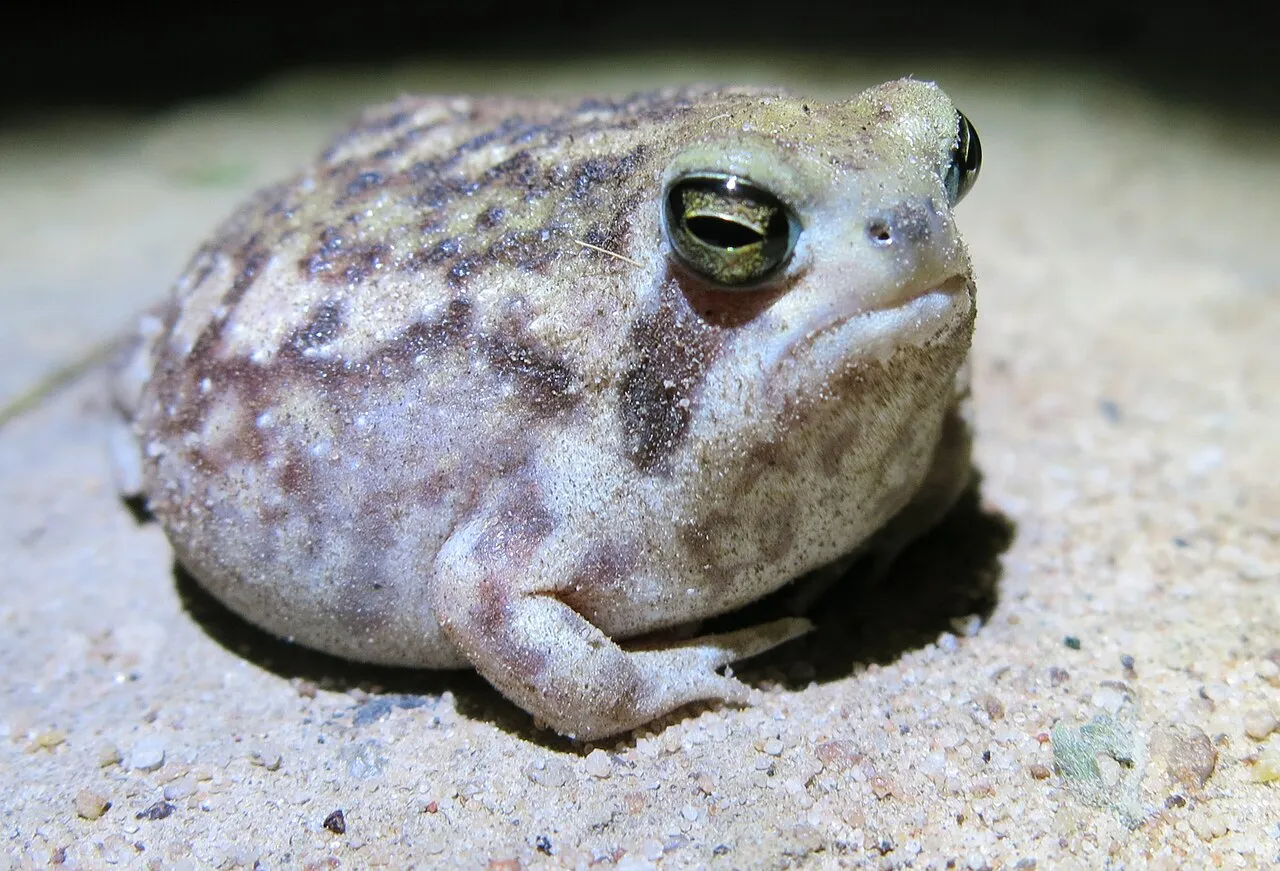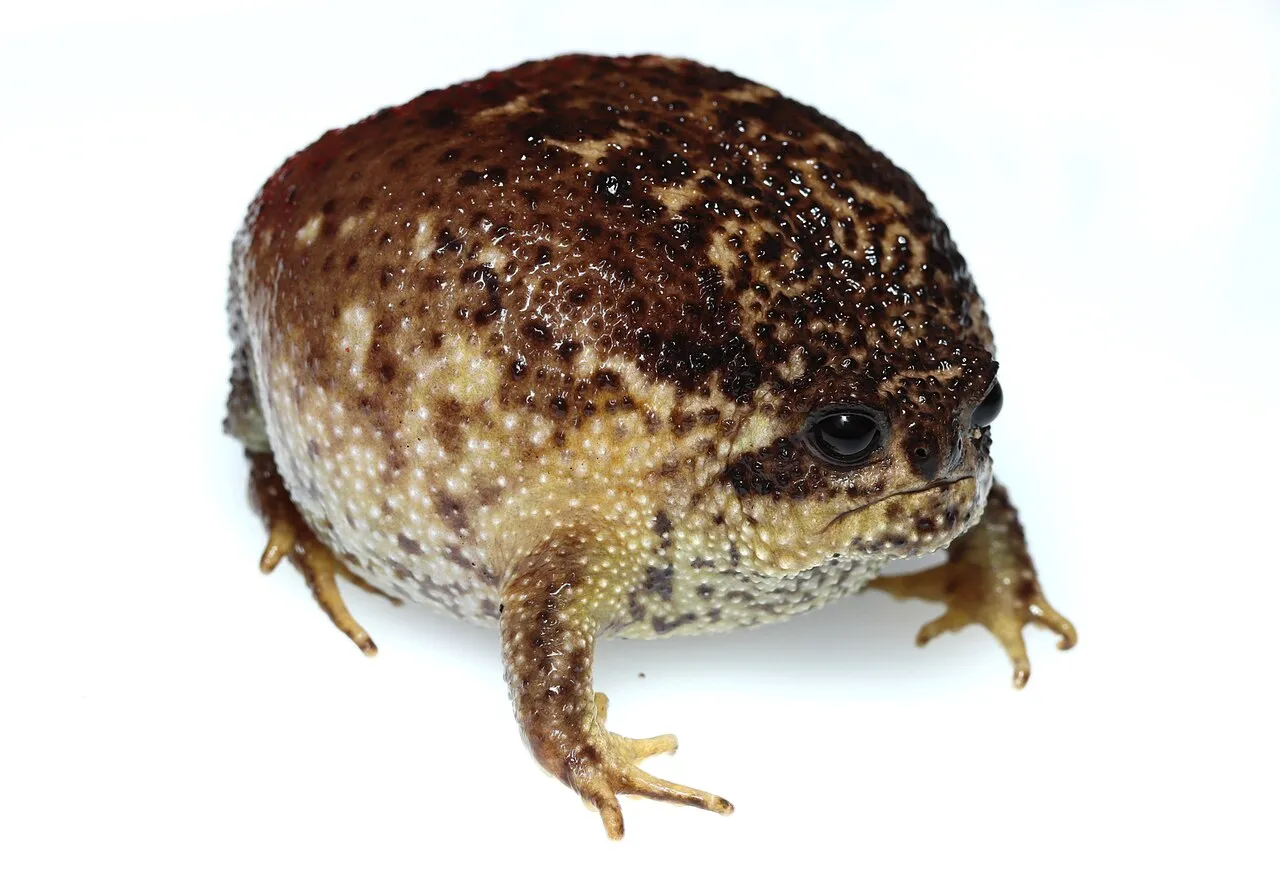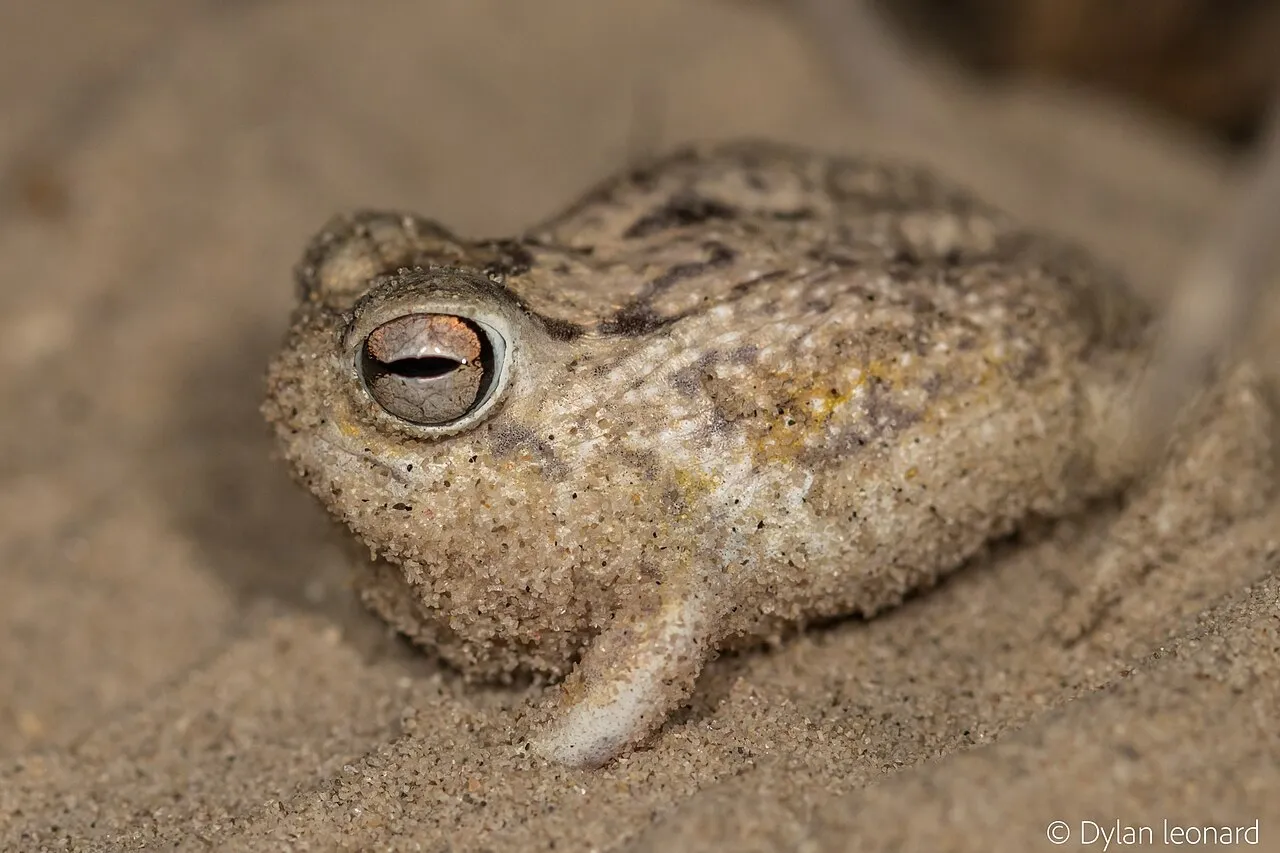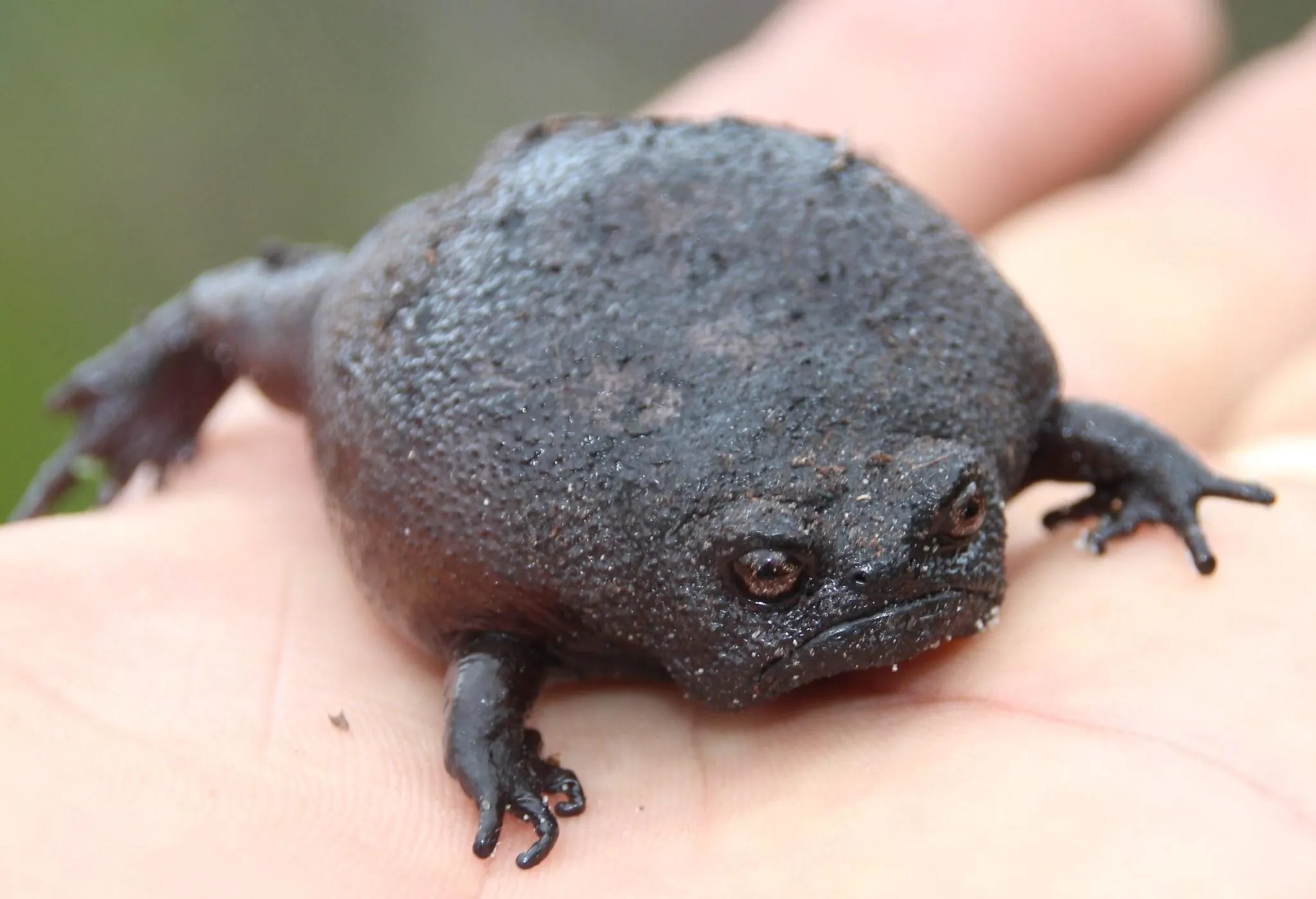
Breviceps fuscus, the black rain frog, also called the plain rain frog, is a frog of the family Brevicipitidae that lives only on the southern coast of South Africa. The species was first described by John Hewitt in 1925, from a specimen collected in Knysna. Its name fuscus refers to the dark colouration1 of the animal.
Rain frogs are round-bodied, short-limbed African frogs, and Breviceps species typically emerge from the ground after rain2, usually at night.
Identification
The Biodiversity and Development Institute describes a stout species with short legs and small, dark eyes. Adults grow to about 40–51 mm in snout–vent length, and females can reach 51 mm and are larger than males3. It can live from 4 to 15 years1.
The upperside is dark brown to black and without markings. The underside is smooth and dark, sometimes with indistinct light spots3. The skin has no warts, but widely spaced lumps or small tubercles and pitting. The feet face inward, which helps the frog burrow1.
There are no tadpoles to identify: the species shows direct development, with no free-living larval stage1, and the young leave the egg as small copies of the adults, called froglets.
The call of the male is a short (0.2 s) chirp with a dominant frequency of 1.8 kHz1.
Habitat and range
The species is endemic to the southern Cape Fold Mountains in the Western and Eastern Cape. It holds a narrow strip along the south-facing slopes, from the Langeberg near Swellendam in the west to Dieprivier Forest near Kareedouw Pass in the east. The range is mostly continuous except for a break between the Langeberg and Outeniqua mountains3.
It lives in Afromontane Forest and Mountain Fynbos along the southern coastal belt, at altitudes to well over 1000 m, and also down to sea level where mountains reach the coast3. A burrowing species of fynbos and forest fringes, it does not require open water1.
Behaviour and breeding
The frog lives in tunnels up to 150 mm deep or among vegetation up to about 30 cm above the ground. In forest it may sit in short, vertical tunnels under logs, which connect to a network of shallow horizontal tunnels from which it emerges to feed. It is primarily nocturnal1 and often occurs at high densities3 in suitable habitat.
It eats small insects, spiders, insect larvae and worms, and crickets are its main source of protein. It cannot jump or swim to evade predators1 because of its body shape. When disturbed, it inflates its body so much that it is difficult to remove from its tunnel. The Bush Pig is a recorded predator: 18 specimens were found in the stomach of one pig3.
The plain rain frog is a summer breeder that starts to call in September, and its choruses may continue for several days in rainy weather. Males call from vegetation up to 1 m above the surface3 and sometimes from inside their shallow burrows.
Mating uses adhesive amplexus: in Breviceps, males and females adhere to each other by a secretion from the male’s abdominal region2. The eggs are laid in burrows about 30–40 mm deep. The yellow eggs are 5 mm in diameter, within 8 mm capsules, and the known clutches held 42 and 43 eggs, each topped with 25–30 empty egg cases3. Males call from burrows, sometimes while guarding eggs1.
Conservation
The IUCN assessed the black rain frog as Least Concern4 in 2013. In the BDI species account of 2025, although its range is relatively restricted, it appears not to be of conservation concern. The same 2025 account says that overuse of indigenous forests and the creation of exotic timber plantations during the past century or more undoubtedly impacted some populations, but the species is still abundant at several localities3. It does not tolerate habitat disturbance1, so afforestation, alien vegetation and too frequent fires are threats.
It is known from these protected areas3: Tsitsikamma National Park, Outeniqua Conservation Area, Grootvadersbosch Nature Reserve and Marloth Nature Reserve.
Similar species
The black rain frog is sympatric with B. acutirostris at Grootvadersbosch and with B. montanus over most of its range3.
- Strawberry rain frog, Breviceps acutirostris5: smaller, the female reaching at most 40 mm, and the back is reddish or pink to creamy white with many raised black granules6.
- Cape mountain rain frog, Breviceps montanus7: the dark back carries large pale patches fused into a band with dark, wavy edges, and a dark facial mask8 runs from the eye to the base of the arm.