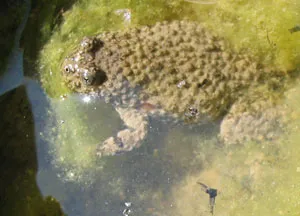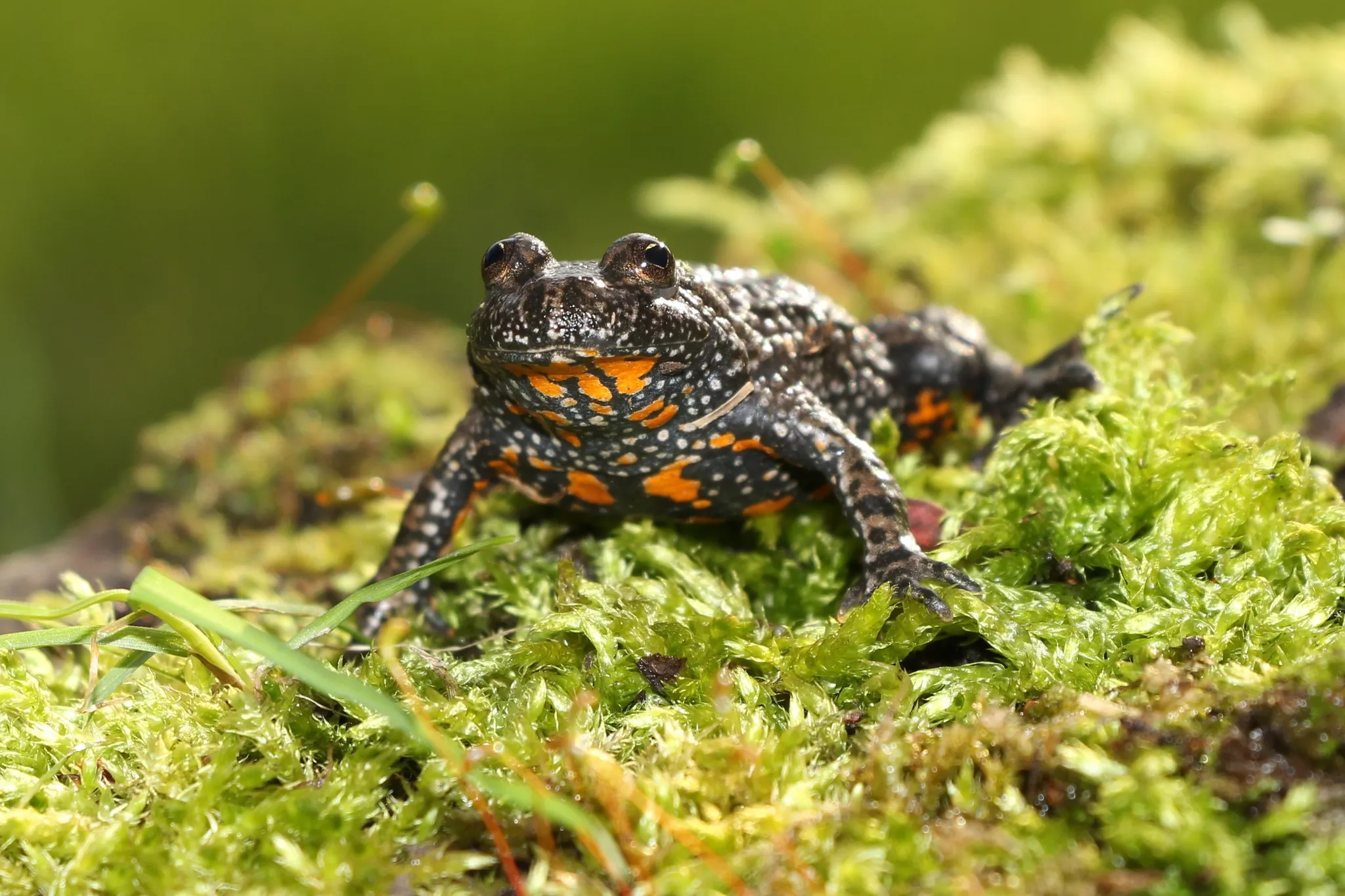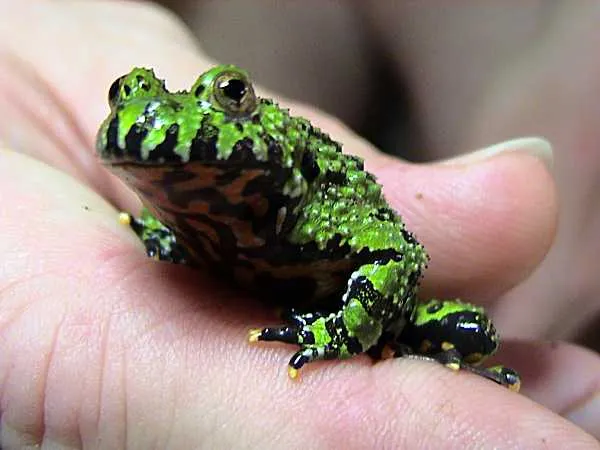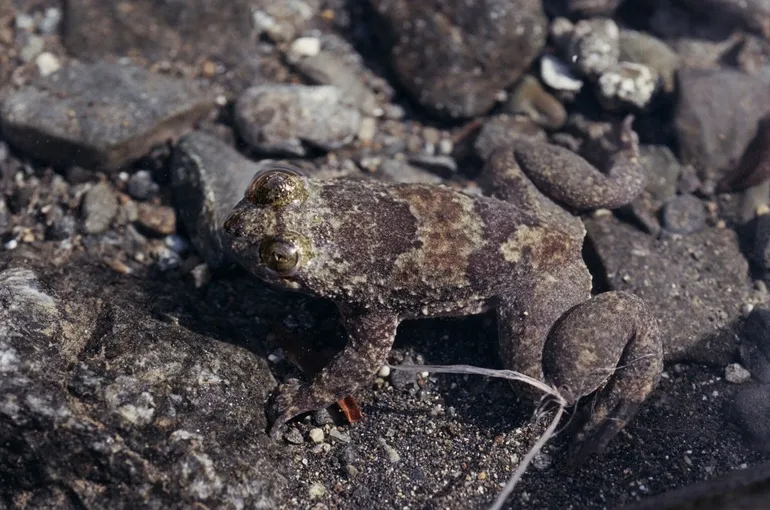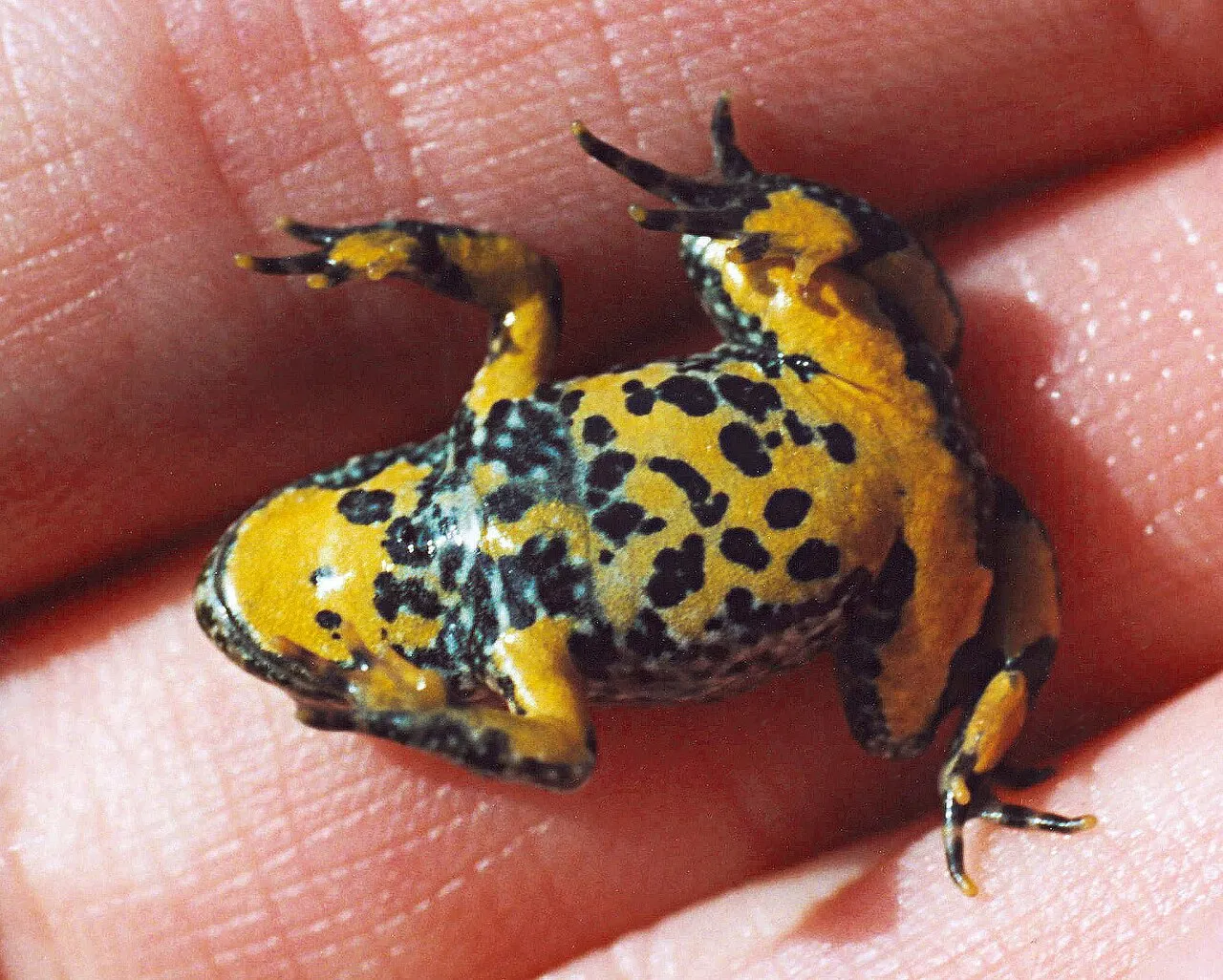
The yellow-bellied toad (Bombina variegata) is a small toad of the archaeobatrachial family Bombinatoridae1, named for its bright yellow underside. It is distributed over much of central and southern Europe, at altitudes of 100 to 2,100 m2.
Identification
Adults measure 28–56 mm and typically weigh 2.3–12 g1, which places them among the smaller members of their family. The upper side is grey-brown, often with washed-out, bright spots, and carries numerous warts with raised swirls. The underside, including the inner sides of the limbs, fingers and toes, is grey-blue to black-blue with bright yellow to orange spots or patches, usually covering more than half of it. The body is compact with a rounded snout, the pupils are heart-shaped and the eardrums are not visible.
A study by Stugren and Vancea in 19681 sorted toads from Romania and the USSR into eight forms by the ratio of yellow to black on the underside. Specimens from northern regions typically had more black than those from southern regions. Males have a notably longer humerus and forelimb, which is believed to give them an advantage while coupling and while fighting other males.
Tadpoles can reach 55 mm in length1. They have a blunt tail and are typically grayish-brown or, in rare cases, transparent.
Habitat and range
The yellow-bellied toad is found in mountainous regions1. Because of the postglacial advance of the European fire-bellied toad, it has been found in lower numbers in comparison, and habitat disturbance has significantly reduced the areas it occupies.
It inhabits areas with lighter to darker substrates3 on land and in water. Study populations in a 2019 longevity study included a former military training area and a neighbouring clay pit near Koblenz in Germany. Another lived in a nature reserve west of Vienna4 covered by deciduous forest interspersed with meadows.
Behaviour and breeding
Within the Bombinatoridae, the yellow-bellied toad is the only species that breeds in such unpredictable sites, including shallow pools that can disappear overnight. Given a choice, it lays its eggs in warmer ponds and prefers ponds that persist for an intermediate period: long-lasting ponds risk a large number of predators, while short-lived ones risk drying out. Pond duration, rather than predation risk, was found to be the most critical factor in choosing a site. A study published in 20161 found that tadpoles in warmer water develop more quickly than those in cooler water.
Some males make waves by kicking their hind legs into a small body of water1. The pattern attracts females and makes a male’s territory known, and not all males can do it because it depends on ponds of a specific depth. When a territory owner meets an intruder, the two fight, each trying to climb the other’s back; the winner then makes waves at very high frequencies.
Females can produce offspring more than once in a mating season, though doing so more than once a year is rare. A female can lay over 200 eggs at a time but typically lays about 401.
Adult lifespan spans 5 to 23 years across populations. In the 2019 study, German populations reached a maximum cohort lifespan of 5 to 8 years, while its Austrian population reached a cohort longevity of 13 to 23 years. The paper also lists one Austrian and two Italian populations with a realized longevity of 20 to 23 years. The same paper gives 27–29 years in captivity, and notes that in amphibians it is rare for wild individuals to exceed 20 years4. The authors propose that the makeup and concentration of skin secretions, which modulate the risk of being preyed on, is the intrinsic factor setting longevity.
The dark back is assumed to convey crypsis. In a 2018 laboratory experiment, toads from one German population quickly matched a lighter substrate, adjusting within one day. Toads moved onto a darker substrate could not significantly reduce their contrast with it. The toad stays camouflaged most of the time and flashes its yellow underside only under duress, a display the 2021 study calls an honest signal of skin poison3. Escape, full and partial threat responses are the most commonly seen1; toads also puff up their chest, discouraging predators that capture and swallow their prey at once.
The skin secretions contain bioactive peptides such as bombesin, bombinins and bradykinin. The toxin can cause significant discomfort to most animals1, and the 2019 study describes the skin peptides as apparently not deadly to predators4 but probably disruptive to their metabolism and irritating to mucous membranes.
A feeding study of 29 toads in May 2009 in Romania found that they had eaten only invertebrates, mostly insects, and that over 95% of the prey5 came from land.
Conservation
The IUCN classes the yellow-bellied toad as Least Concern, in the 2022.2 Red List6. Habitat loss, loss of genetic variation and the spread of disease, all linked to climate change, have contributed to its decline1. Fragmentation is the largest of the habitat problems that have isolated the species, and reduced genetic diversity, from fragmentation or post-glacial dispersal, can result in high levels of inbreeding. On a continental scale, conservation efforts should focus on creating metapopulations that allow more interaction between groups.
The species was listed as endangered in Germany in 2009 and as critically endangered in Lower Saxony in 19943. Experiments in Germany have moved individuals from denser areas to sparse ones, and researchers consider testing an individual’s ability to change colour before relocating it. Relocation also brings the risk of spreading disease1.
Similar species
- European fire-bellied toad (Bombina bombina): the yellow-bellied toad’s compact body is not so flat as this relative’s1.
- Apennine yellow-bellied toad (Bombina pachypus): endemic to Italy south of the Po valley7, and once thought to be a subspecies of the yellow-bellied toad.