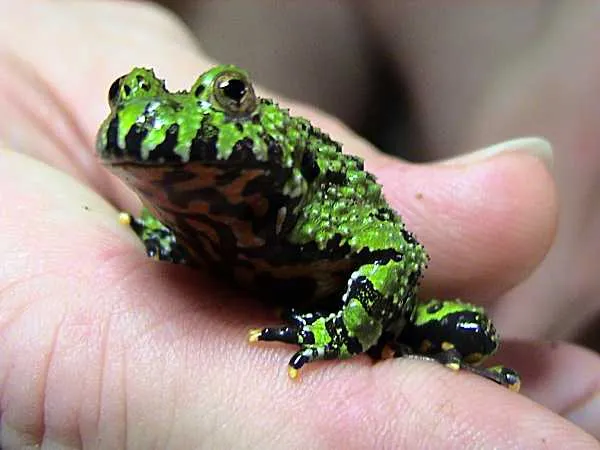
The Oriental Fire-bellied Toad, Bombina orientalis, is a small, brightly marked amphibian of the family Bombinatoridae, native to Korea, northeastern China and the Russian Far East. Its mottled green back and fiery red-and-black belly make it one of the more recognizable frogs of Northeast Asia, and the same warning coloration has made it a familiar sight in the pet trade. In the wild it spends its life moving between slow streams, ponds and the forest floor, and it remains common enough across its range to be classed as of Least Concern.
Despite the name, B. orientalis belongs to the fire-bellied toad family Bombinatoridae, within the genus Bombina, rather than the true toads of family Bufonidae. Its cryptic dorsal pattern paired with a startling, colourful belly is a textbook example of aposematism, the pairing of a warning signal with an unpleasant or toxic defence. The same belly that warns off predators in the wild is what draws collectors to it in captivity.
Identification
Adults reach about 38–51 mm (1.5–2.0 in) in length and weigh roughly 28–57 g. The upper body is bright grayish or brownish green with black mottling, covered in small tubercles that are, according to the species’ Wikipedia entry, the most pronounced of any toad in the genus Bombina. The belly tells a different story: it is patterned in yellow, red or orange-red mottled with dark spots, and the tips of the fingers and toes are typically red. Males can be told apart from females by nuptial pads on the first and second fingers, used to grip a partner during mating.
Habitat and range
The species is native to Korea, northeastern China (including Anhui and Shandong) and the Primorsky Krai region of far eastern Russia, with an introduced population near Beijing established since 1927; escaped pet-trade individuals have also turned up in Florida, USA, with Broward County reports but no confirmed established breeding population there.
Within this range it is semiaquatic, living in slow-moving streams and ponds and moving onto land into coniferous and broadleaved forests. It occurs from lowlands up to about 1,100 m elevation and is tolerant enough of poor water quality to breed even in heavily polluted ponds, a trait that has made it useful to researchers studying aquatic pollution. That tolerance, combined with its wide native range spanning three countries, is part of why the species remains widespread rather than confined to a handful of pristine sites.
Behaviour and breeding
Unlike many frogs, the Oriental Fire-bellied Toad is diurnal, active during the day rather than at night, which researchers link to a reliance on sunlight for vitamin D3. Adults hunt terrestrial invertebrates such as worms, molluscs and insects; lacking the ability to flick out a long tongue, they instead leap directly at prey to catch it. Larvae feed on algae, fungi, detritus and protozoans in the water where they hatch.
When threatened, the toad performs the defensive “unkenreflex”: it may flip onto its back, arching its head and holding up its limbs to expose the warning colours of its belly. If handled roughly, it can secrete a milky, mildly toxic substance from the skin of the hind legs and sometimes the belly.
Breeding takes place in spring, with calling concentrated around mid-May. Males produce a soft call that has been compared to the sound of a musical triangle rather than the throaty croak typical of many frogs. Females lay 40 to 110 eggs in a large cluster near the water’s surface. The resulting tadpoles begin growing legs after 6–8 weeks and are fully metamorphosed by August or September of the same year.
Conservation
Bombina orientalis is classed as Least Concern, as shown in the facts box above. Its broad range across Korea, northeastern China and the Russian Far East, combined with its tolerance of disturbed and even polluted water, means the species is in no immediate danger overall, even where local wetlands are lost to development. It also remains popular in the pet trade thanks to its hardiness and bright colouring.
Similar species
Within its own genus, B. orientalis can be told apart from relatives such as Bombina pachypus by the absence of gular sacs, and from yellow-bellied Bombina species by its predominantly red, rather than yellow, ventral colouring and bright red finger and toe tips. The mottled green back and red-and-black belly, together with its Northeast Asian range, make the species difficult to mistake for anything else in the region.