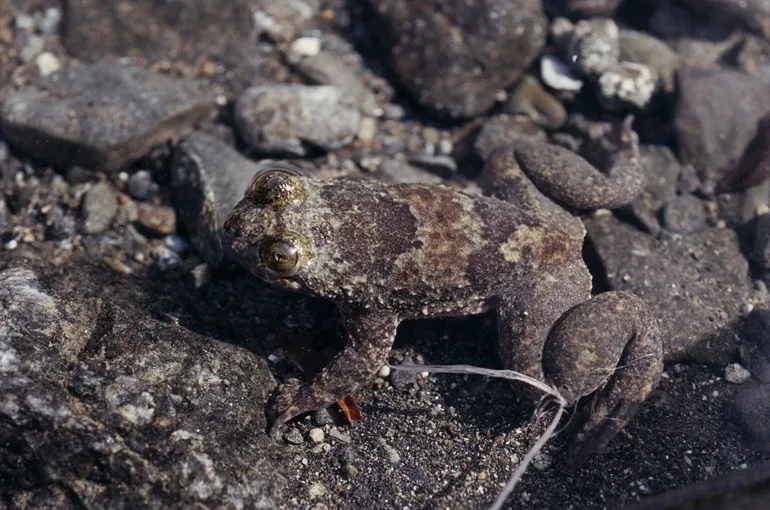
Barbourula busuangensis, the Philippine discoglossid frog, is a large, flattened aquatic frog endemic to the Busuanga, Culion, Balabac, and Palawan islands in the Philippines. It was first described in 1924 by Taylor and Noble and belongs to the small family Bombinatoridae, in a genus that holds only one other living species, Barbourula kalimantanensis of Borneo. Unlike most frogs seen basking at pond edges or calling from vegetation, this species spends almost its entire life in the water of fast-flowing island streams, surfacing to float and diving the moment it senses disturbance.
Identification
The frog has a body that is flattened dorso-ventrally, with the nostrils and eyes positioned on top of the head, an arrangement typical of frogs that spend most of their time just below the water’s surface. It lacks external eardrums (tympani) and has robust, powerful limbs with webbing on both the hands and feet; like its Bornean relative, this build suits swimming against strong currents. The skin bears fine tubercles, and the overall coloration is dark greenish-black with faint pale green hatching and spotting that blends well with wet rock and streambed vegetation.
Habitat and range
This species is restricted to fast-flowing, unpolluted streams in lowland tropical forests at elevations below 800 m, and is largely aquatic rather than terrestrial. It often floats on the surface of these streams but is very wary, diving to the bottom and hiding whenever it senses disturbance. Its known range spans four islands in the western Philippines, Busuanga, Culion, Balabac, and Palawan, giving it a somewhat wider distribution than its sole congener in Borneo, which is confirmed from only two localities. Its survival still depends on a limited set of clean, fast-running forest streams across those islands.
Behaviour and breeding
The breeding biology of Barbourula busuangensis is not well understood, and tadpoles of the species have never been observed in the wild. Researchers examining pregnant females have found some large, unpigmented eggs, a detail that has led to the suggestion that development may occur directly, without an intervening free-swimming tadpole stage, unusual for a frog this large and this aquatic. Attempts to breed the species in captivity have not succeeded, so much of its reproductive life history remains inferred rather than directly observed.
Conservation
The IUCN category for Barbourula busuangensis is given in the facts box above. The main pressures on the species are degradation of its stream habitat, changing agricultural practices, quarrying, mining, and pollution of the streams it depends on. Because the frog is almost entirely aquatic and tied to a narrow set of environmental conditions (fast flow, low pollution, forest cover), these pressures act directly on the only habitat it can use, rather than on a broader range it might otherwise retreat into. Populations are fragmented across the four islands, so a decline from mining or agricultural runoff on one island is not easily offset from elsewhere.
Similar species
Barbourula busuangensis belongs to the small family Bombinatoridae, in the genus Barbourula alongside Barbourula kalimantanensis, its only other described relative. The two species share the same flattened body, webbed limbs, and dependence on fast, cold, unpolluted streams, but Barbourula busuangensis is distinguished by its broader range across four Philippine islands, compared to the two known Bornean localities of its relative, and by the dark greenish-black colouring with pale green mottling that sets it apart from the browner, black-mottled pattern described in Barbourula kalimantanensis.