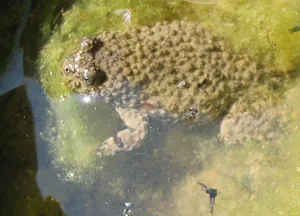
Bombina pachypus, the Apennine yellow-bellied toad, is a small amphibian of the family Bombinatoridae. It is endemic to Italy, found south of the Po Valley throughout the Apennine Hills and down the length of the peninsula. The species was originally classified as a subspecies of the yellow-bellied toad, Bombina variegata, before being recognised as a separate species.
Identification
Bombina pachypus has a compact body and a rounded snout, with skin on the back covered in tubercles. The upper side is dark tan or dark greyish-brown, often marked with washed-out, bright spots, a pattern that blends the toad into leaf litter and mud. Turn it over and the colouring switches dramatically: the underside is greyish-blue to black-blue with striking bright yellow to orange spots or patches, usually covering more than half of the underside. One feature sets the genus apart from most other toads at a glance: a triangular pupil, rather than the round or horizontal pupils typical of other amphibians.
Habitat and range
The species occupies a broad spread of lowland and upland habitats, including temperate forests, temperate grassland, swamps and freshwater marshes, as well as agricultural land, from 20 to 1,700 metres above sea level. It is not fussy about where it breeds, using ponds, wetlands, ditches, ruts, pools and even drinking troughs as spawning sites. That tolerance for disturbed and seasonal water bodies lets it persist on arable land, pastureland and seasonally flooded agricultural land alongside more natural habitat, within its exclusively Italian range south of the Po.
Behaviour and breeding
Bombina pachypus is diurnal, active during the day, and hibernates from about November to April. Breeding activity starts soon after the toads leave hibernation, and females lay multiple clutches of a few eggs at a time in temporary water bodies rather than one large clutch, spreading the risk across the short-lived pools, ditches and troughs the species favours. Like other members of the genus, it relies on colour rather than flight when threatened: faced with a predator, it arches its back to expose its brilliantly coloured underparts as a warning of its toxicity, backed up by a toxic secretion produced by its skin.
Conservation
The IUCN category is shown in the facts box above. The causes behind the species’ decline are not fully resolved: changes in agricultural practices may partly be to blame, or the fungal disease chytridiomycosis may be the cause, with habitat loss identified as the primary threat.
Similar species
Bombina pachypus was long treated as a subspecies of the yellow-bellied toad, Bombina variegata, and the two remain close relatives separated mainly by range and fine anatomical detail rather than by obvious colouring, since both carry the bright yellow-to-orange belly markings typical of the genus. Geography is the simplest way to tell them apart in the field: Bombina variegata is found mainly across western Europe and in a handful of eastern European countries, while Bombina pachypus is confined to peninsular Italy south of the Po, so the two do not overlap. Within its own range, Bombina pachypus has no other Bombina species to be confused with.