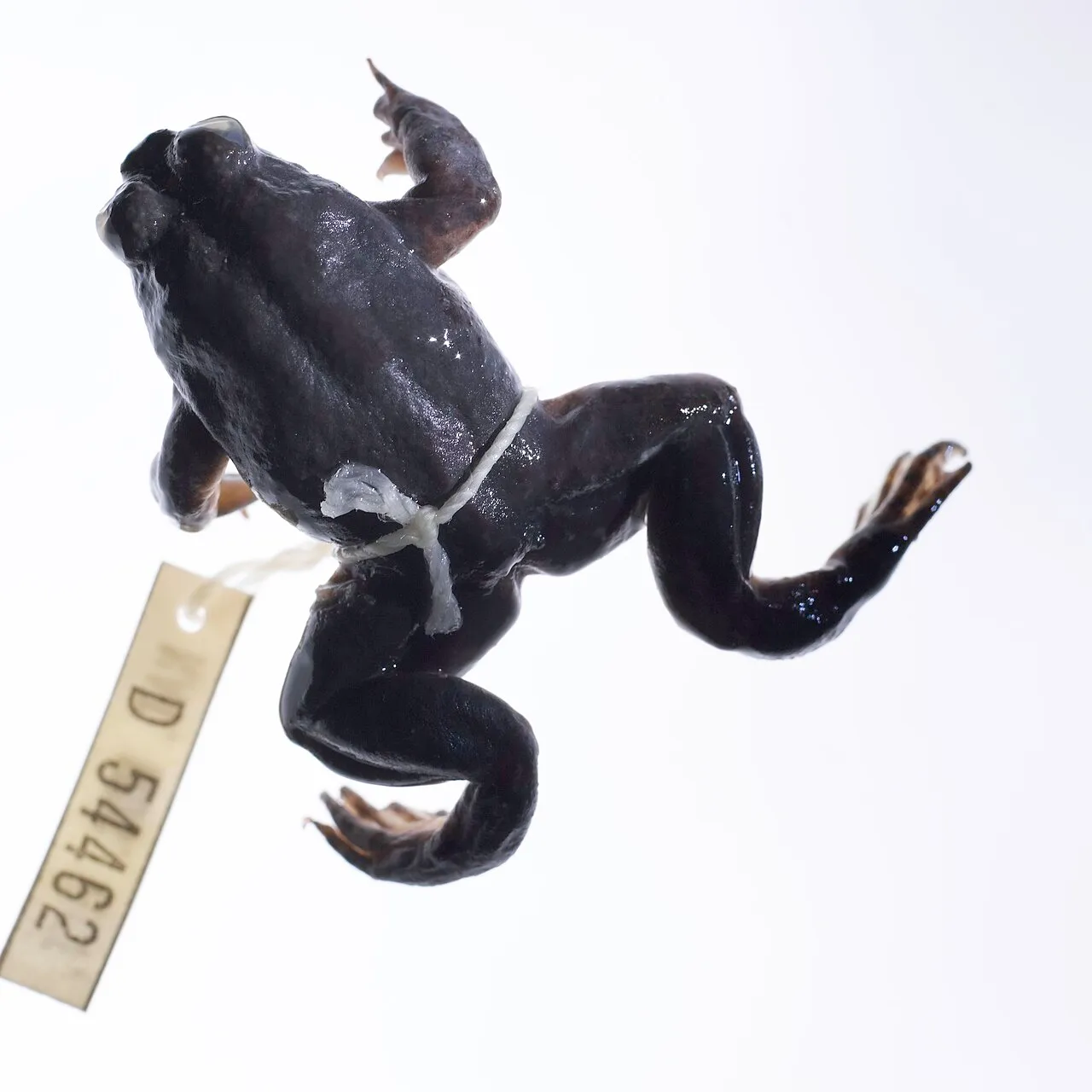
Rheobatrachus silus, the southern gastric-brooding frog, was a stream-dwelling frog in the family Myobatrachidae, genus Rheobatrachus, found only in southeastern Queensland, Australia: the Blackall Range and Conondale Ranges north of Brisbane, in the Mary, Stanley and Mooloolah River catchments, at 350-800 m elevation, over a range of under 1,400 km². That footprint, barely larger than a mid-sized city, made it one of the more geographically confined frogs ever documented in Australia. It is best known for a breeding method unlike that of any other frog: females brooded their young inside the stomach. The species is now extinct, and its loss remains one of the starkest cautionary tales in modern amphibian conservation, since a frog with such an unusual reproductive biology vanished before researchers could study it in any depth.
Identification
Rheobatrachus silus showed a modest difference in size between the sexes. Males measured 30-44 mm and females 41-54 mm, the females running noticeably larger, likely linked to the demands of carrying a stomach full of developing young through to emergence as froglets. Like other members of its genus, it was a flattened, smooth-skinned frog adapted to life on and under rocks in fast-flowing water, with webbed hind feet suited to a largely aquatic lifestyle rather than to climbing or burrowing. Its low-slung profile and slippery skin let it wedge into crevices beneath boulders and resist being swept downstream, a build shared with the handful of other frog species adapted to torrent-fed mountain streams.
Habitat and range
The species lived in rainforest, wet sclerophyll forest and riverine gallery open forest with closed canopy and emergent eucalypts, always close to water. It was predominantly aquatic, closely tied to permanent streams, rock pools and soaks, and was never found in cleared riparian zones, a dependence on intact streamside forest that left it with nowhere to go once its habitat was disturbed. That strict reliance on cool, flowing, well-shaded water meant the frog could not simply shift into nearby cleared or logged land the way some more generalist stream frogs do, and it likely made the population unusually sensitive to any change in water quality, flow or temperature along its home streams.
Behaviour and breeding
Rheobatrachus silus is the frog that gave gastric brooding its name. Females swallowed their own fertilised eggs, suspended normal stomach digestion, and incubated the eggs and tadpoles inside the stomach before releasing fully formed juveniles through the mouth. No other frog is confirmed to have reproduced this way; the related northern species, Rheobatrachus vitellinus, is the only other species known to share the trait, and both genus members are now gone. Suspending normal digestion for weeks on end while a brood developed was a striking enough feat that the species drew scientific interest well beyond herpetology, interest cut short once the frog itself disappeared.
Conservation
Rheobatrachus silus is Extinct. Its decline was abrupt: a population of about 78 individuals recorded in 1976 fell to the last confirmed wild sighting in 1981, and the last captive individual died in 1983. It was formally declared extinct in 2000 under Australia’s Environment Protection and Biodiversity Conservation Act, and the IUCN Red List lists the species as Extinct. The speed of the crash, within a handful of years and inside a small, already narrow range, points to the same chytrid fungus outbreaks that have driven losses in many upland Australian stream frogs, though by the time the cause was understood the species was already gone. No living population or viable genetic line of the species is known to survive today.
Similar species
Rheobatrachus silus shared its genus with Rheobatrachus vitellinus, the northern gastric-brooding frog, which lived further north in Queensland’s Eungella National Park and brooded its young the same way before it too disappeared in the 1980s. No Rheobatrachus species is known to survive today, making the stomach-brooding behaviour first described in Rheobatrachus silus a trait now seen in no living amphibian.