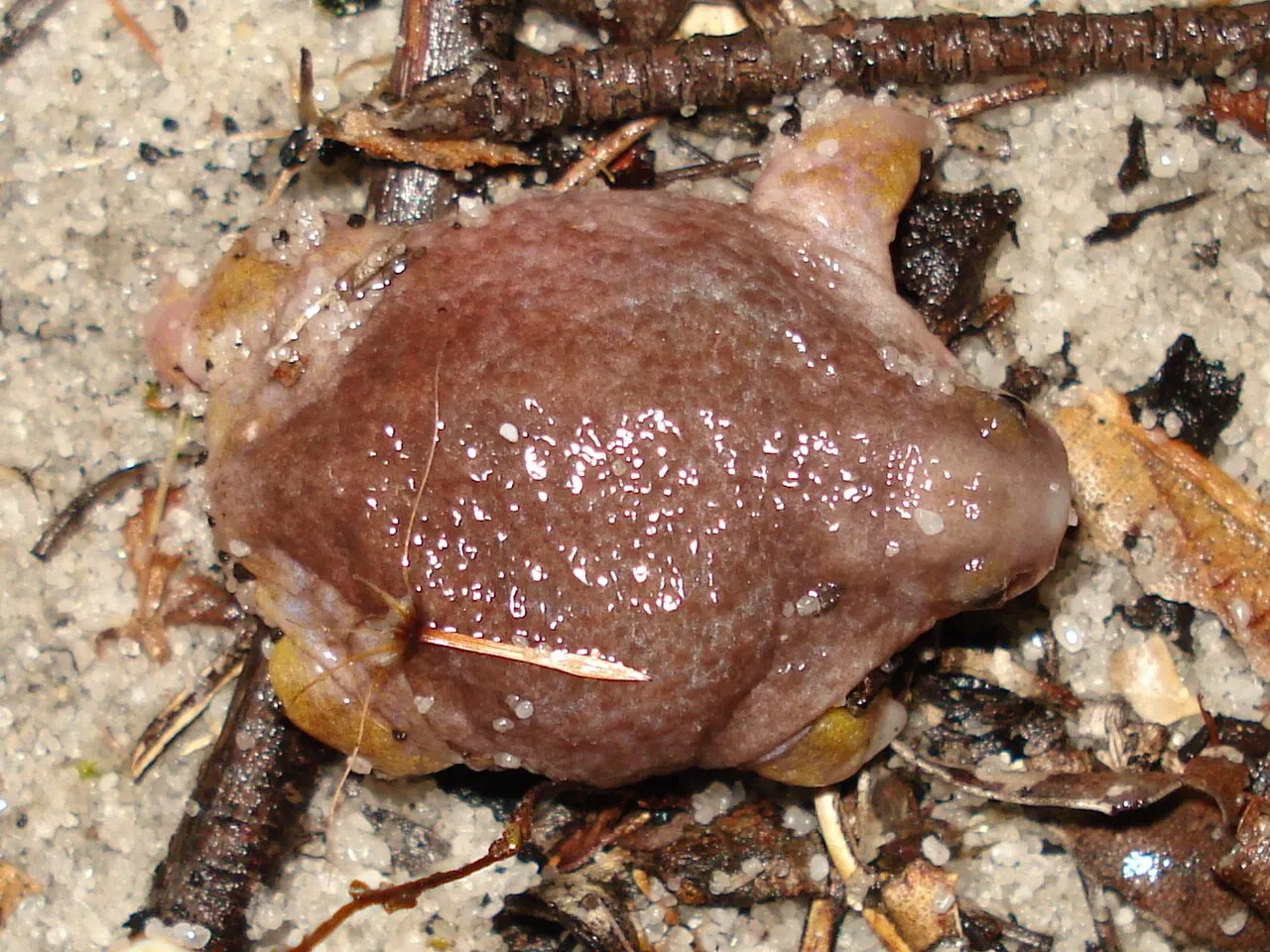
The turtle frog, Myobatrachus gouldii, is a small, globular burrowing frog named for its round body, small head and short limbs, which give it a passing resemblance to a hatchling turtle without its shell. It is endemic to southwestern Western Australia, found between Geraldton and the Fitzgerald River, including the Perth region.
Identification
M. gouldii reaches up to 45 mm in length, small for a frog but stout-bodied rather than slender. Its proportions set it apart from most other Australian frogs in its range: the body looks inflated, and the limbs are built for digging, not leaping. The brown to pinkish-brown skin carries no obvious markings, so shape is the clearest field mark, not colour.
Habitat and range
The species lives in semi-arid sandy country across its southwestern Western Australian range, between Geraldton in the north and the Fitzgerald River in the south. Unlike most frogs, it is not tied to surface water: its eggs undergo direct development with no free-living tadpole stage, which lets it occupy dry, sandy habitat far from ponds or streams.
Behaviour and breeding
The turtle frog’s limbs and build reflect a burrowing lifestyle unusual among frogs: it burrows forward through soil and into termite mounds using its short, muscular limbs and an enlarged pectoral girdle, digging head-first like a turtle. This brings it into termite galleries, which also serve as a food source. Because its eggs develop directly, with no free-living tadpole stage, breeding does not depend on rain-filled pools, allowing the species to reproduce underground in the sandy soils it burrows through.
Conservation
The facts box carries the species’ current IUCN Red List category, Least Concern. Its wide range across southwestern Western Australia and its independence from surface water for breeding mean it is not considered to face the habitat-fragmentation pressures that threaten many pond-breeding frogs in the same region.
Similar species
Its globular shape and digging limbs set the turtle frog apart from other frogs in its range; most sympatric species have the longer legs and more typical frog-like proportions suited to jumping and swimming, not burrowing. Its closest relatives among the Myobatrachidae lack the same extreme body shape, making M. gouldii the most visually distinctive burrowing frog across southwestern Australia.