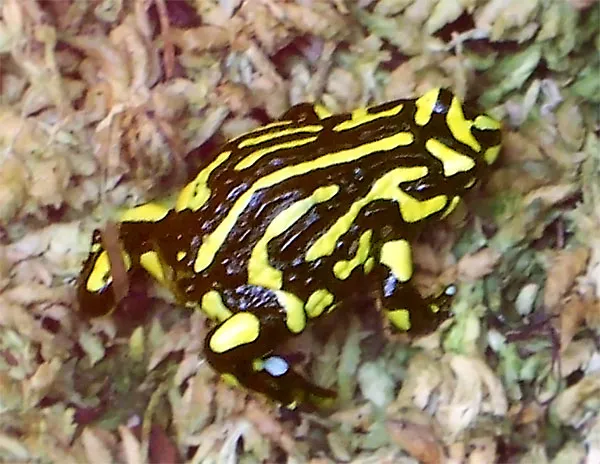
Pseudophryne corroboree, the southern corroboree frog, is a small, vividly striped frog of the family Myobatrachidae, confined to a small area of Kosciuszko National Park in the Snowy Mountains of New South Wales, Australia, from Smiggin Holes in the south northwards to the Maragle Range. It is one of Australia’s most recognisable frogs by colour alone, and also one of its most threatened: by 1989 its occupied range had already contracted to a fragmented area of less than 10 km2. The species was described in 1953 by the Fulbright research scholar John A. Moore, from a specimen collected at Towong Hill Station in Corryong, Victoria.
Identification
The southern corroboree frog is yellow and black in colour, with vivid yellow and black stripes running across the head, back and limbs. It is a small frog: females measure about 26-31 mm and males about 22-29 mm in length, with females running slightly larger. The body and head are short and wide, with a snout that comes to a slight point, fingers and toes that lack webbing, and a black iris. That bold, high-contrast pattern is a warning colouration, and it sets the species apart from almost every other frog in its range at a glance.
Habitat and range
The species breeds in sphagnum bogs at elevations above 1,200 m, using shallow pools, fens, seepages, wet grassland and wet heaths during the December breeding season, and it is found at altitudes of 1,300-1,760 m above sea level. Its entire known range is a narrow strip of the Snowy Mountains, confined to Kosciuszko National Park from Smiggin Holes in the south to the Maragle Range in the north, placing the whole species inside a single protected area.
Behaviour and breeding
Southern corroboree frogs breed on land rather than directly in open water: males build chamber nests within grasses and moss and compete for females through song during the December breeding season. A successful male may attract up to ten females in sequence, and each female lays up to 38 eggs, with the male depositing sperm directly onto the eggs. The eggs are slow to develop: embryos and early tadpoles remain inside the egg coat for four to six months, and complete tadpole development takes six to eight months, with metamorphosis occurring between December and February — meaning eggs laid in one breeding season do not produce metamorphosed frogs until the following year. Frogs do not reach sexual maturity until around four years old, after roughly a year as an embryo or tadpole and two further years as a juvenile. Adults feed on beetles, mites, ants and insect larvae, while tadpoles graze on algae and other small pieces of organic material in their pools.
Conservation
The facts box above carries the species’ current IUCN Red List category, Critically Endangered, and fewer than 30 individuals remained in the wild as of 2022, with the decline driven largely by the amphibian chytrid fungus. The species was reported as abundant during the 1970s before declining drastically through the 1980s, with an 80% decline recorded over the ten years to 1989, and it faces continuing pressure from bushfires, climate change, residential and commercial development including ski resorts, and pollution, in addition to chytrid fungus. Wild populations are now sustained largely through captive breeding: programmes were established at the Amphibian Research Centre in 1997, Melbourne Zoo in 2001, Taronga Zoo in 2006 and Healesville Sanctuary in 2007, and by 2018 more than 400 southern corroboree frogs were held in zoos. The 2019-20 bushfires destroyed roughly two-thirds of the frogs held in breeding enclosures in the park, and in response about 100 captive-bred frogs were released back into Kosciuszko National Park in March 2022.
Similar species
Within its own genus, the closest look-alike is the northern corroboree frog, Pseudophryne pengilleyi, which is distinguishable by narrower and more greenish-yellow striping than the southern species’ brighter yellow-and-black pattern. The two species’ ranges do not overlap, so location together with the depth and colour of the stripes is usually enough to separate them in the field.