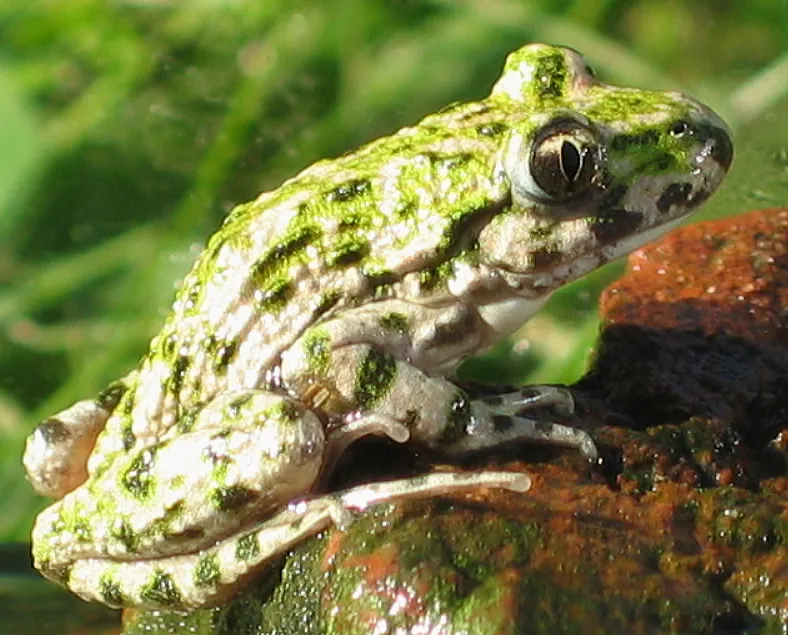
Pelodytes punctatus, the common parsley frog, is a small, slender amphibian of the family Pelodytidae. It is found in France, northeastern Spain and a small part of northwestern Italy (southern Piedmont and Liguria). Its powerful hind legs let it jump 50 to 70 cm in a single leap, well beyond its own body length, which has earned it the nickname “mud-jumper.”
Identification
This is a small frog: males reach about 35 mm snout-vent length, females about 39 mm, close to the 30 to 55 mm range typical of the whole family Pelodytidae. The upper body is variable in colour, usually with irregular green patches on a light brown, grey or light olive background, with elongated warts, often in undulating rows, sometimes orange along the flanks. Like other pelodytids it has rounded but vertically oriented pupils, and it carries a small gland behind each protruding eye, above the tympanum, but no parotid glands. Its long hind legs and flattened head mark it out, and its fossorial habits mean it is built for burrowing into loose ground between bouts of activity.
Habitat and range
Within its French, northeastern Spanish and northwestern Italian range, the species occupies habitats from sea level to mountainous areas up to 1,630-2,000 m elevation, breeding mainly in temporary ponds with aquatic plants at lower elevations. It specifically prefers to breed at lower elevations of around 60-460 m, and favours larger pond areas with standing aquatic vegetation over small or bare pools. Outside the breeding season, adults are sedentary, keeping to the same shelters and returning to the same locations over several years.
Behaviour and breeding
The common parsley frog can breed twice a year, once in autumn and once in spring, with timing that shifts across its range: late February to early April in France, and November to March in Portugal, while populations in Andalusia may spawn several times a year. Breeding is triggered by heavy rainfall, and can be postponed by up to two months during drought. Males call with a quiet croak produced with paired inner vocal sacs, audible even underwater, each call lasting about 1.5 to 3 seconds and carrying no further than roughly 300 m; females answer with a distinct “kee, kee” note.
A female lays her eggs in a zig-zag pattern on submerged plants, 30 to 400 eggs at a time, sometimes across more than ten separate clutches. The tadpoles are poor competitors when sharing a pond with other species, and their development is flexible: those in shallow or drying ponds cut short their larval period, while tadpoles in ponds of steady depth grow to a larger body size. Depending on where in the range they hatch, metamorphosis can happen as early as January or run through to March. Adults hibernate for shorter periods than most other anurans, and some southern populations skip hibernation altogether.
Conservation
The IUCN category is shown in the facts box above. Numbers are decreasing across the range as habitat loss removes breeding sites: between 1997 and 1999 alone, the Mediterranean ponds that typically housed the species’ larvae decreased by nearly half, on top of losses to wetland drainage, construction and fire. Introduced predators compound the pressure: mosquitofish (Gambusia holbrooki) and red swamp crayfish (Procambarus clarkii) both increase predation on tadpoles, with measurable effects on tadpole development appearing within about 30 years of crayfish moving in. Despite this, the species remains protected under European law, including the Berne Convention and the Habitats Directive.
Similar species
Pelodytes punctatus belongs to a small family: Pelodytidae has one living genus, Pelodytes, with five species spread across southwestern Europe and the Caucasus. Its closest and most easily confused relative is the Iberian parsley frog, Pelodytes ibericus, endemic to Portugal and Spain, where the two species’ ranges come close in northeastern Spain. The two look alike, sharing the same green-speckled colouring, but the Iberian parsley frog is a little smaller, with shorter limbs, than the common parsley frog. Away from that overlap zone, Pelodytes punctatus is told apart from other small Mediterranean frogs by its vertically oriented pupils and the fusion of the tibiale and fibulare, the ankle bones, typical of the family, a skeletal trait shared with no other frogs sharing its range.