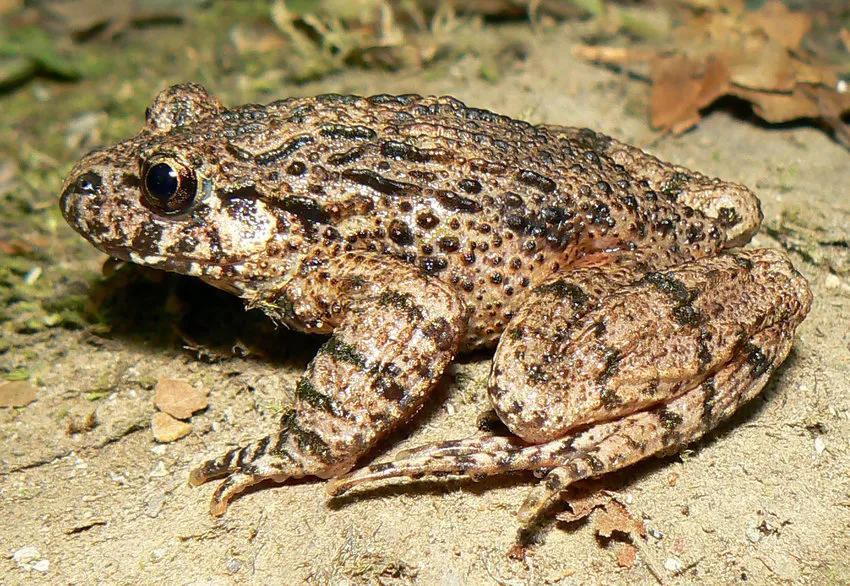
Pelodytes caucasicus, the Caucasian parsley frog, is a small amphibian of the family Pelodytidae, first described by George Albert Boulenger in 1896. It is found in Azerbaijan, Georgia, Russia and Turkey, and possibly in Armenia, a range tied closely to the mountains that give the species its name.
Identification
Adult snout-vent length runs about 40-55 mm, with males (43.6-54.8 mm) averaging larger than females (40.0-50.3 mm), toward the larger end of the 30-55 mm range typical of the whole family Pelodytidae. That male-biased size difference was confirmed in a sample of frogs from Lake Borçka Karagöl in Artvin, Turkey, where males also outweighed females, at 11.32 g against 8.81 g on average. The same study found individuals aged between 2 and 6 years, with growth fastest in the first three years of life for both sexes. Like its relatives in the family, it carries rounded but vertically oriented pupils, blunt to pointed finger and toe tips, and ankle bones (the tibiale and fibulare) fused together, a skeletal trait shared with no other frog in its range.
Habitat and range
Across its Caucasus range in Azerbaijan, Georgia, Russia and Turkey, the frog’s natural habitats are temperate forests, temperate shrubland, rivers, intermittent rivers, freshwater marshes, intermittent freshwater marshes and freshwater springs. Most of what is known about its habits comes from spring, when frogs gather in vernal pools to breed.
Behaviour and breeding
Outside the spring breeding season, the species has an unusual summer refuge: one study found that frogs take shelter inside remote limestone caves, showing a strong preference for caves that harboured bat colonies, because they could feed on the insects that proliferated in the bats’ guano. Beyond the spring gathering in vernal pools and this cave-sheltering habit, the species’ natural history is still poorly understood.
Conservation
The IUCN category is shown in the facts box above; the species was most recently reassessed for the 2025.2 Red List update, one of two assessments on record. The main pressure on the species is habitat loss, which can remove both the vernal pools the frogs need for breeding and the forest and shrubland they live in the rest of the year.
Similar species
Pelodytes caucasicus is one of only five living species in the genus Pelodytes, the sole genus in the family Pelodytidae, spread across southwestern Europe and the Caucasus. Its closest relative in range terms is the common parsley frog, Pelodytes punctatus, but the two do not overlap: Pelodytes punctatus is confined to France, northeastern Spain and northwestern Italy, far to the west of the Caucasus. Within its own range, the Caucasian parsley frog’s vertically oriented pupils and fused ankle bones mark it out from other small amphibians, a skeletal trait that, like the rest of the family, no other frog sharing its range carries.