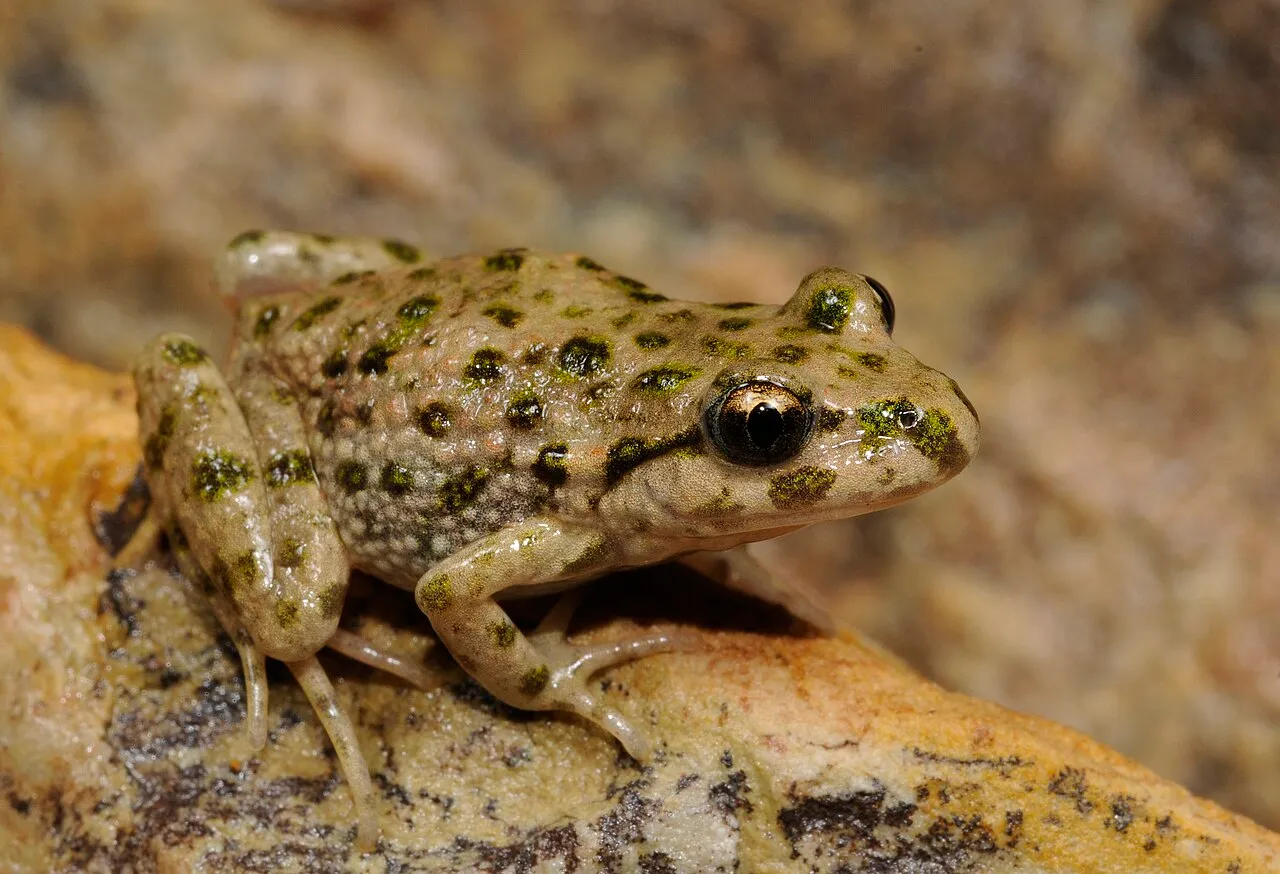
Pelodytes ibericus, the Iberian parsley frog, is a small amphibian of the family Pelodytidae, endemic to the Iberian Peninsula, found only in Portugal and Spain. It is the sister species of the common parsley frog, which it resembles closely but grows a little smaller and carries shorter limbs.
Identification
Adults reach about 40 mm (4 cm) in length, with shorter limbs than their sister species. The skin is smooth or granular, with a scattering of dark-coloured tubercles, and the dorsal surface ranges from olive, greenish-brown, dark brown or greenish-grey, flecked with green specks, while the underside is white or cream. During the breeding season, the throat of breeding males turns dark-coloured, a useful cue for telling the sexes apart at ponds in spring.
Habitat and range
The species occupies open areas, under bushes, among scattered trees, in salt marshes, fields and gardens, including intensively farmed land, and breeds in ponds, ditches, slow-moving streams and flooded areas. Within its Iberian range it is quite common in suitable habitats in Spain but seems to be rare in Portugal, despite occurring in both countries.
Behaviour and breeding
Breeding takes place in spring, often after heavy rain, when adults move to the ponds, ditches and flooded ground where they lay their eggs. Egg masses contain up to 350 eggs, and several clutches may be laid over the course of a few days. The eggs hatch after about a fortnight, and the resulting tadpoles may take about three months to develop before undergoing metamorphosis.
Conservation
The IUCN category is shown in the facts box above, Least Concern. The main pressures on the species are habitat degradation, loss of breeding pools and predation by invasive red swamp crayfish, the same introduced predator that threatens amphibians across much of the Iberian Peninsula.
Similar species
Pelodytes ibericus belongs to a small genus within the family Pelodytidae. Its closest and most easily confused relative is the common parsley frog, Pelodytes punctatus, which shares the same green-speckled colouring but is slightly larger and longer-limbed, and whose range reaches northeastern Spain, close to where the two species’ distributions come near each other.