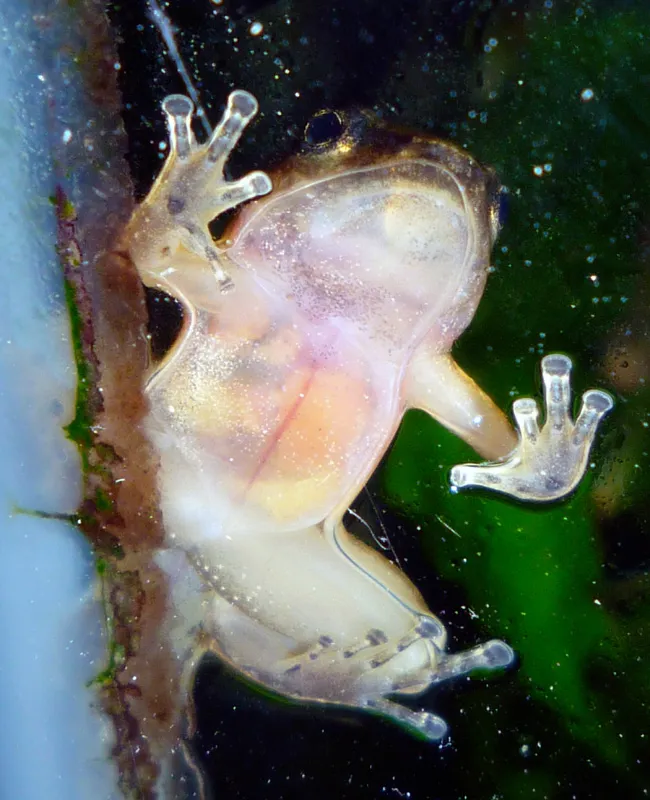
Mannophryne trinitatis, the Yellow-throated Frog, is a small, diurnal frog of the family Aromobatidae, endemic to Trinidad, found in the island’s Northern and Central Ranges. Populations on the nearby Paria Peninsula of Venezuela were once included under this name but are now recognised as a separate species. It is best known for a striking territorial display in which calling males darken almost to black while females flash a bright yellow throat, and for the extended care males give their tadpoles afterwards.
The species was first described by Garman in 1888, under the name Phyllobates trinitatis, and was later placed in the genus Colostethus before reaching its current genus, Mannophryne. Mannophryne venezuelensis, found on Venezuela’s Paria Peninsula, was formerly treated as part of this species before the two were separated.
Identification
The species is small: males average about 25 mm in snout-vent length, females slightly larger at about 28 mm. Its dorsal surface is brown and dark, with mottled flanks, a well-defined pigmented collar and pale dorsolateral stripes, along with dark pigmentation around the margins of the soles and palms. The clearest field mark, though, is behavioural rather than a fixed pattern: during territorial encounters, calling males change colour from pale brown to jet black, while females display bright yellow throats against the males’ plainer grey throats, a contrast that gives the species its common name.
Habitat and range
Mannophryne trinitatis lives along rocky streams in moist montane forest, from sea level up to high elevations. It favours narrow, shallow streams with clear, slow-moving water, where deeper pools let its tadpoles develop away from the main current. Adults feed mainly on arthropods and small insects, including the fruit flies Drosophila hydei and D. melanogaster and the beetle Callosobruchus chinensis, hunting through the day as a diurnal species rather than at night.
Behaviour and breeding
Both sexes are territorial and defend two kinds of ground: smaller, nonreproductive patches holding food, water and shelter, and larger reproductive territories contested with calling rivals during the breeding season. Females engage in this territorial defence more often than males, using visual threat displays, wrestling and chasing, and flashing their yellow throats at intruders. Males, for their part, court females from a distance with advertisement calls, combined with throat display and toe-tip jumping, while their skin darkens from pale brown to jet black; the same calls also warn off rival males and predators from the calling site.
Once a female approaches a calling male, the pair moves to an oviposition site such as a rock crevice or wet leaves near the stream, where she lays her eggs after rainfall has raised the humidity. Clutch size in Trinidad ranges from about 6 to 13 eggs in the Northern Range and 12 to 26 eggs at Tamana cave in the Central Range. Parental care then falls to the male: he guards the clutch until the eggs hatch after about 21 days. The newly hatched tadpoles measure roughly 14 to 16 mm and grow to about 37 mm before metamorphosing, feeding mainly on algae and leaf litter, and occasionally on bat guano and invertebrate infauna. When predators are numerous, the male carries the tadpoles on his back for three to four days to reach predator-free water, sometimes moving them into other pools such as phytotelmata, water-holding structures formed by plants; he cannot breed again while transporting them, though the work costs him little in lost feeding time. In the stream, the frogs and their tadpoles are themselves prey: the killifish Anablepsoides hartii and shrimp of the genus Macrobrachium commonly take both, and the frogs also carry intestinal parasites such as cestodes, nematodes and acanthocephalans.
Conservation
The facts box above carries the species’ current IUCN Red List category, Least Concern. Despite that status, the species faces habitat loss from deforestation, pollution and agricultural practices across its limited Trinidadian range, and the lack of population genetics studies means local declines could go unrecorded.
Similar species
Mannophryne trinitatis belongs to a genus of stream-breeding frogs endemic to Trinidad and nearby parts of South America, several of which share its small size and rocky-stream habitat. Mannophryne venezuelensis of Venezuela’s Paria Peninsula, once grouped within this species before the two were split, is its closest known relative. No other Mannophryne page is yet published on this site for direct comparison, but the combination of small size, montane stream habitat, biparental care and the male’s colour-changing territorial display is distinctive within Trinidad’s frog fauna.