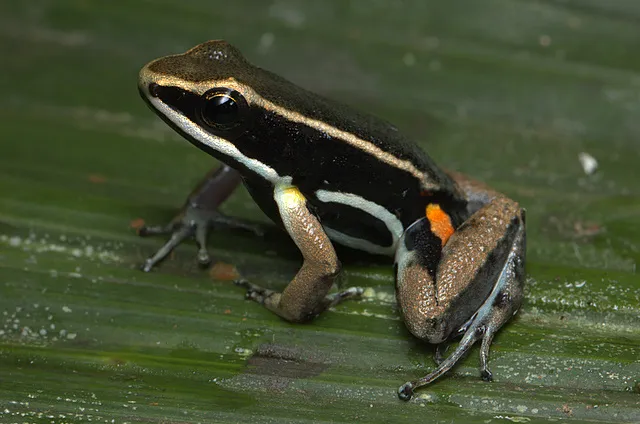
Allobates femoralis, the brilliant-thighed poison frog, is a small, diurnal, ground-dwelling frog of the family Aromobatidae, found across the Amazon basin in Bolivia, Brazil, Colombia, Ecuador, French Guiana, Guyana, Peru and Suriname, with one unconfirmed sighting in Venezuela. It was first described in 1884 by the herpetologist George Albert Boulenger. Despite the common name, it belongs to a different family from the brightly toxic Dendrobatidae, and is better known among biologists for an unusually long courtship and for males that carry their tadpoles across the forest to water.
Identification
Males measure about 28-33 mm in snout-vent length, with females marginally larger. The dorsum and limbs are dark brown to black and the throat is black, while the belly is white marked with black. The clearest field marks are a pale brown stripe running along each side from the snout to the base of the legs, an orange-yellow patch behind each arm, and a half-moon-shaped orange patch on the outside of each thigh — the “brilliant thighs” of the common name.
Habitat and range
The species lives on the floor of tropical lowland forest, typically below 300 m elevation, though populations in Colombia and Ecuador range up to 1,000 m. It is diurnal and terrestrial, active on the leaf litter by day rather than climbing into the canopy or calling after dark as many other frogs do. Its diet consists of small insects such as beetles, crickets, roaches and ants, with juveniles favouring springtails.
Behaviour and breeding
Males defend territories with two acoustically distinct calls: an advertisement call used to hold ground against rivals, and a courtship call of lower frequency, given only at close range to a female. Females follow males that give either call. Territorial disputes between rival males are aggressive and can last about 15 minutes. Breeding runs from November to April, peaking in January and February. Courtship itself is unusually prolonged: a male leads a female to an egg-laying site in a behaviour known as the “courtship march,” a process that can take two to three days, among the longest courtship durations known in the species’ relatives. Males are polygynous and may court several females in turn, attending up to five clutches at once under this system; females sharing a male’s courtship do not act aggressively toward each other.
A female lays a clutch of 8-17 eggs beneath a leaf or log; mating itself takes the cephalic form of amplexus typical of the family, rather than the pelvic clasp seen in many other frogs. The male stays close by rather than leaving immediately: he remains at the oviposition site next to the female for about 2.6 minutes on average before moving off to guard the eggs. Once the tadpoles hatch, the male carries them, one trip sometimes lasting from several hours to days, to a pool or stream as far as 180 m from his own territory; if a male is lost, a female will take over tadpole transport instead. Finding the same pools reliably over repeated trips is thought to require strong spatial memory and learning on the male’s part, which has made the species’ parental care a subject of its own research into amphibian cognition, alongside studies of the visual, acoustic and tactile signals exchanged during the courtship march.
Conservation
The facts box above carries the species’ current IUCN Red List category, Least Concern. It has a wide range across the Amazon basin, a population considered stable, and no identified major threats, and is listed on CITES Appendix II, which regulates rather than bans international trade.
Similar species
Within its range, Allobates femoralis can be confused with Lithodytes lineatus, another ground-dwelling frog with pale dorso-lateral stripes. The two are told apart by the stripe pattern and thigh markings: in L. lineatus the pale line encircles the back rather than stopping at the legs, the limbs are barred, and the thighs carry several orange patches rather than the single half-moon mark that identifies A. femoralis. The orange-yellow patch behind the arm, combined with the single half-moon thigh patch, remains the most reliable clue when the two are seen side by side.