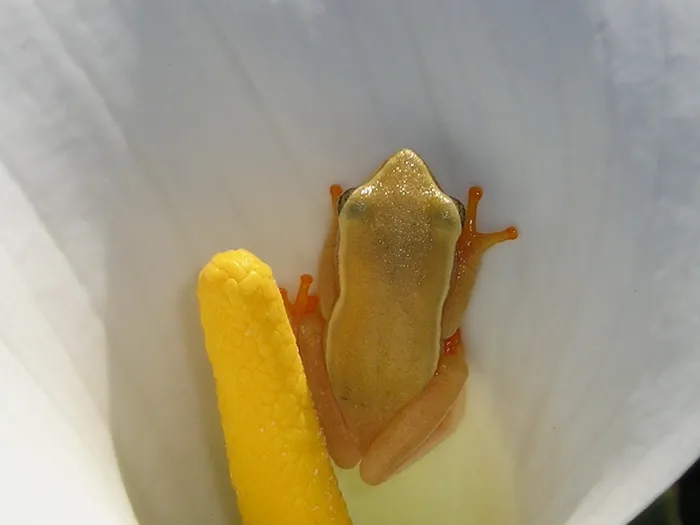
The arum lily frog, Hyperolius horstockii, is a reed frog of South Africa’s southern coast, named for its habit of sheltering inside the white flowers of the arum lily. It is endemic to South Africa’s southern coastal plain, ranging from Cape Town in the Western Cape to Port Elizabeth in the Eastern Cape. The species was first described in 1837 by the naturalist Hermann Schlegel, who placed it in the genus Hyla as Hyla horstockii before it was later moved to Hyperolius, the reed frogs, within the family Hyperoliidae.
Identification
Adults reach about 40 mm in length, a moderate size for the genus Hyperolius; its tadpoles grow to a similar size, about 40 mm, before completing metamorphosis. The dorsal surface ranges from cream to brown, sometimes marked with small black spots, with a pale dorsolateral line running from the snout along the flanks above a dark-brown lateral band; the underside is creamy white and slightly granular. Males carry a bright ochre throat flap used in calling, and the species has horizontal pupils. Its feet and legs are a bright orange, which the frog tucks under its body during the day to stay hidden, only showing the colour when it moves. Like many reed frogs, it can shift its skin colour to match its surroundings, a camouflage that works alongside its colour-matching choice of resting sites rather than, as is sometimes assumed, any use of flower pollen on its skin; the species does not rely on arum lily pollen to camouflage itself. The facts box carries the species’ current size range and conservation status.
Habitat and range
H. horstockii lives in Mediterranean-type shrubby vegetation (fynbos) near rivers, swamps, freshwater lakes, marshes and ponds, the characteristic vegetation of its Cape coastal range. Its breeding sites include large and small pans, dams, vleis and slow-flowing, quiet streams with enough emergent vegetation for egg-laying and calling. It is often found sheltering at the base of arum lily flowers (Zantedeschia aethiopica), where it waits for pollinating insects — a habit that gives the species its common name and doubles as an ambush perch for catching the insects the flower attracts. The frog’s diet is not detailed beyond this ambush strategy in the sources checked for this profile, but its presence inside the flower is explicitly linked to hunting the pollinators that visit it rather than simply resting there.
Behaviour and breeding
Males call at night from elevated positions above water, typically from emergent vegetation such as sedges, reeds, shrubs and grasses, starting just after sunset and sometimes sporadically in the late afternoon on cloudy, rainy days. The breeding season runs from September to January, coinciding with the Cape’s wetter months, and after mating, females lay clutches of 10–30 eggs attached to submerged roots and stems of plants rather than releasing them freely into open water. This attachment of eggs to submerged plant structures, rather than free-floating clutches, mirrors the species’ general reliance on dense emergent vegetation at every stage of breeding, from the calling perch to the egg-laying site.
Conservation
The species’ facts box carries its current IUCN Red List category, Least Concern, consistent with its relatively wide range along the southern Cape coast. Even so, the sources checked for this profile note a specific pressure: some populations are threatened by habitat loss driven by the invasion of alien vegetation and by fire, both of which can degrade the fynbos and wetland vegetation the species depends on for shelter and breeding. By contrast, the species is not threatened by the collection and sale of arum lilies, despite its close association with the flower, since the frogs are not removed along with the cut blooms in any way documented in the sources checked.
Similar species
No other Hyperolius species profile is yet published on this site; readers are referred to the facts box for taxonomy within the family Hyperoliidae. The arum lily frog’s combination of a pale dorsolateral line, a dark lateral band and bright orange feet tucked out of sight is distinctive within the genus, and its arum lily habit is the single easiest field clue to separate it from other small Cape reed frogs sharing the same fynbos streams and marshes.