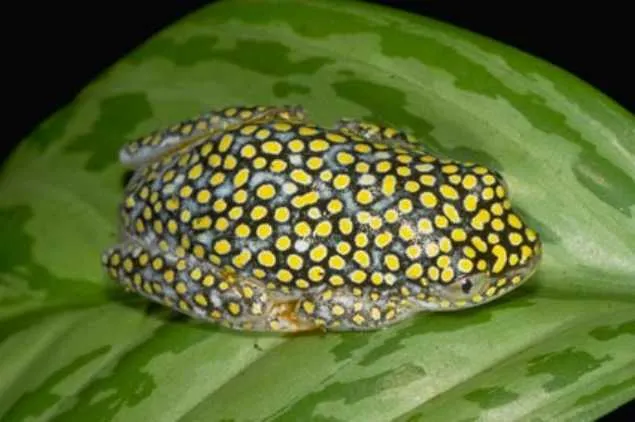
The Whitebelly Reed Frog, Heterixalus alboguttatus, is a small hyperoliid described by George Albert Boulenger in 1882 and endemic to Madagascar: as far as is known, it occurs nowhere else. It belongs to the genus Heterixalus within the family Hyperoliidae. The species shows pronounced sexual dimorphism, meaning the two sexes differ visibly in appearance rather than looking alike: males and females look almost nothing alike within the same population, down to the colour of the skin itself rather than just its markings.
Identification
The species shows marked sexual dimorphism: females have a yellow-spotted dorsal pattern, while males are almost uniformly white. Females measure about 30–33 mm snout-vent length; the facts box carries the full range. Both the whitebelly common name and the yellow-spotted pattern in the scientific name (alboguttatus, “white-spotted”) describe the same feature: the pale, speckled back of breeding females, which the plain white males lack. In practice this means the two sexes can look like different species at a glance, and only the combination of size, locality and the plain white male pattern separates them from their close relatives. The photograph on this page shows a female, perched on a leaf and displaying the yellow-spotted back that gives breeding females their distinctive look; a male encountered in the same spot would show none of that patterning.
Habitat and range
H. alboguttatus occurs in open environments such as savannahs, degraded forest, swamps, grasslands and ricefields. It breeds in both temporary and permanent water bodies, particularly ricefield habitats. This spread of habitat types, from natural wetlands and grassland to farmed ricefields, means the species is not confined to pristine forest: both its everyday habitat and its breeding sites include land that people actively farm, rather than only undisturbed wilderness. Degraded forest on that list is forest that has already been logged or otherwise altered rather than left intact, which places this frog firmly among the generalists of Madagascar’s amphibian fauna rather than among the many species restricted to untouched rainforest.
Behaviour and breeding
During the breeding season, females perch on sunlit leaves of Pandanus plants and other vegetation above the water. A clutch contains around 500 black and white eggs. Laying the eggs on leaves above the water, rather than directly into it, keeps the clutch out of the water itself until the tadpoles are ready to hatch and drop down into it below. Pandanus, the plant named as a favoured perch, is a screw pine, a group of plants typically found growing at the edge of wetlands and other damp ground, which fits a frog that needs a sunlit, elevated surface close to the water it breeds in.
Conservation
The species’ facts box carries its current IUCN Red List category, Least Concern. Its open and degraded-habitat types are generally expanding in Madagascar due to human activity. In other words, the conversion of land to ricefields and other open ground, which shrinks the habitat available to many forest-dependent species, has instead increased the amount of the open and degraded habitat that this particular species uses for both living and breeding. The Least Concern category itself means the IUCN does not currently judge the species to qualify for any of the more threatened Red List categories, based on the evidence available at the time of assessment; it is a statement about today’s status, not a guarantee against future change.
Similar species
H. alboguttatus forms a species complex with Heterixalus boettgeri and Heterixalus madagascariensis, and is known to hybridize with H. boettgeri. A species complex of this kind means the three are close enough in appearance and genetics that boundaries between them have shifted over time: H. alboguttatus was itself once listed as a subspecies of H. madagascariensis before being recognised as distinct. Hybridisation with H. boettgeri further blurs the picture in areas where their ranges overlap, so a frog matching the general pattern described above is not automatically identifiable as H. alboguttatus without attention to locality and the specific combination of features given here. For a non-specialist in the field, the safest approach is to treat any white-bodied or yellow-spotted Heterixalus seen outside a confirmed locality for this species as unconfirmed rather than to assume it on pattern alone, given how closely the three members of the complex can resemble one another.