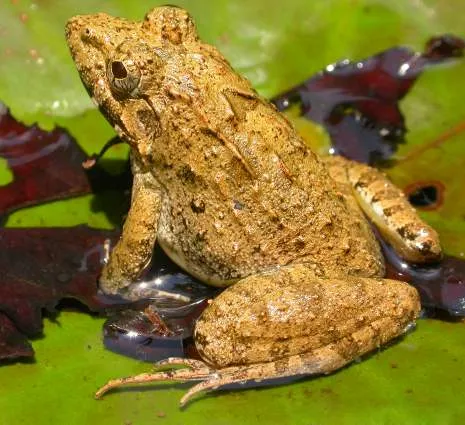
Hoplobatrachus tigerinus, known locally as the Bull Frog, is a large, heavily built frog native to Afghanistan, Bangladesh, India, Myanmar, Nepal and Pakistan, with uncertain presence in Bhutan and China, where it is one of the most familiar amphibians of the Indian subcontinent’s wetlands and paddy fields. It has also been introduced to the Maldives, Madagascar and India’s Andaman Islands, where it has established itself as a widespread invasive species. Its size and adaptability to human-altered wetlands have made it one of the more visible frogs across its range, both where it belongs and where it does not.
Identification
Adults reach about 170 mm (6.7 in) in snout-vent length, with considerable variation between populations depending on food availability and water conditions; Animal Diversity Web records an average length around 168 mm and a weight between about 0.27 and 0.77 kg, among the larger frogs sharing its range. Outside the breeding season it wears a dull olive-green or brown-green colouring with dark spots that blends into wetland vegetation, but males turn a striking yellow during the breeding season, with a pair of blue vocal sacs on either side of the throat and nuptial pads on the first finger, while females stay heavier and longer than males year-round. Its closest look-alike, the smaller congener Hoplobatrachus crassus, can be told apart at close range: see Similar species below.
Habitat and range
The species occupies freshwater wetlands, both natural and artificial, including paddy fields, sheltering in holes or vegetative cover near permanent water at elevations between about 25 and 1,140 m, and is generally absent from forested and coastal ecosystems. Within its native range it is found throughout wetland areas of the Indian subcontinent, with records extending to southern Nepal and northern Myanmar. Its tolerance of farmed wetlands such as rice paddies has helped it persist alongside people across a landscape that has been heavily converted to agriculture, and the same tolerance is what has let it establish so readily outside its native range: populations introduced to the Maldives, Madagascar and the Andaman Islands (first recorded there in October 2011) have become invasive, competing with and preying on native amphibians and reptiles.
Behaviour and breeding
Outside the breeding season, the frog is primarily nocturnal and largely solitary, spending relatively little time in open water and instead sheltering in surrounding vegetation, where it hides from predators such as snakes. It is an opportunistic predator of invertebrates, small mammals and birds, a diet broad enough to make it, in places where it has been introduced, a threat to smaller native wildlife. Breeding is tied to the monsoon season, when frogs gather in pools of rainwater to mate; males call loudly and turn bright yellow to attract females, who lay large clutches of eggs about 2.5–2.8 mm across, each enclosed in a double coat of jelly. No parental care follows egg-laying, and many tadpoles die before reaching adulthood even though large numbers of eggs are produced at once. Males mature at about 10 months and females at around two years, and wild frogs can live more than seven years.
Conservation
The species’ facts box carries its current IUCN Red List category, Least Concern, reflecting stable populations across most of its native range and its ability to thrive in the farmed wetlands that now dominate much of South Asia. That same adaptability is a liability elsewhere: where the species has been introduced, notably on the Andaman Islands, its carnivorous tadpoles compete heavily with native amphibian larvae, and the frog itself preys on native reptiles and amphibians, making it a conservation concern for the ecosystems it invades rather than for the species itself.
Similar species
Within its native range, the Bull Frog’s closest look-alike is the smaller congener Hoplobatrachus crassus, which overlaps with it across much of India, Bangladesh and Nepal. H. crassus is the smaller of the two, with females reaching about 8–10 cm and males about 5–8 cm, and can be distinguished by its proportionately longer hind legs and a shovel-shaped metatarsal tubercle used for burrowing. In practice, the Bull Frog’s larger size, blunter build and, in season, its yellow breeding colour and blue vocal sacs are usually enough to separate it from its smaller relative in the field.