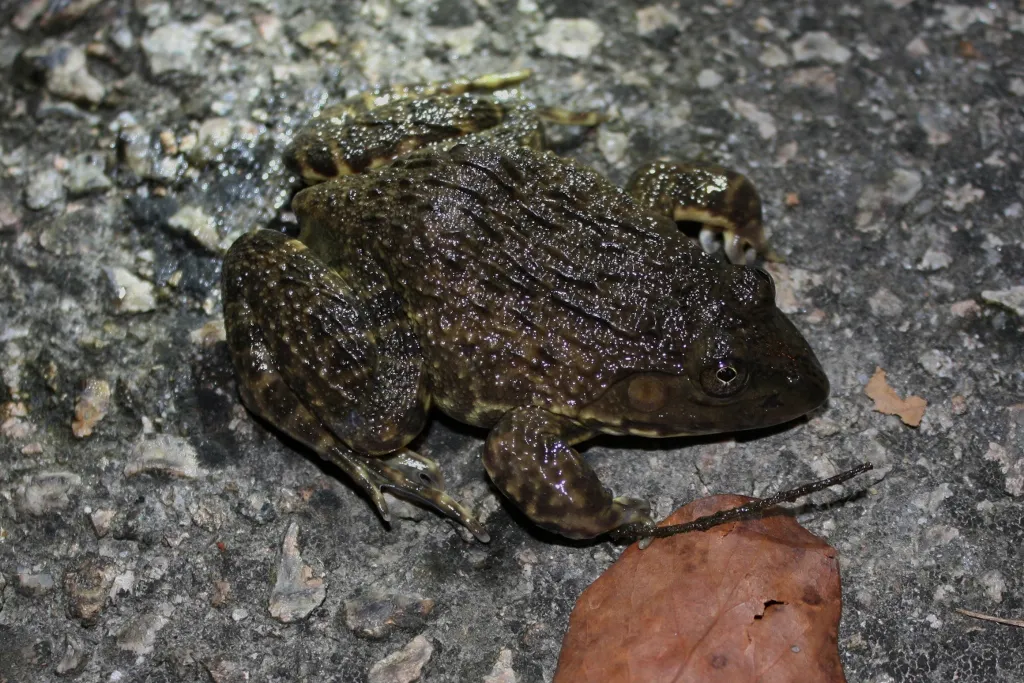
Hoplobatrachus rugulosus, the Chinese bullfrog, is a large, robust frog found across Cambodia, China, Hong Kong, Laos, Macau, Malaysia, Myanmar, the Philippines, Singapore, Taiwan, Thailand and Vietnam. Its wide range through Southeast and East Asia overlaps with some of the region’s most intensively farmed wetlands, and the species has adapted to live alongside that farming rather than in spite of it.
Identification
Adults are large and heavily built, reaching about 120 mm or more in snout-vent length, with females growing larger than males. That size and bulk place it among the bigger frogs within its range, comparable to its congener Hoplobatrachus tigerinus further west; see Similar species below for how the two compare.
Habitat and range
The Chinese bullfrog is a wetland generalist, occupying freshwater and intermittent marshes, arable and pasture land, rural gardens, urban areas, ponds, aquaculture ponds, open excavations, irrigated and seasonally flooded agricultural land, and canals or ditches. That tolerance for farmed and built environments, alongside natural marshland, helps explain why it remains common across a range spanning Cambodia, China, Hong Kong, Laos, Macau, Malaysia, Myanmar, the Philippines, Singapore, Taiwan, Thailand and Vietnam.
Behaviour and breeding
The species is primarily insectivorous, feeding on the invertebrates that its wetland and farmland habitats provide in abundance. It breeds in spring to early summer, a pattern shared with other wetland-breeding frogs across its monsoon-influenced range, using the same ponds, ditches and flooded fields it occupies the rest of the year.
The Chinese bullfrog’s relationship with people goes beyond simply tolerating farmed wetlands: it is widely farmed itself, notably in Sichuan in China, as well as in Malaysia and Thailand, and its forelimbs and hind legs are eaten as frog legs, including in Filipino adobo-style dishes. Smaller individuals also turn up in the pet trade and as live food for arowanas and other predatory fish. That long history of farming has left a genetic mark: the domesticated Thai farmed form and wild Chinese populations belong to two separate genetic lineages, suggesting the species may in fact be a cryptic complex of more than one species still filed under a single scientific name.
Conservation
The species’ facts box carries its current IUCN Red List category, Least Concern, consistent with a wide range and the frog’s evident ease living in farmed and urban wetlands alongside people, rather than only in undisturbed habitat. Its popularity as farmed food across Sichuan, Malaysia and Thailand has, if anything, reinforced that wide distribution rather than threatened it, though the possibility that “Hoplobatrachus rugulosus” covers more than one genetic lineage is a reminder that a single Least Concern rating may not speak equally for every population carrying the name.
Similar species
Hoplobatrachus tigerinus, the Bull Frog of South Asia, is the Chinese bullfrog’s closest and best-documented congener, though the two do not overlap geographically: H. tigerinus belongs to the Indian subcontinent, while H. rugulosus occupies Southeast and East Asia further east. Both are large, heavily built frogs of farmed wetlands, and both tolerate paddy fields and other human-altered water bodies well, but the Bull Frog reaches a larger confirmed size, at about 170 mm in snout-vent length, than the roughly 120 mm reported for the Chinese bullfrog.