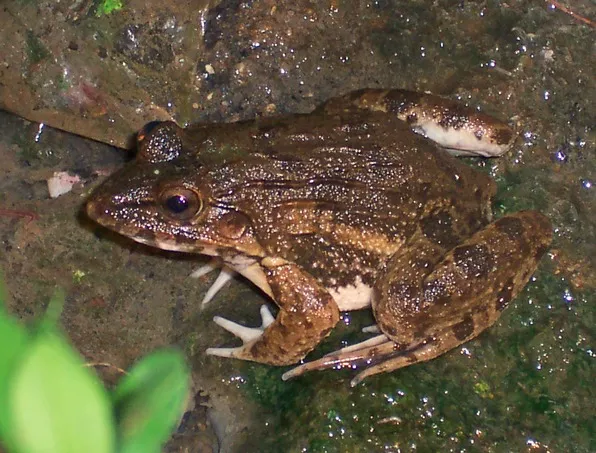
Fejervarya cancrivora, the Crab-eating Frog, is a large member of the ricefield frog genus Fejervarya in the family Dicroglossidae, found across southeastern Asia, including Taiwan, China, Sumatra, the Philippines and, rarely, Orissa in India. It has also been introduced to Guam, likely from Taiwan, extending its range well beyond the mainland and island habitats where it occurs naturally. Its common name points to an unusual trait. Tolerance for salt water is rare among frogs, and Fejervarya cancrivora is one of the few amphibians known to survive brief excursions into the sea, a trait that shapes where and how it lives.
Identification
Among the larger species in its genus, Fejervarya cancrivora shows pronounced size differences between the sexes: adult males measure about 60.2–79.8 mm in snout-vent length, while females are considerably larger at about 85.1–107.1 mm. That size, well above most of its smaller Fejervarya relatives, is one of the more reliable field clues to identifying it within a genus that otherwise contains many superficially similar ricefield frogs (see Similar species below). A frog of this bulk turning up in a mangrove-fringed marsh rather than a freshwater paddy is a further hint toward this species over its smaller, strictly freshwater relatives.
Habitat and range
The species inhabits mangrove swamps and marshes, coastal wetland habitats that expose it regularly to brackish and even fully saline water. Unusually for an amphibian, it tolerates brief excursions into seawater, with adults surviving salinities up to about 2.8% and tadpoles up to about 3.9%, placing it among the small number of frog species known to cope with conditions that would be lethal to most others in its class. This tolerance likely underlies its wide and somewhat patchy distribution, spanning Taiwan, China, Sumatra, the Philippines and Orissa in India, with an introduced population on Guam, since mangrove and estuarine habitat lets it move along coastlines that fresh-water-bound frogs cannot cross. Sightings scattered this widely, and this close to the coast, across Asia’s mainland and islands fit a species that can use the sea to move between coastal sites.
Behaviour and breeding
Fejervarya cancrivora’s most distinctive behaviour is physiological. Its capacity to cope with saline water lets it forage and move through mangrove and marsh habitat that few other frogs can use, tolerating seawater at concentrations up to about 2.8% as an adult and 3.9% as a tadpole. That tadpoles withstand a higher salinity than adults suggests even its earliest life stages, spent in the standing water of coastal marshes, already cope with the same brackish conditions instead of developing in a sheltered freshwater nursery first. That tolerance effectively opens up an ecological niche, coastal brackish wetlands, that is largely unavailable to other amphibians, reducing competition for space and food in the parts of its range closest to the sea.
Conservation
The species’ facts box carries its current IUCN Red List category, Least Concern, consistent with a wide range across southeastern Asia and a habitat tolerance, including brackish and saline mangrove wetlands, that few competing species share. A species able to use coastal habitat that most amphibians cannot is, all else equal, less exposed to the freshwater-wetland loss that threatens many of its relatives, though mangrove clearance for aquaculture and coastal development remains a pressure on the same habitat it depends on.
Similar species
Fejervarya cancrivora belongs to a genus containing many similarly built, ground-dwelling ricefield frogs across South and Southeast Asia, several of which overlap with it geographically. Its comparatively large size, females reaching about 85.1–107.1 mm and males about 60.2–79.8 mm in snout-vent length, sets it apart from most smaller Fejervarya species, and its documented tolerance of saline mangrove and marsh habitat is not shared by its freshwater-restricted relatives, making habitat as useful a distinguishing feature in the field as size. A large Fejervarya-type frog in a coastal mangrove or brackish marsh is more likely to be this species than one of the many smaller, freshwater-bound relatives found inland.