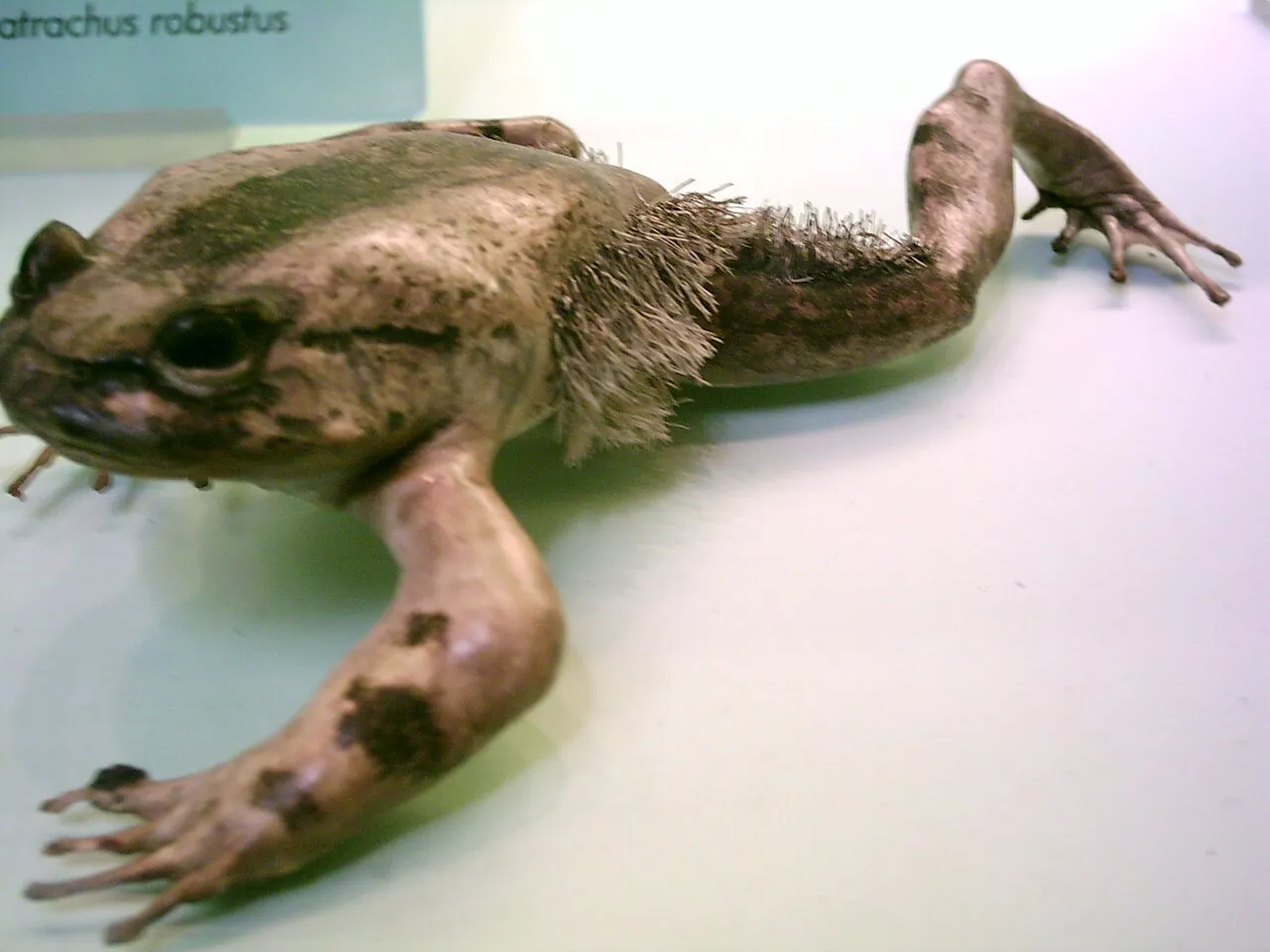
Trichobatrachus robustus, the hairy frog, is a large, heavily built frog of the family Arthroleptidae, found across Central and West Africa in Cameroon, Equatorial Guinea, the Democratic Republic of the Congo, Nigeria, Gabon and Angola. It is also known as the horror frog or wolverine frog, names earned by two unrelated oddities: hair-like structures that breeding males grow on their flanks, and a defense mechanism in which the frog breaks its own toe bones to force sharpened spikes through the skin.
Identification
The species is sexually dimorphic in size, with males reaching about 100-130 mm in snout-vent length and females about 80-110 mm, figures close to Wikipedia’s own range of 10-13 cm for males and 8-11 cm for females. Adults have a broad, stubby head with a short, rounded snout. During the breeding season, males develop hair-like dermal papillae along their flanks and thighs, thin projections of skin that each carry a small artery; the increased surface area is thought to work like an external gill, helping a male absorb enough oxygen to stay underwater while he guards eggs. The genus name Trichobatrachus itself is built from the Greek words for “hair” and “frog,” a direct reference to this feature. The frog’s second and most startling trait is hidden in its toes: it carries retractable claws made of bone rather than keratin, each anchored to a bony nodule by strands of collagen, and when threatened the animal breaks that connection and forces the sharpened bone through the skin to use as a weapon. How the claw retracts afterwards is not fully understood, though Wikipedia notes passive retraction during tissue regeneration as one hypothesis. Genetic evidence suggests the species may eventually be reclassified into the genus Astylosternus, though it is still treated as the sole member of its own genus.
Habitat and range
Trichobatrachus robustus is primarily terrestrial, living in forested regions and partially cleared agricultural land that retains some cover, only returning to water to breed. It favours fast-flowing forest rivers and streams, where females lay their egg masses directly on rocks in the current rather than in still water. Outside the breeding season the frog keeps to land, foraging away from the streams it depends on for reproduction.
Behaviour and breeding
Adults are opportunistic predators, taking slugs, myriapods, spiders, beetles and grasshoppers. After a female lays her eggs on streamside rocks, a male stays with them for an extended period, and it is during this vigil that his hair-like papillae do their work, keeping him oxygenated while mostly submerged. The resulting tadpoles are unusually well armed for herbivore-heavy amphibian larvae: they are carnivorous, with several rows of horned teeth, an adaptation suited to the fast, rocky streams where they develop.
Conservation
The species’ facts box carries its current IUCN Red List category, Least Concern, reflecting a range that spans six Central and West African countries. Locally, pressure is real: Wikipedia records habitat loss, pollution, hunting for food and the wild animal trade, and possibly chytridiomycosis as threats, with some populations declining even though the large overall range keeps the species out of a threatened category. In Cameroon the frog is roasted and eaten, and hunted with long spears or machetes; among the Bakossi people it carries traditional beliefs that frogs fall from the sky and that eating them aids fertility.
Similar species
No other frog shares the hairy frog’s bone-claw defense outright, but Wikipedia notes one partial parallel: the Otton frog (Babina subaspera) of Japan’s Amami Islands, which carries a similar spike in its thumb, though without the breakable bone mechanism that makes Trichobatrachus robustus’s claws functionally unique in the animal kingdom. Within its own range, no other West or Central African frog combines the hairy frog’s dermal papillae with its bone claws, so an adult male in breeding condition is not easily mistaken for anything else.