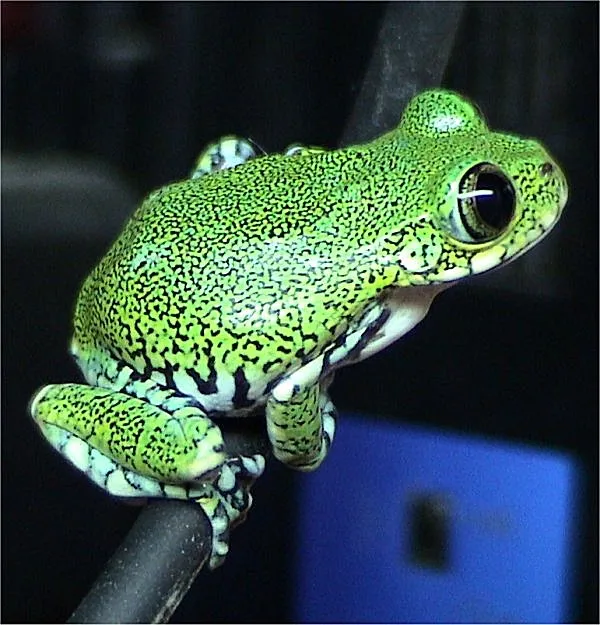
The big-eyed tree frog, Leptopelis vermiculatus, is a forest frog named for the outsized eyes that dominate its face. It is endemic to Tanzania, known from the Usambara Mountains and nearby forests, at elevations of about 900–1800 m, where it lives almost entirely within the forest canopy rather than on the ground.
Identification
Adults measure 40–85 mm in length, making this a medium to large species within its genus; the facts box carries the full range. The frog occurs in two colour phases: a bright green form with scattered black specks across the back and marbled black-and-white flanks, and a brown form carrying an irregular, darker brown triangular patch on the back. In both phases the eyes are the clearest field mark, described as very large relative to the body and golden in colour, marked with brown lines and flecks. Large toe pads support its climbing habit.
Habitat and range
The species keeps to closed-canopy wet tropical rainforest, staying within the montane forests of the Usambara range and surrounding areas rather than ranging into open or disturbed ground. Its restriction to elevations of roughly 900–1800 m ties it closely to a narrow band of intact forest.
Behaviour and breeding
L. vermiculatus is insectivorous, taking advantage of the insect life the closed canopy supports. Breeding males call from the water and are strongly territorial, using two distinct calls — a repeated “ga…ga…ga” to attract females, and a harsher “rrrrrrrr-ga” to warn off rival males. Outside its native range, the species is sometimes kept as a pet.
Conservation
The species’ facts box carries its current IUCN Red List category, Endangered. It is confined to a limited band of montane forest in the Usambara Mountains, so logging or forest clearance there removes conditions it cannot easily find elsewhere.
Similar species
Other tree frogs in the genus Leptopelis share a similar body plan and forest canopy lifestyle, but the combination of large size, prominent golden eyes and the Usambara range sets L. vermiculatus apart.