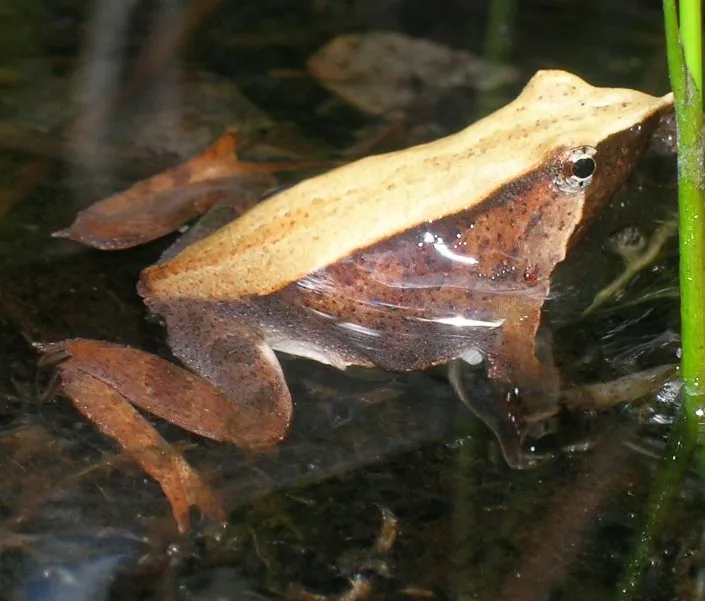
Rhinoderma darwinii, Darwin’s frog, is a small, leaf-mimicking frog of the family Rhinodermatidae, native to the Valdivian temperate rainforest of southern Chile and adjacent Argentina. It is best known for a breeding strategy found nowhere else among living frogs: the male carries the tadpoles through metamorphosis inside his own vocal sac.
Identification
The frog is very small, with a snout-to-vent length of about 22-31 mm, and is built around a distinctive fleshy, pointed proboscis on the snout that gives the head a triangular shape. Its skin is mostly smooth, with only a few wart-like glands, and its upperparts range from brown to bright green depending on the substrate it is imitating, an adaptation that lets a still frog pass for a dead or living leaf on the forest floor. That camouflage differs by sex: females tend to stay brown and keep to matching brown substrates, while males range more widely across both colours, and a brooding male is often partially or fully green on its upper side. The underside breaks that camouflage entirely: a black background carries big white spots along with smaller yellow and orange spots, and on the throat the black is marked with large white blotches in a pattern unique to each individual, which researchers use to tell individual frogs apart. The front feet are unwebbed while the hind toes are partially webbed.
Habitat and range
The species lives in cool, moist native temperate forest, in glades, bogs and near slow-moving streams, at altitudes up to about 1,100 m, favouring a mix of grassland, mossy ground, coarse woody debris, and young trees and bushes within otherwise mature native forest. Its range runs from Concepcion Province south to Palena Province in Chile, and from Neuquen Province to Rio Negro Province in Argentina, tracking the extent of the Valdivian forest on both sides of the Andes.
Behaviour and breeding
Darwin’s frog is insectivorous, taking insects and other terrestrial arthropods from the leaf litter it so closely resembles. Its reproduction, however, is what sets the species apart. A female lays a small clutch, typically 4 to 10 eggs at a time, occasionally up to forty across a single patch of leaf litter, on damp soil rather than in water. The male stands guard nearby, and once the embryos show the first signs of movement inside the egg, roughly three to four weeks after laying, he swallows them whole and carries them, not in his stomach, but in his vocal sac. The eggs finish hatching inside the sac about three days later, and the tadpoles then develop there for roughly six weeks, living off their own yolk reserves and secretions produced by the wall of the sac rather than anything the male eats. A male typically broods five to eight tadpoles at once, and, contrary to older assumptions that a brooding male stops feeding entirely, at least one dissected specimen was found with beetles and flies still in its stomach. When development is complete, the young leave in a series of convulsive movements, hopping out of the male’s mouth as fully formed miniature frogs.
Conservation
The IUCN category is shown in the facts box above. Darwin’s frog is not the only Rhinoderma to face pressure: its closest relative, Rhinoderma rufum, shared the same mouth-brooding strategy but has been presumed extinct since 1981, a loss that stands as a warning for what could happen to Rhinoderma darwinii if the Valdivian forest it depends on keeps shrinking.
Similar species
Rhinoderma rufum, the northern Darwin’s frog, is the only other species in the genus and the only other frog known to brood its young in this way, but it has been presumed extinct since 1981, a loss that leaves Rhinoderma darwinii as the sole surviving mouth-brooding frog. Away from its own genus, Rhinoderma darwinii’s leaf-mimicking brown-and-green camouflage recalls many leaf-litter frogs worldwide, but none of them share its most identifying trait: no other living frog raises its tadpoles inside the father’s vocal sac.