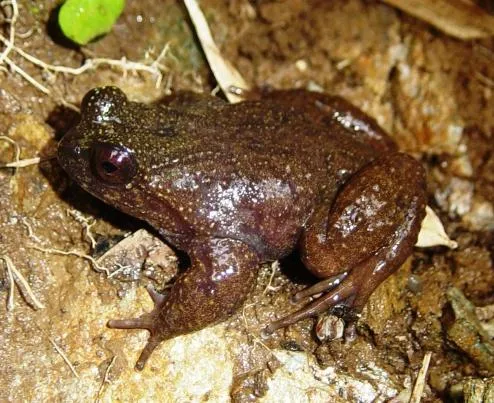
Insuetophrynus acarpicus, known in English as Barrio’s frog, is the only species in its genus and a member of the family Rhinodermatidae. It is endemic to Chile, known only from the Valdivian Coast Range between the Los Ríos and Araucanía regions, where its known range spans about 33 km of coastline, making it one of the more narrowly distributed frogs in the family.
Identification
The species is a sturdy frog with muscular limbs and strong jumping ability, built for life among stream-side stones rather than for climbing or burrowing. Its toes are partially webbed, while the fingers are short, thick and unwebbed, a combination suited to gripping wet rock. The back is reddish brown with whitish granulations and darker transverse bands on the hind legs, and the dorsal skin is granular and warty. Size differs between the sexes: males measure 41-56 mm and females 35-53 mm in snout-vent length, with the facts box carrying the full figure; tadpoles reach about 61 mm in total length at developmental stage 43.
Habitat and range
The frog lives along coastal streams in temperate forest, at elevations of 50-486 m above sea level, within its narrow 33 km stretch of the Valdivian Coast Range. Adults shelter under stones by day and forage along stream margins at night, staying close to the cover and moisture the stream bed provides. Tadpoles occupy a different part of the same stream: they live in muddy, slow-current areas hidden beneath stones, away from the faster water adults can tolerate.
Behaviour and breeding
Unlike many stream frogs that favour the bank, Barrio’s frog spends much of its time in water despite being a poor swimmer, a trait that ties it closely to the streams it inhabits and likely limits how far individuals range from them. No open source gives further detail on this species’ calls or courtship beyond the stream-bound habits above and the tadpole habitat described under Habitat and range.
Conservation
The facts box above carries the species’ current IUCN Red List category, Endangered. That status reflects the frog’s extremely narrow range, a single 33 km stretch of coastline, where the main pressure is clear-cutting and afforestation across its limited coastal range, both of which alter the streams the species and its tadpoles depend on.
Similar species
Insuetophrynus acarpicus is the sole species in its genus, so no congener exists for comparison. Within the family Rhinodermatidae, it is profiled alongside Rhinoderma darwinii, Darwin’s frog, on this site; the two share a Chilean range and a family tree but differ sharply in biology and appearance, as Darwin’s frog is small, leaf-camouflaged and mouth-broods its tadpoles, while Barrio’s frog is a larger, stream-bound species with no documented parental care.