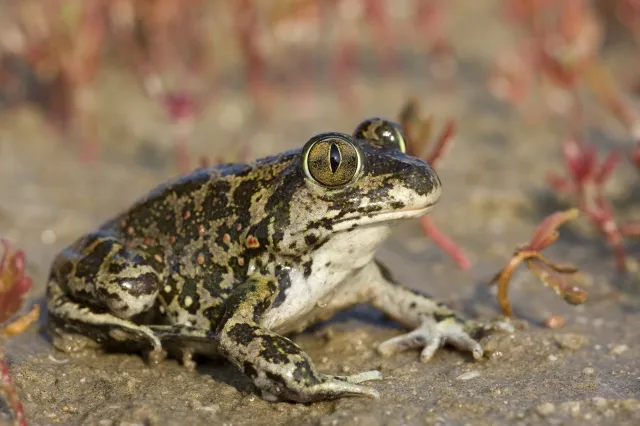
Pelobates syriacus, the Syrian spadefoot, is a burrowing toad of the family Pelobatidae, native to Armenia, Azerbaijan, Bulgaria, Georgia, Greece, Iran, Israel, Lebanon, the Russian Federation, Syria and Turkey. Within that range it is quite common in Iran but uncommon across much of the rest of its distribution, and is thought to be extinct in Jordan. Like other spadefoot toads it carries a hardened, spade-like tubercle on each hind foot that it uses to dig backwards into loose soil.
Identification
The Syrian spadefoot can grow to a length of about 9 centimetres (3.5 in), making it one of the larger members of its genus. As in the rest of the family it has a squat body, smooth skin and eyes with vertical pupils. The clearest field mark against its closest relative, the common spadefoot, is skull shape: where Pelobates fuscus has a domed skull, the Syrian spadefoot is told apart by its flat-topped skull.
Habitat and range
The species occupies a broad range running from the Balkans and the Caucasus through the Levant to Iran, native to Armenia, Azerbaijan, Bulgaria, Georgia, Greece, Iran, Israel, Lebanon, the Russian Federation, Syria and Turkey. It lives in light woodland, bushy and semi-desert areas, badlands, arable fields and dunes, preferring loose soil for burrowing but also turning up in rocky areas and pebbly clay soils. Within that range, its distribution is limited by temperature, rainfall and the availability of fishless ponds in which its tadpoles can develop.
Behaviour and breeding
As in the rest of its family, the Syrian spadefoot is a fossorial burrower that favours open ground with loose soil over dense, compacted ground, digging itself in backwards and emerging mainly during rain to breed. Breeding depends on temporary, fish-free ponds, and tadpoles in this family can develop unusually fast in water that is likely to dry up, with some individuals reaching the adult form in as little as two weeks; a few even turn cannibalistic, eating brood-mates to speed their own growth.
Conservation
The IUCN category is shown in the facts box above. The species’ overall range is large, but it is uncommon across much of its distribution outside Iran and is thought to be extinct in Jordan.
Similar species
The Syrian spadefoot shares its genus with several other burrowing toads that mostly replace one another geographically. The common spadefoot, Pelobates fuscus, of Central Europe and Western Asia, is best separated from it by skull shape: P. fuscus has a domed skull where the Syrian spadefoot’s is flat-topped. The western spadefoot, Pelobates cultripes, of the Iberian Peninsula and southern France, grows larger still, up to 11 cm, and has a black rather than the Syrian spadefoot’s yellowish spade on the hind foot. Neither relative’s range overlaps with the Balkans, the Caucasus, the Levant or Iran, where the Syrian spadefoot is found.