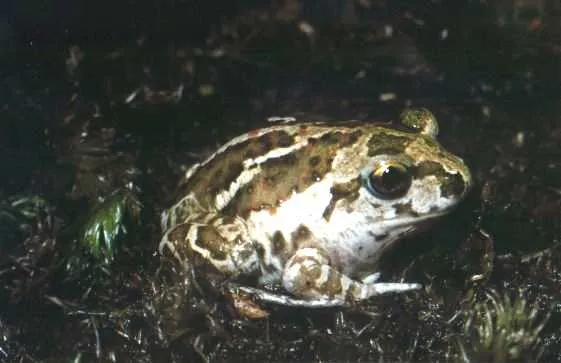
Pelobates fuscus, the common spadefoot, is a stocky, burrowing toad of the family Pelobatidae, native to an area extending from Central Europe to Western Asia, with confirmed populations along the Mura, Drava and Sava rivers in Croatia, in the Posavina region of Bosnia and Herzegovina, and in the Ticino river valley of Lombardy, northern Italy. Its common name comes from the hardened, spade-like tubercle on each hind foot that spadefoot toads use to dig backwards into loose soil; when alarmed it can also give a very loud call and exude a noxious secretion that smells of garlic, the trait behind its other common name, the garlic toad.
Identification
Females are the larger sex, reaching about 80 mm (3.1 in), males about 65 mm (2.6 in). Skin colouring is usually light-grey to beige-brown on the back, mottled with darker marks that differ between individuals; the belly is white, sometimes with grey mottling, and albino individuals have been recorded. Like other members of its family it has a squat body, smooth skin and eyes with vertical pupils. One useful field mark against its closest lookalike: the common spadefoot has a domed skull, where the related eastern spadefoot, Pelobates syriacus, is told apart by its flat-topped skull. Two subspecies are traditionally listed, P. f. fuscus in central Europe and P. f. insubricus in northern Italy, though a genetic study found no distinguishing haplotype between the two, so the split does not hold up as separate subspecies.
Habitat and range
The native range runs from Central Europe to Western Asia, with the best-documented populations along lowland river valleys and their wetlands, such as the Mura, Drava and Sava in Croatia and the Ticino in northern Italy. As in the rest of its family, it is a fossorial burrower that favours open ground with loose, sandy soil over dense, compacted ground, digging itself in backwards and emerging mainly during rain to breed in temporary pools. Eastern European populations differ enough that they may warrant treatment as a separate species, Pelobates vespertinus, which was formally split from P. fuscus on genetic grounds.
Behaviour and breeding
Breeding follows the pattern of the wider spadefoot family: eggs are laid in temporary ponds that can dry up quickly, so the tadpole stage is unusually brief, with some individuals reaching the adult form in as little as two weeks; a few tadpoles even turn cannibalistic, eating brood-mates to speed their own growth. Outside the breeding season the common spadefoot spends most of its time underground, only surfacing at night or after rain. Its main defence is vocal and chemical rather than physical: when disturbed it gives a loud alarm call and can release a secretion that smells strongly of garlic, which most predators find unpleasant enough to leave it alone.
Conservation
The IUCN category is shown in the facts box above. Range fragmentation is a live taxonomic as much as conservation question here: the eastern populations, now assessed as the separate species Pelobates vespertinus, and the Italian population of subspecies P. f. insubricus both sit at the edges of the common spadefoot’s range, the kind of disjunct, river-valley distribution that makes local populations more exposed to habitat loss than the species’ broad overall range would suggest.
Similar species
The common spadefoot shares its genus with five other burrowing toads that mostly replace one another geographically. The western spadefoot, Pelobates cultripes, of the Iberian Peninsula and southern France, is bigger (up to 11 cm), greener, and has a black rather than pale spade on the hind foot. The eastern spadefoot, Pelobates syriacus, ranges from eastern Europe to Western Asia and is best told from the common spadefoot by its flat-topped rather than domed skull. The Balkan spadefoot, Pelobates balcanicus, was only confirmed as a species distinct from P. syriacus in 2019 and is endemic to Albania, Bulgaria, Greece, North Macedonia, Serbia and Türkiye. Closest of all is Pallas’ spadefoot, Pelobates vespertinus, of eastern Europe and Central Asia, long treated as a subspecies of P. fuscus and still similar enough that it is best separated by three pale stripes down its back and a dark stripe between the eyes, both absent in true P. fuscus. None of these relatives overlap with the common spadefoot’s own core range, so a spadefoot toad seen in Central Europe with a domed skull and no back striping can be identified as Pelobates fuscus by range and these two marks alone.