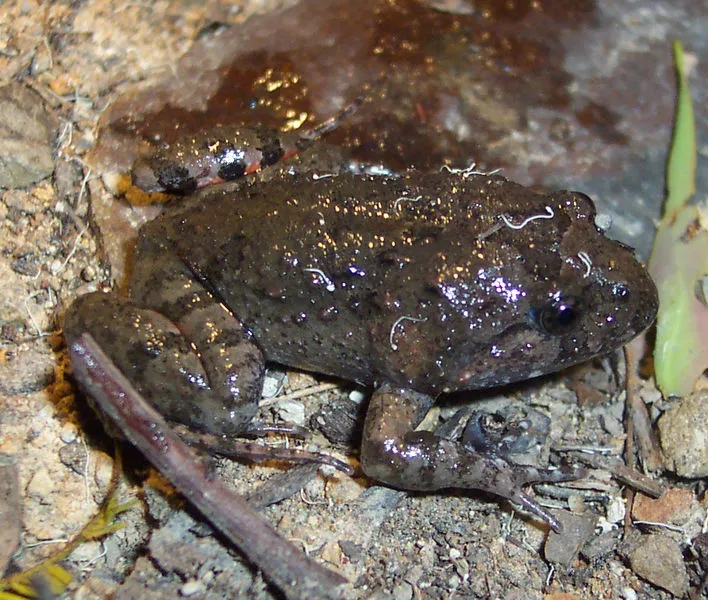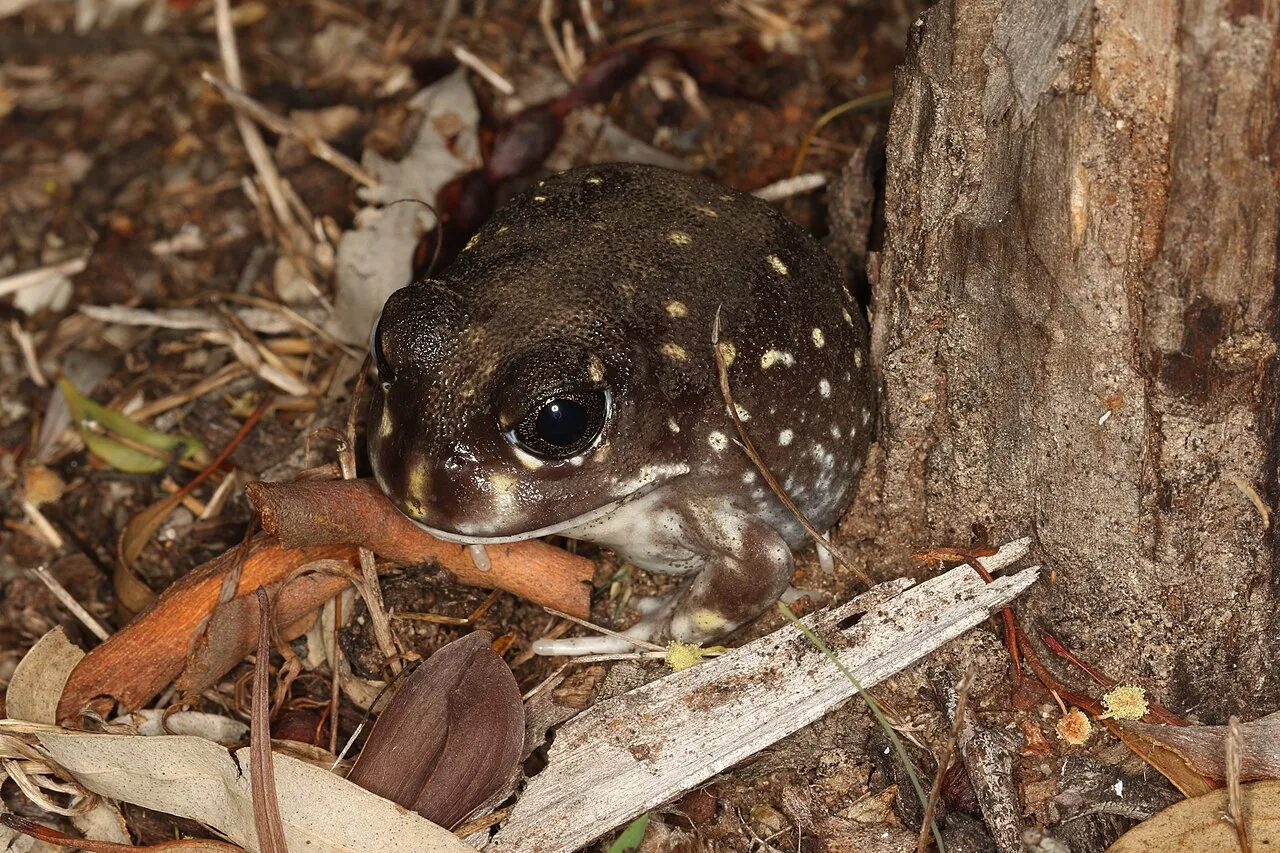
Limnodynastes dumerilii, the eastern banjo frog, is a frog of the family Limnodynastidae. It is also called the pobblebonk, after a “bonk” call likened to a plucked banjo string. The species is found from southeast Queensland to Tasmania and southeast South Australia2, taking in most of eastern New South Wales, the ACT and all of Victoria. Outside Australia it has turned up once, as tadpoles found in New Zealand in 1999 and destroyed1.
Identification
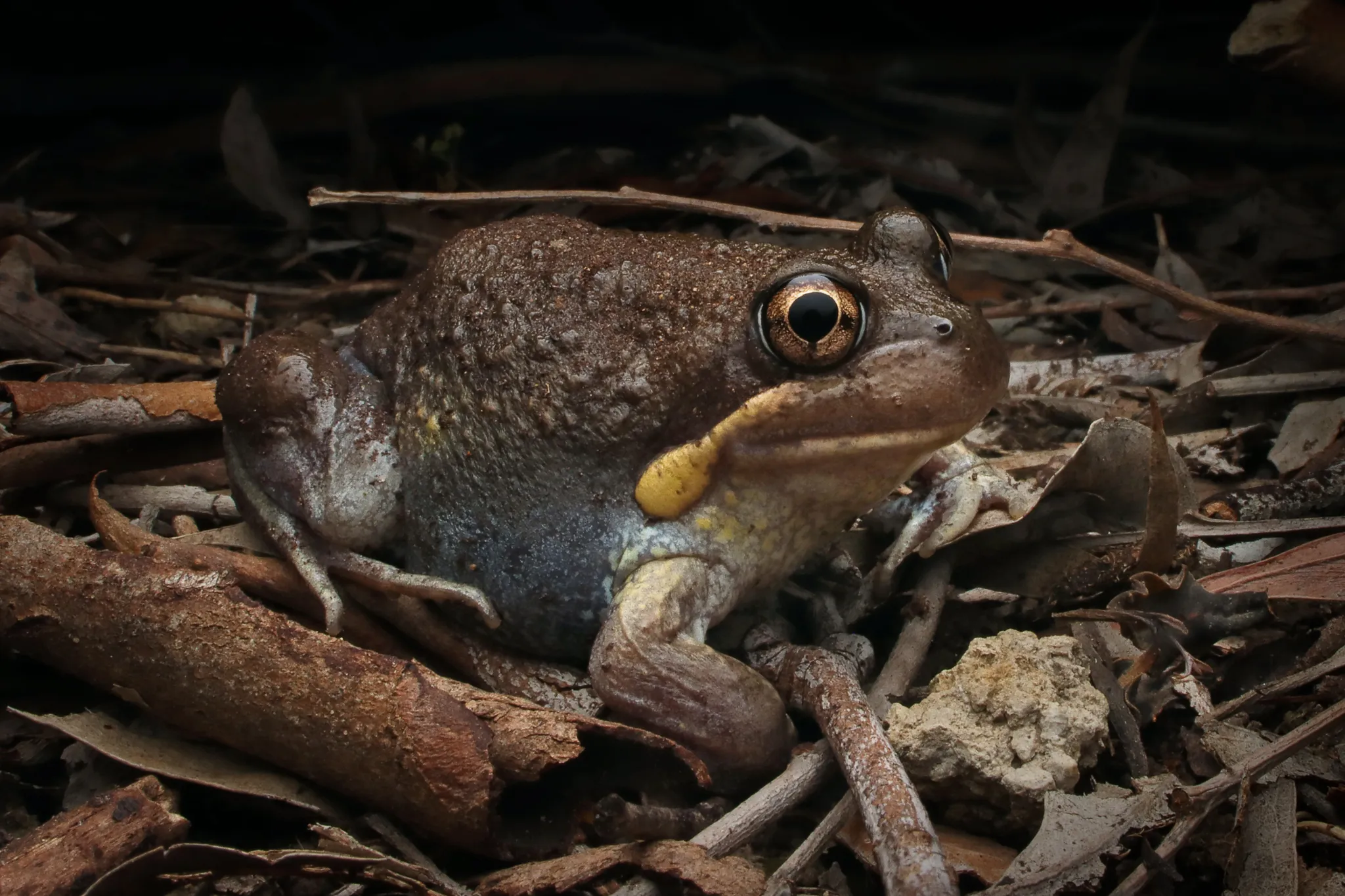
This is a large frog reaching up to 7.5 cm2 in body length; Animal Diversity Web gives adults as 52–83 mm3. The back is brown or grey-brown, with orange or yellow mottling on the sides, and a pale or yellow stripe runs from under the eye to the shoulder. The belly is mottled brown and yellow, the throat sometimes yellow4.
The pupil is horizontal and the iris golden-brown. The fingers are unwebbed and the toes one-quarter webbed2, both without discs.
The skin is warty, the legs thick and short, the head round. Large glands show at the edge of the mouth and on the tibia, and a pale “shovel” or spade sits on the hind toe. The gland at the corner of the mouth holds mucous, seromucous and granular glands, and the granular ones secrete a rodent-repelling agent3.
Research published in 2024 moved the coastal New South Wales populations, formerly thought to be the subspecies L. d. grayi, into a species of their own, Limnodynastes superciliaris. Since that 2024 split, FrogID divides the species into four subspecies4, which differ in distribution and only slightly in call and colour.
Habitat and range
The eastern banjo frog occurs in many different habitats4, among them woodland, heathland, farmland and even suburban areas. It burrows in loamy soil in grassland or wetland and river areas3.
The four subspecies split the range between them. L. d. dumerilii is the most widespread, from South-East Queensland and the ACT through the slopes and ranges of New South Wales and northern Victoria to the Murray River into South Australia. L. d. fryi is only found in the Snowy Mountains area of south-eastern New South Wales. L. d. insularis lives south of Jervis Bay, along the south coast of New South Wales, in eastern Victoria and throughout Tasmania, and is told apart by blue on the flank. L. d. variegata, very similar to insularis1, occurs in western Victoria and south-eastern South Australia and is chiefly distinguished by range.
Behaviour and breeding
The pobblebonk is a burrowing frog, usually seen only after rainfall. In dry times, and often just during the day, it burrows underground1, and it has been known to call from underground at any time of year after rain. Its advertisement call is a “bonk” or banjo-like single syllable3.
FrogID records calling peaking from September to December4, and the Australian Museum gives the breeding season as spring to autumn2. The frogs are often seen in large numbers after rain, and under the right conditions mass spawning can occur over just a few days1.
Eggs are laid as a foamy mass on the surface of stream pools, dams and ponds. A female lays up to 4,000 eggs, using skin flaps on the fingers3 to move bubbles from the water surface into the nest. Tadpoles can reach up to 7 cm in total length, dark brown or golden brown with gold clusters, and often stay on the bottom of the water. They take four to five months to develop into frogs2, although tadpoles in colder areas may take much longer.
The eastern banjo frog’s reference genome has been sequenced: a 2.38 Gb genome, compact for an amphibian, with 24,548 protein-coding genes1.
Conservation
On the IUCN Red List of Threatened Species 2022.2 the species is listed as Least Concern5. It is unlisted under Australia’s federal EPBC Act4. Animal Diversity Web’s account, last updated in 2000, noted that these frogs are often dug up by gardeners3 and face habitat loss, with many Australian grasslands then endangered or threatened.
Similar species
Heleioporus australiacus, Neobatrachus pictus and Neobatrachus sudellae share parts of its range, but all have a vertical pupil instead of a horizontal one2, and different back colours and patterns. In western New South Wales, Limnodynastes interioris, the giant banjo frog, is a similar species that tends to inhabit more arid areas1; the eastern banjo frog is usually smaller and has less toe webbing4.
In Queensland, Limnodynastes terraereginae, the scarlet-sided pobblebonk, is a small fat frog with distinctive orange or red irregular markings. Along the coast of New South Wales, Limnodynastes superciliaris, formerly thought to be L. d. grayi, does not breed in flowing water, which helps separate it from L. d. dumerilii where both occur. The western banjo frog, Limnodynastes dorsalis, is also called a pobblebonk and is told apart by range: it is common around Perth1 in Western Australia.