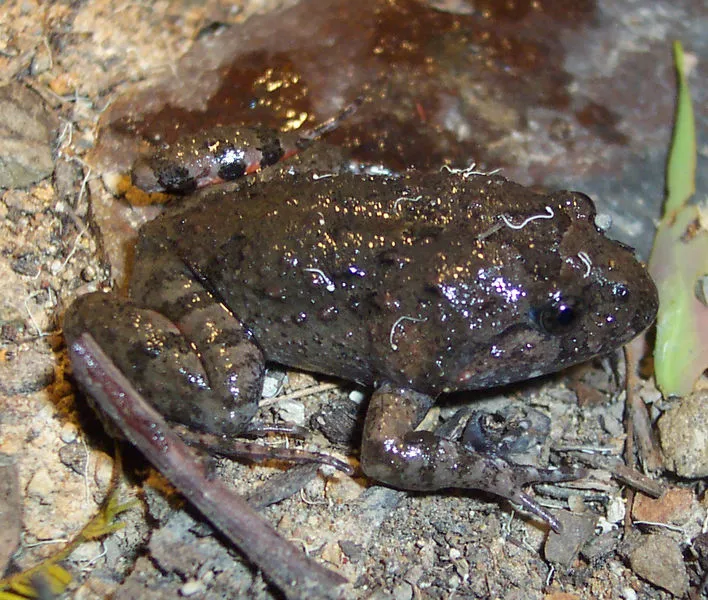
The Tusked Frog, Adelotus brevis, is a stocky, ground-dwelling frog named for the pair of tooth-like projections present on the lower jaw of both sexes, though larger in males. It is the sole member of its genus, Adelotus, in the family Limnodynastidae, a group of Australian and New Guinean ground frogs. It is native to eastern Australia, ranging from Eungella National Park in central Queensland south to Ourimbah, New South Wales, occurring in both coastal and highland parts of that range; its highland populations have declined sharply in recent decades.
Identification
A. brevis is unusual among Australian frogs in that the female is smaller than the male: males reach about 50 mm in snout-vent length against roughly 40 mm for females. The feature that gives the species its name is a pair of modified teeth protruding from the middle of the lower jaw, about 5 mm long, slightly curved and sharply pointed, which fit into grooves in the upper jaw when the mouth is closed; the Wikimedia Commons photograph used on this page shows these tusk-like projections clearly in a wild individual from Wallingat National Park, New South Wales. The back is typically brown to olive-black, often with a butterfly-shaped marking between the eyes, while the underside carries a marbled black-and-white pattern with flashes of red on the groin and hind legs, visible when the frog is disturbed.

Habitat and range
The species lives around dams, ditches, flooded grassland and creeks in rainforest, wet sclerophyll forest and woodland, in both coastal lowland and highland parts of its eastern Australian range. This mix of still and slow-moving water bodies in forested country supplies the sheltered sites it needs for the foam nests described below, and the species’ dependence on this habitat is thought to be one reason its highland populations have fared worse than coastal ones as forest cover has changed.
Behaviour and breeding
Male Tusked Frogs use their tusks in combat with rivals, locking jaws much as deer lock antlers and biting each other under the head and around the neck to compete for breeding sites; the species’ unusual sexual dimorphism, with the larger males, is thought to reflect the advantage of greater size and jaw strength in these fights. Breeding runs from October to December, when males call with a distinctive “tok-tok” note from concealed nest sites and build foam nests hidden from direct sunlight that can hold over 600 eggs. The male guards the eggs until they hatch, and the tadpoles take roughly two to three months to metamorphose into froglets.
Conservation
The facts box carries the species’ current IUCN Red List category, Least Concern, a status based on the Tusked Frog’s wide overall range across coastal and highland eastern Australia. Despite this overall status, the species is not uniform across its range: its highland populations have declined sharply in recent decades while coastal lowland populations remain more secure, a split that means the species’ conservation picture varies considerably by locality within eastern Australia. A species assessed as Least Concern overall can still be in serious local trouble, and the gap between its coastal and highland fortunes is a reminder to read a broad category alongside the finer-grained population trends behind it.
Similar species
The combination of lower-jaw tusks, a smaller female than male, and the marbled black-and-white underside with red groin flashes makes A. brevis difficult to confuse with other Australian frogs sharing its range.