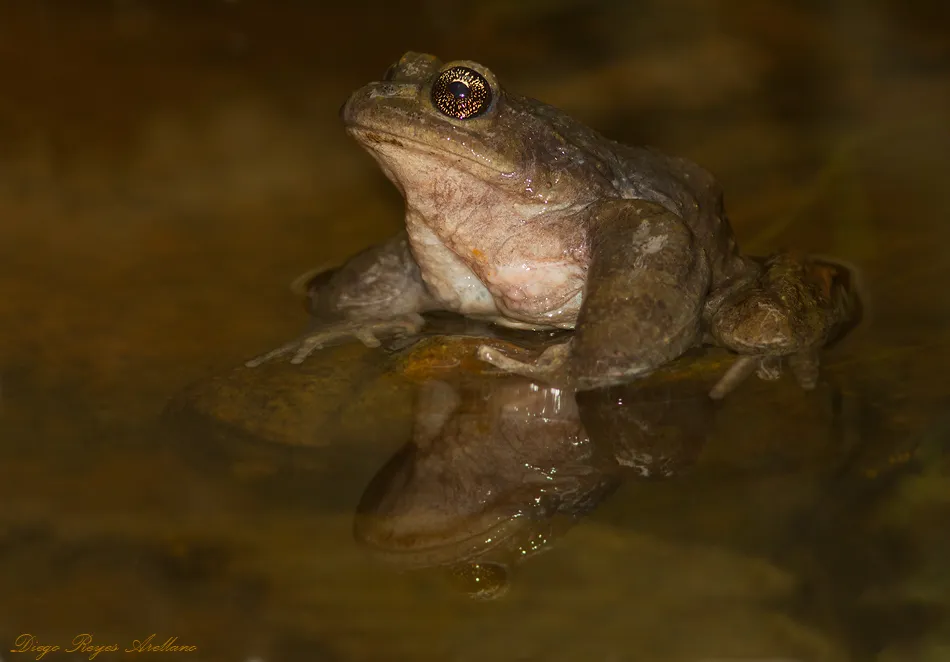
The Black Spiny-chest Frog, Alsodes nodosus, is a stream-dwelling frog endemic to central Chile; records of this species from Argentina are not considered valid, making it one of several range-restricted Alsodes species confined to a single side of the Andes. Both its common and scientific names point to the same feature: the knotty, spine-covered chest patches that breeding males develop, nodosus being Latin for “knotty.”
Identification
A voucher specimen from the species’ range gives a sense of its size: a specimen (SSUC-AM 261) from Quebrada Escobares, Valparaíso Region, measured 25 mm in snout-vent length, a modest size typical of small stream-breeding frogs in the genus. The feature that sets breeding males apart is far more distinctive than their size: breeding males develop nuptial patches on the chest formed by eight to nine small rounded pads covered in tiny thorn-like spines, the structure behind both the English name Black Spiny-chest Frog and the species epithet nodosus. Outside the breeding season, when these patches are less developed, the species is harder to tell apart from its relatives by sight alone.
Habitat and range
A. nodosus inhabits streams in shrubland between 150 and 1,900 m elevation, a broad elevational span that carries it from low coastal hills well into the Andean foothills of central Chile. Within that range it has been recorded within Cerro La Campana National Park, Río Clarillo National Reserve and Roblería del Cobre de Loncha National Reserve, three protected areas that between them give the species at least some refuge from the habitat pressures described below.
Behaviour and breeding
As in other Alsodes, breeding activity centres on the species’ spiny chest patches: males carrying nuptial patches on the chest formed by eight to nine small rounded pads covered in tiny thorn-like spines use them during the close bodily contact of amplexus in the streams the species depends on for reproduction. Beyond this structure, little else about the species’ breeding behaviour has been described in sources an editor can open; the facts box above is limited to what is directly sourced.
Conservation
The species’ facts box carries its current IUCN Red List category, Near Threatened. The English Wikipedia article on the species attributes this status to habitat loss from urbanisation, agriculture and logging, plus predation by introduced fish and larger frogs, pressures that bear directly on a stream specialist confined to a single, densely populated part of Chile. The protected areas noted above give part of its range some formal cover, but the bulk of its 150–1,900 m elevational span lies outside those boundaries.
Similar species
The Cabreria Spiny-chest Frog (Alsodes barrioi) is a close relative in the same genus, but it occupies a different part of Chile, known only from its type locality in the Cordillera de Nahuelbuta, Malleco Province, well south of A. nodosus’s central Chile range. It is also more at risk, classified as Endangered rather than Near Threatened. Both species belong to the small group of Alsodes identified by the spine-covered nuptial pads that give the genus its “spiny-chest” common names.