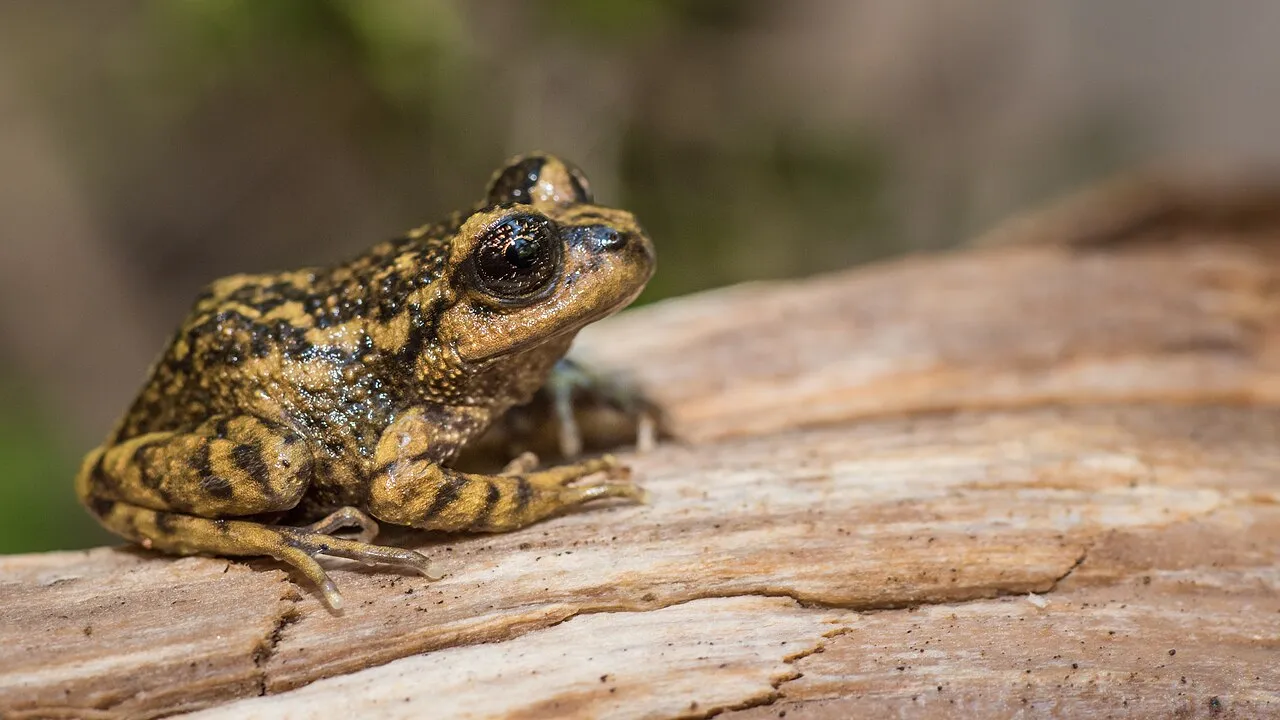
Alsodes barrioi, the Cabreria spiny-chest frog, is a species in the family Alsodidae, endemic to Chile and known only from its type locality in the Cordillera de Nahuelbuta, Malleco Province. It was described in 1981 by Veloso, Díaz, Iturra and Penna, who named it for Avelino Barrio, a Spanish botanist and zoologist who lived in Argentina.
Identification
AmphibiaWeb, the IUCN Red List and Amphibian Species of the World usually carry a snout-vent length and colour description, but all three answer automated requests with a bot challenge rather than a page, so no size or colour figure is given here. What can be said comes from its genus: Alsodes frogs carry the common name spiny-chest frogs because, during the breeding season, adult males grow thorny structures on the fingers and rounded spiny patches on the chest, the feature behind the Cabreria spiny-chest frog’s own English name.
Habitat and range
The species is known from a single place, the Cordillera de Nahuelbuta in Malleco Province, Chile. There it lives under logs or stones close to mountain streams, in forest where the surrounding vegetation mainly comprises Nothofagus dombeyi and Araucaria araucana. Observations place the frogs between 500 and 1,500 metres above sea level.
Behaviour and breeding
No open source gives citable facts about this species’ own calls, courtship or tadpole development. What is documented about its genus gives a likely picture: Alsodes frogs generally breed in high-elevation streams, and their tadpoles develop slowly, including overwintering under ice cover, a pattern consistent with Alsodes barrioi’s own stream habitat at up to 1,500 m. The species itself is relatively abundant at its type locality, and its survival there is tied to those same streams: Wikipedia notes that the habitat is being afforested by introduced pines, and that harvesting these plantations would have dramatic consequences for the streams where the frogs breed.
Conservation
The facts box above carries the species’ current IUCN Red List category, Endangered. That status reflects how narrow the frog’s known range is: a single valley system, where the main pressure is the conversion of native habitat to pine plantations and the disturbance that harvesting those plantations would bring to the breeding streams.
Similar species
Alsodes barrioi is one of 19 species in the genus Alsodes, all found only in Chile and Argentina and together making Alsodes the most species-rich frog genus in Patagonia. Every one of them shares the spiny-chest trait that gives the genus its common name, so the feature does not separate Alsodes barrioi from its relatives; its narrow, single-valley range in the Cordillera de Nahuelbuta does. None of the open sources compare Alsodes barrioi directly against a named congener, so no specific resemblance is claimed beyond that shared genus-level description.