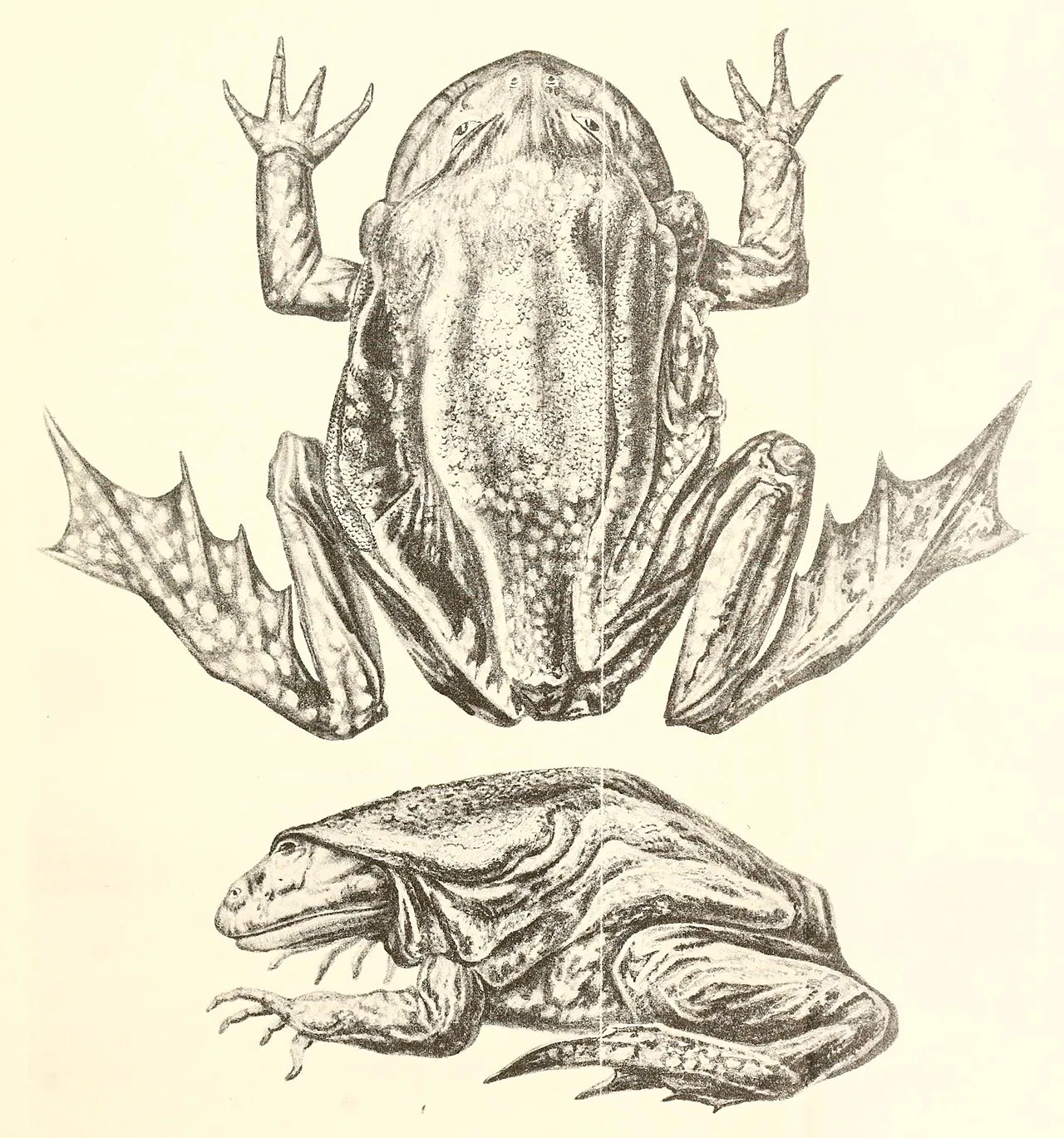
Telmatobius culeus, the Titicaca water frog, is a large, fully aquatic frog of the family Telmatobiidae, endemic to the Lake Titicaca basin shared by Bolivia and Peru, including connected rivers and the smaller lakes Arapa, Lagunillas and Saracocha. It never leaves the water, and its famously loose, baggy skin has made it one of the best-known frogs of the high Andes.
Identification
The species comes in two forms. The typical form reaches a snout-vent length of 75-170 mm, exceptionally up to 200 mm, while a smaller form measures only 40-89 mm; in both, females grow larger than males. Its skin hangs in loose folds around the body and limbs, an adaptation that increases surface area for absorbing oxygen directly from the cold, often low-oxygen water of the lake, since the frog relies heavily on cutaneous respiration rather than surfacing to breathe air.
Habitat and range
Telmatobius culeus is fully aquatic, living at altitudes of about 3,800-4,250 m in cold freshwater with year-round temperatures of 8-17.5°C. It favours mixed mud and sand bottoms with rocks or aquatic plants, typically deeper than 10 m, with records down to 120 m, making it one of the deepest-living frogs known. Its range is confined to Lake Titicaca and its connected waters on the Bolivia-Peru border, plus the smaller lakes Arapa, Lagunillas and Saracocha.
Behaviour and breeding
Because it almost never leaves the water, the Titicaca water frog’s loose folds of skin serve as its main respiratory surface in a lake that can run low on dissolved oxygen at altitude, an adaptation shared with only a handful of other fully aquatic frogs worldwide. Living at depths that put it beyond the reach of surface predators and weather, it forages and shelters among the mud, sand, rocks and aquatic plants of the lake bed described above rather than basking or calling from open banks the way most frogs do.
Conservation
The IUCN category is shown in the facts box above. The species is classified as Endangered and is also listed on CITES Appendix I, the strictest tier of international trade protection, reflecting concern over population declines in its single-lake range.
Similar species
Telmatobius culeus belongs to a large Andean genus of more than seventy described water frogs, many of them similarly restricted to single lakes, rivers or highland basins across Peru, Bolivia, Chile and Argentina. Few, however, match its combination of large size, extreme depth range and the deeply folded skin that has made it, alongside the Lake Junin frog, one of the most recognisable members of the genus.