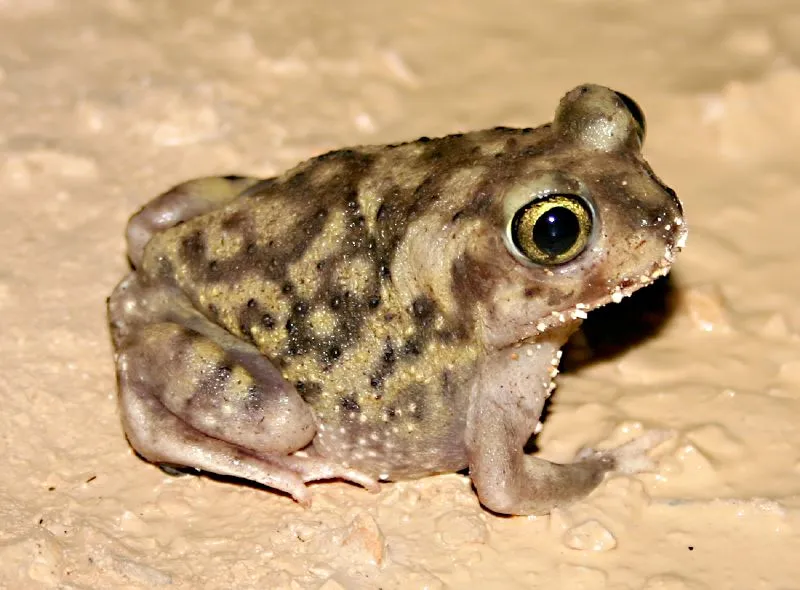
Scaphiopus couchii, Couch’s spadefoot, is a stout, burrowing toad of the southwestern United States (Texas, New Mexico, Arizona, southern California, Nevada, Utah) south through Mexico, including the Baja California Peninsula. Unlike most toads it has vertical pupils, and its name comes from the hardened, spade-like tubercle on each hind foot that it uses to dig itself backwards into the ground. It spends almost all of its life underground, surfacing only to feed or breed after the summer thunderstorms that briefly fill desert pools.
Identification
Adults reach 56-88 mm (about 2.25-3.5 in) in length, a stout body typical of the genus. Coloration runs from bright green-yellow to brown-yellow with mottled dark markings, and these markings are more extensive in females than in males. The belly is white, and the skin is covered with many small warts. The clearest field mark is on the hind foot, where a single, sickle-shaped tubercle, or spade, sits on the inner surface — a shape that separates this species from the western spadefoot genus Spea, whose spade is rounded rather than sickle-shaped. As in other spadefoots, the pupils are vertical, unlike the horizontal pupils of most true toads.
Habitat and range
The species occupies arid and semi-arid grassland prairies, mesquite savannas and desert across its southwestern US and Mexican range. For most of the year it stays underground in burrows it digs backwards with its spade-like hind feet, an adaptation that limits water loss and shelters it from the desert heat; below ground it can remain dormant in a watertight cocoon through the dry season. It emerges to breed in temporary rain pools and overflow areas from April through September, then returns underground for roughly ten months of dormancy without feeding, living off stored fat reserves.
Behaviour and breeding
Couch’s spadefoot is nocturnal and triggers its emergence to the surface on rain, breeding explosively as soon as summer thunderstorms fill desert pools. Males call to attract females with a harsh and noisy lamb- or goat-like bleat lasting half a second to a second, and research on the species shows that females prefer brighter-colored males. The breeding window is short by necessity: eggs hatch within 36 hours, and tadpoles can complete metamorphosis in as little as 30 to 40 days after hatching — with some populations reportedly maturing in as few as 9 days under pressure from fast-evaporating pools. Unlike most tadpoles, those of this species are omnivorous, eating insects, algae, other tadpoles and fairy shrimp as the race against a drying pond intensifies. Adults themselves are mainly insectivorous, and in captivity have been recorded living an average of 6.7 years.
Conservation
The IUCN category is shown in the facts box above. Animal Diversity Web notes the species is sensitive to environmental stressors such as acid rain and ultraviolet radiation, a vulnerability tied to its dependence on shallow, short-lived desert pools for breeding — the same pools that any change in rainfall patterns or groundwater use could put at risk.
Similar species
Couch’s spadefoot shares its genus with Scaphiopus holbrookii, the Eastern spadefoot, and Scaphiopus hurterii, Hurter’s spadefoot — neither of which has a page on this site yet. The ranges barely overlap: Couch’s spadefoot holds the southwestern deserts, while the Eastern spadefoot is found throughout the southeastern United States, north along the Atlantic coast into southern New England, in loose, sandy soils rather than the mesquite savanna Couch’s spadefoot prefers. Where ranges do come close, coloration separates them: the Eastern spadefoot is brownish with two yellowish stripes on its back that can form a lyre or hourglass pattern, quite unlike the mottled green-yellow to brown-yellow of Couch’s spadefoot, and it is also smaller, at 44-57 mm compared with Couch’s spadefoot’s 56-88 mm. All three Scaphiopus species share the genus’s sickle-shaped hind-foot spade and vertical pupils, so geography and the back pattern are the more reliable field marks within the region where any two might be confused.