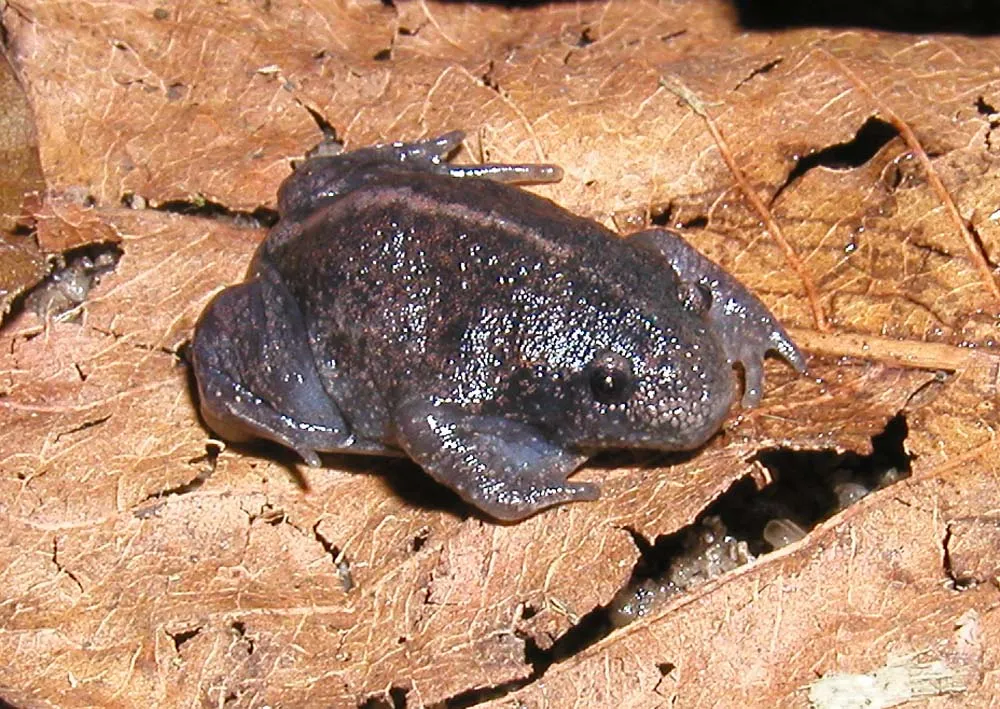
The Mexican burrowing toad, Rhinophrynus dorsalis, is the only living representative of its family, the Rhinophrynidae. Its lineage diverged from other amphibians over 190 million years ago2, and its closest sister group is Pipidae, the aquatic clawed frogs. It lives in coastal lowlands from southern Texas3 south to Costa Rica, and is virtually never seen until heavy rains1 bring it out of its burrow to breed.
Identification
Animal Diversity Web calls its rotund body and broad reddish/orange middorsal stripe1 enough to identify this toad. The body is flat, almost as wide as it is long, in loosely fitting wrinkled skin that turns taut and shiny when the body swells during the mating call. It is dark brown to black, with a bright red-orange stripe from head to tail2 and other red-orange splotches; the underside is gray to dark brown and lacks the splotches.
Females are larger than males, and adults measure 75 to 88 mm2 from snout to vent. Animal Diversity Web gives 2 to 2 3/4 inches, with a record of 3 1/2 in.1
The head is small and triangular and comes to a point, with very small eyes. There is no neck and no visible tympanum. The snout wears an armor of small keratinous spines2, and the lips are sealed by secretions from glands under the mandible.
The legs are short and muscular, and each digit ends in nail-like keratinized structures. Animal Diversity Web also notes horny, shovel-like appendages on the feet. The front feet lack webbing between the digits, while the back feet are short and extensively webbed2. A calling or alarmed toad puffs itself up into the shape of a somewhat flattened balloon, only its triangular snout1 poking out at one edge.
Habitat and range
NatureServe places it in coastal lowlands from southern Texas to northwestern Honduras on the Atlantic side, and from the Rio Balsas (Mexico) to Costa Rica3 on the Pacific side. Animal Diversity Web says it barely enters the United States1. On the Gulf and Caribbean side, the range takes in much of the Yucatán Peninsula, northern Guatemala and Belize, and there is an isolated record from northeast Nicaragua. The Pacific population reaches south through Guatemala, El Salvador, Nicaragua and Honduras to northwest Costa Rica2.
It ranges from sea level to above 500 m3.
Its natural habitats include forest, savanna, shrubland, grassland, and inland wetlands, mainly lowland tropical dry and moist forests. It is generally found in seasonally flooded areas because it relies on temporary ponds for breeding. Animal Diversity Web describes it as terrestrial and nocturnal, with adults that remain in fairly small areas. It digs its burrows with its strong short limbs and nails2 and stays underground during winter and drought1.
Behaviour and breeding
NatureServe records it as active at night in warm wet weather3. Many frogs shoot out the tongue with a lingual flip, but in this species the tongue stiffens and protrudes as the jaw moves backwards. The mechanism is specialized for capturing small insect prey in burrows. The toad primarily subsists on ants and termites2 found underground. Animal Diversity Web says it eats insects, especially termites1, which it licks up with its tongue, as well as other invertebrates.
It is considered an explosive breeder: after heavy rains, many individuals exit burrows at the same time and gather at temporary pools. The mating period lasts between one and three days, one of the shortest seasons among amphibians. Some toads may migrate one mile to a more suitable pond. Animal Diversity Web says the species can mate more than once and during any month1. In one study, females were most likely to be carrying eggs during May and June2, though reproduction can occur in October and January as well.
Males float on the water, inflate their bodies and call. Their advertisement call is a single upward tone lasting about 1.36 seconds, and a shorter, higher pre-advertisement call often comes just before it. Animal Diversity Web describes the voice as loud and low-pitched1. Males seldom fight, and females select their mates based on the frequency and tonality2 of these calls. In the mating pairs studied, females mate with smaller males, but large females often mate with the larger males present.
Eggs are laid in water, in two jelly tubes. In Costa Rican populations, clutches hold 2,000 to 8,000 eggs; another study counted 1,000 to around 8,000 eggs2, with larger females carrying proportionally more. Tadpoles hatch in a few days and transform into adults in one to three months1.
Conservation
As of 2019 the IUCN listed it as Least Concern4, and its population trend is described as stable. Mexican law protects it in the Special Protection category. Texas lists it as a threatened species, because much of its limited habitat there has been converted for agricultural uses and urban development2.
Similar species
Animal Diversity Web says it looks somewhat like a narrow-mouthed toad of giant size1.