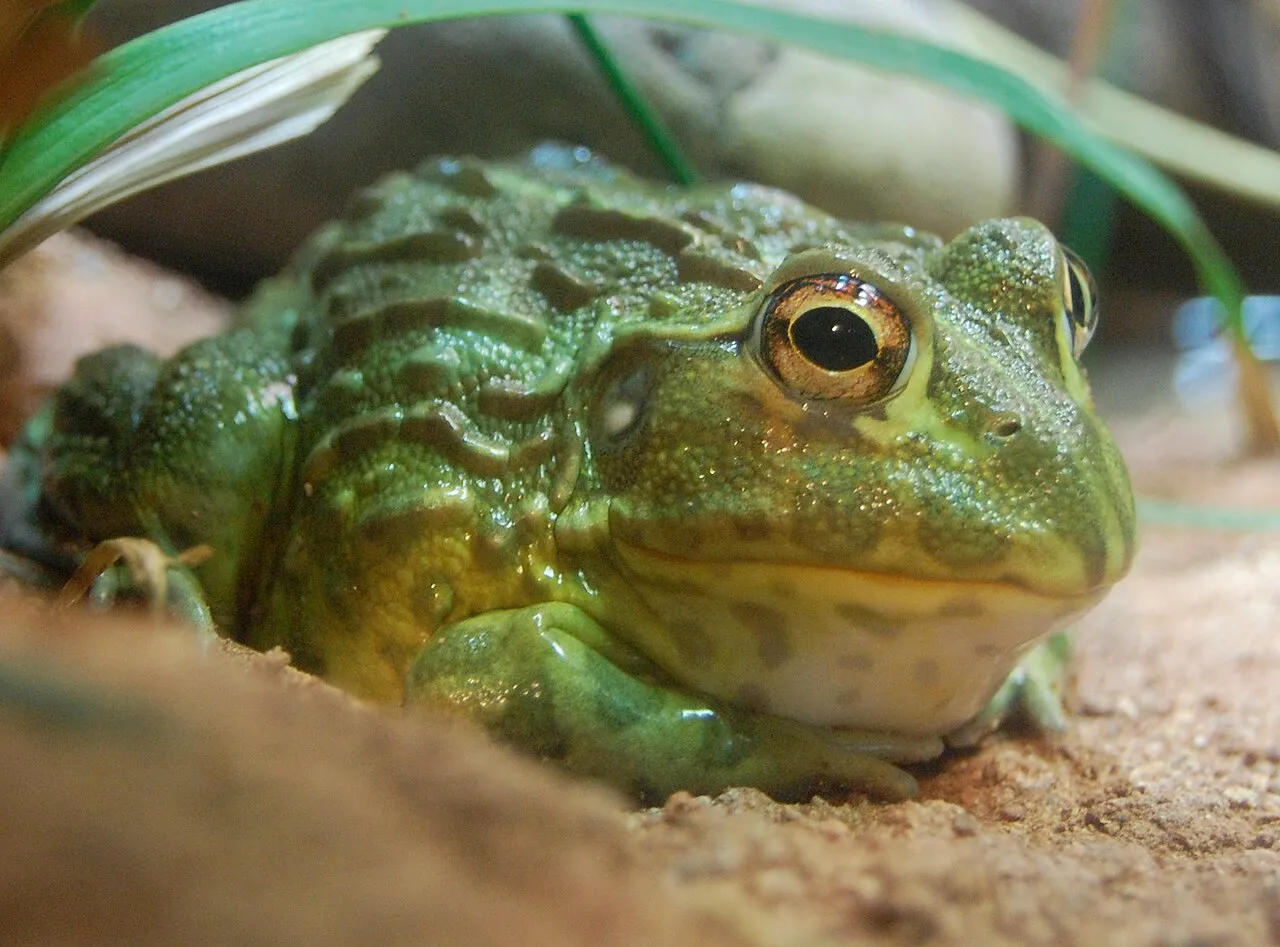
Pyxicephalus adspersus, the African bullfrog, is a heavy-bodied, widespread across sub-Saharan Africa: recorded in Angola, Botswana, Kenya, Malawi, Mozambique, Namibia, South Africa, Tanzania, Uganda, Zambia and Zimbabwe, with a possible presence in the Democratic Republic of the Congo, and a range extending north and east toward Somalia and west toward Nigeria frog, though it has been extirpated from Eswatini. It is one of the largest frogs on the continent, best known for its aggressive burrowing males, its ability to sit out droughts sealed in a self-made cocoon, and — unusually for a frog this size — fathers that guard their tadpoles rather than abandoning them.
Identification
The species is strongly sexually dimorphic: males are much larger, reaching about 245 mm in snout-vent length and up to 1.4 kg in weight, while females are roughly half the size of males, an unusual reversal of the pattern seen in most frogs, where females are the larger sex. Animal Diversity Web puts males at more than 9 inches (23 cm) and over 2 pounds (0.9 kg). Adults are dark olive-green above, with ridges running laterally along the back; the belly is white to creamy-yellow, and breeding males develop yellow forelimbs and a yellow-orange throat, while females have a cream-white throat. Juveniles look quite different from adults: they are bright green with a yellow stripe down the back, a pattern that fades as they mature. Each hind foot carries a spade-like metatarsal tubercle used for digging, and the lower jaw bears three tooth-like odontodes strong enough to restrain struggling prey — a bite that has earned wild adults a reputation for being difficult to handle safely.
Habitat and range
The African bullfrog occupies moist to dry savanna and subtropical to tropical dry shrubland, including the Kalahari and highveld areas between roughly 1,200 and 1,500 m elevation, plus intermittent freshwater lakes and marshes, arable land, pastureland, canals and flooded ditches. It breeds in temporary floodplains and drying puddles after rains and survives dry periods and cold winters by burrowing underground to estivate. Its tolerance of farmland and artificial water bodies has let it persist across much of southern and eastern Africa even as land is converted to agriculture, though the Eswatini population has disappeared entirely.
Behaviour and breeding
Adults spend most of the year underground: to survive drought, an African bullfrog sloughs off several layers of epidermal cells that harden into a cocoon covering the whole body except the nostrils, dramatically cutting water loss, a dormancy that can last a year or more until rain rehydrates it. During the rains, frogs sit partially buried with only the nose exposed, ambushing prey that passes within reach; they are voracious, opportunistic carnivores that take insects and other invertebrates, small rodents, reptiles, small birds, fish and other amphibians, including — famously at Pretoria Zoo — seventeen juvenile Rinkhals snakes eaten by a single captive frog. Cannibalism is common: males sometimes eat the very tadpoles they are guarding, and juveniles prey on tadpoles too.
Breeding starts after roughly 65 mm of rain falls over two days, when males gather at temporary pools and compete aggressively for territory, the largest males defending the best spots and producing a deep, low-pitched whoop lasting about a second. Females lay 3,000–4,000 eggs, which hatch within about two days, with tadpoles metamorphosing roughly three weeks later. Unusually for a frog, males stay to guard the clutch and the resulting tadpoles, even digging a canal from a drying pond to a larger one to keep the tadpoles alive — vigilance undercut by the fact that the same males, and other juveniles, also eat a share of what they guard.
Conservation
The species’ facts box carries its current IUCN Red List category, Least Concern, reflecting broad, largely stable populations across sub-Saharan Africa and its tolerance of farmed and altered habitats. Locally the picture is more mixed: the frog has been extirpated from Eswatini, and it is reportedly eaten as a delicacy in Namibia, a use that can add pressure on regional populations even where the species as a whole is in no danger. In captivity, individuals kept as pets have been recorded living up to 35 years, far beyond what most wild frogs achieve.
Similar species
The African bullfrog’s closest look-alike is its smaller congener, the edible bullfrog (Pyxicephalus edulis), which shares much of its range across southern and eastern Africa. Confusion between the two is common enough that Pyxicephalus edulis’s own description notes misidentification with closely related species as an ongoing problem. Size is the most reliable clue: male edible bullfrogs reach only about 8.3–12 cm in snout-vent length, well under half the length of a large male African bullfrog, and the species does not approach the sizes attained by the African bullfrog at all. In the field, any bullfrog-shaped frog approaching or exceeding 20 cm in the region is almost certainly Pyxicephalus adspersus rather than its smaller relative.