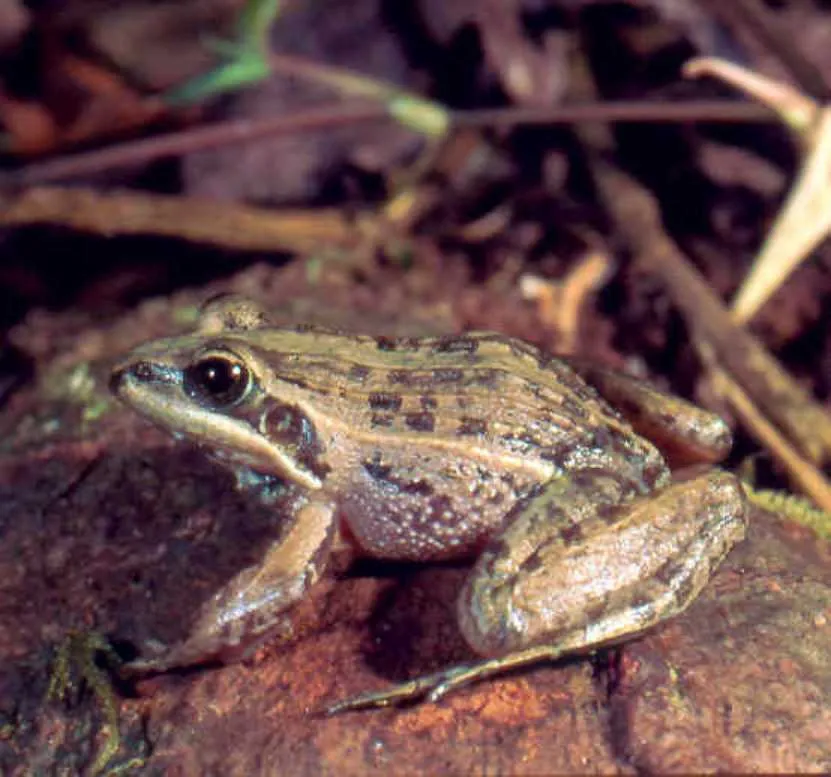
Ptychadena mascareniensis, the Mascarene Grass Frog, is a member of the grass frog genus Ptychadena in the family Ptychadenidae. It was described in 1841 by Dumeril and Bibron; the name Ptychadena hylaea, coined by Schmidt and Inger in 1959, is now treated as a synonym, and recent work recognises the species as masking a complex of cryptic lineages that taxonomists are still working to untangle. It occurs across sub-Saharan Africa, throughout Madagascar and on Mauritius, a spread that makes it unusual among the continent’s frogs. It is considered the only African amphibian species to have naturally colonised Madagascar and the Mascarene islands, a crossing of open ocean thought to have happened before humans reached Madagascar around 2000 years ago, long before any person could have carried it there.
Identification
Ptychadena mascareniensis is a medium-sized grass frog with a pointed snout and long legs, a build typical of its genus and suited to the long jumps grass frogs use to escape through open ground cover. A population studied in Burkina Faso measured snout-vent length at about 34 mm in the single male examined and 39 mm in females, the females running noticeably larger, and showed a webbing formula of I 1-2 II 1-2 III 1-2 IV 2-1 V, with supernumerary tubercles absent from the feet. The back carries four pairs of continuous longitudinal skin folds: a median pair running from between the eyes to the sacrum, a second pair starting behind the eye and reaching the lower back, a shorter third pair sitting between the second pair and the white lateral folds, and the lateral folds themselves running from the back of the eyelid to the groin. This fold pattern is shared across much of the genus but is useful alongside colour pattern for confirming the species. Colouration is brown above, dotted with dark and whitish spots on the back and hind legs, usually with a broad green or reddish vertebral band running from the snout to the venter and a fine white line along the upper leg, a combination of a contrasting vertebral stripe and spotted flanks that helps separate it from plainer-backed relatives in the field.
Habitat and range
The species is a habitat generalist, found in subtropical and tropical dry, moist and montane forest, savanna, shrubland, grassland, rivers, lakes, swamps, marshes and sandy shores, a breadth of natural habitat that few other Ptychadena species match. It also tolerates heavily modified land, including arable fields, pastures, plantations, rural gardens, urban areas, canals and irrigated, seasonally flooded or aquaculture land, so it persists in farmed and settled landscapes where more specialised frogs disappear. In Madagascar it has been recorded at Andasibe, Moramanga and Ranomafana National Park, among the island’s better-known rainforest reserves. Geographically it spans sub-Saharan Africa, Madagascar and Mauritius, and its presence on the Mascarenes and Madagascar, reached by natural colonisation rather than introduction, sets it apart from every other African amphibian, none of which are known to have made the same ocean crossing on their own.
Behaviour and breeding
In West African savanna the species breeds most often in paddy fields, making cultivated wetland as much a part of its life cycle as any natural pond. Field surveys have also turned it up in ponds within national parks and sheltering under grass cover in water-filled depressions, for example in the Comoe-Leraba Forest, suggesting it will use almost any body of standing water that offers some cover. That flexibility in where it breeds, from paddy fields and park ponds to grass-sheltered puddles, plausibly underpins its unusually wide range: a species tied to one narrow wetland type would be far less likely to establish itself across three habitat zones as different as mainland Africa, Madagascar and the Mascarene islands. The same tolerance for farmed and modified wetland habitats that supports its breeding also lets it forage and shelter across the generalist range described above, from closed forest to open farmland.
Conservation
The species’ facts box carries its current IUCN Red List category, Least Concern, in keeping with a wide natural range and a documented tolerance for farmed and urban land alongside natural wetland and forest habitat. A frog able to breed in paddy fields and persist in arable fields, plantations and garden ponds is, all else equal, less exposed to the habitat loss that threatens amphibians restricted to undisturbed wetland or forest. The taxonomic uncertainty around its cryptic species complex means future revisions could split the current broad assessment into narrower-ranging species, each needing its own status review, but under the name as currently recognised the population faces no elevated risk.
Similar species
Ptychadena mascareniensis belongs to a genus of ground-dwelling grass frogs found across Africa, many of which share its general build and spotted pattern. Its four pairs of continuous longitudinal skin folds and particular webbing formula are useful characters for separating it from similarly patterned Ptychadena species, and the fine white line along the upper leg alongside the broad green or reddish vertebral band adds a further check in the field. Its clearest clue, though, may be geography: it is the only member of its genus, and the only African amphibian, recorded as having naturally colonised Madagascar and the Mascarene islands, so any Ptychadena-type frog encountered there is likely to be this species. Elsewhere across its mainland African range, confirming the webbing formula and fold pattern against a field guide or the original description remains the surer way to rule out the genus’s other grass frogs.