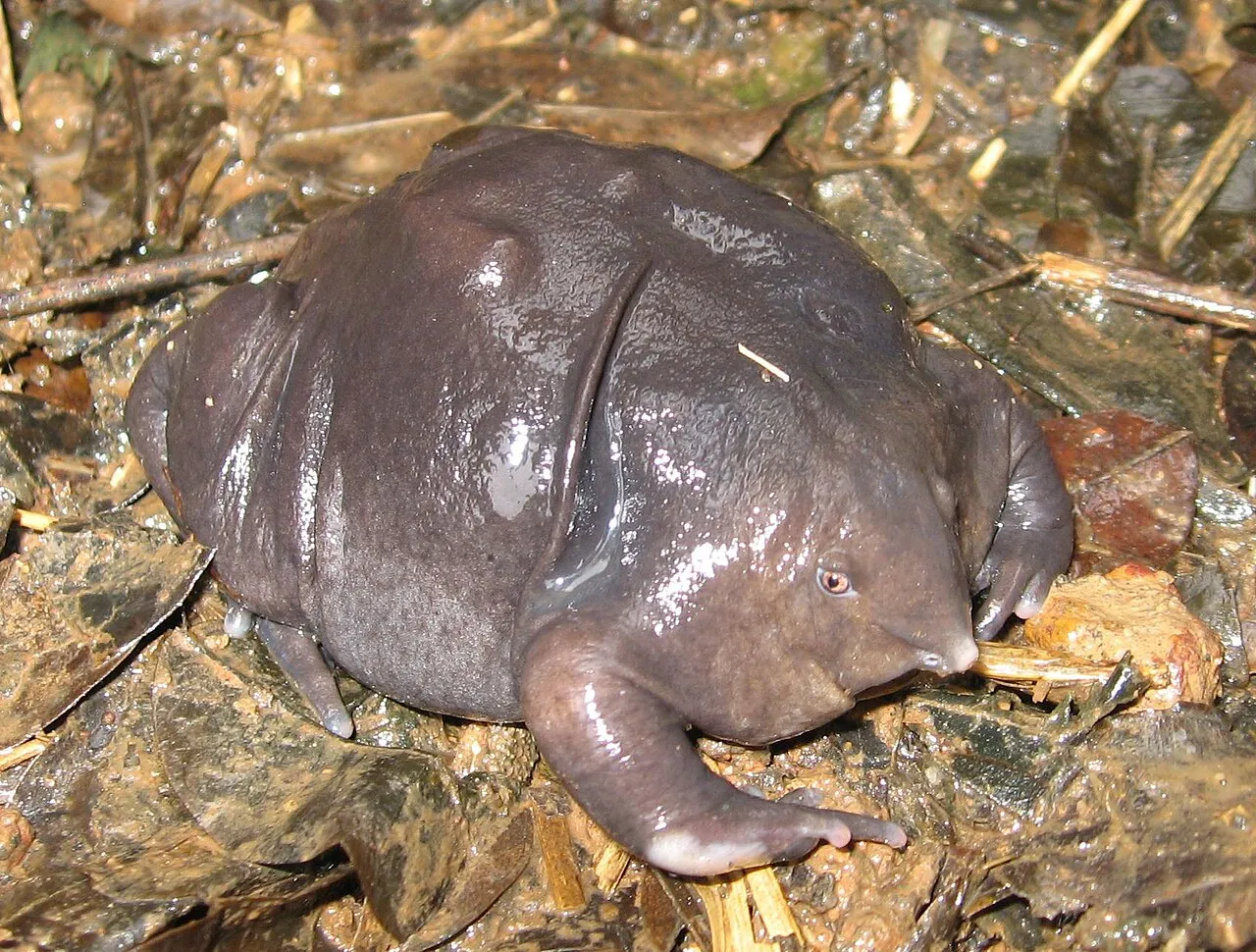
Nasikabatrachus sahyadrensis, the purple frog, is the sole living member of its family, Nasikabatrachidae, and is endemic to the Western Ghats of India, from the Camel’s Hump Hill Range in the north to the northernmost part of the Agasthyamalai Hill Range in the south; earlier records had placed it only south of the Palghat Gap, but its known range has since expanded northward as further populations were found. Its stout, purplish-grey body and pointed snout make it one of the more distinctive frogs on the subcontinent; most of its life, though, is spent out of sight, underground.
Identification
The holotype measured about 70 mm (2.8 in) in snout-vent length, with males markedly smaller than females — roughly one-third their length, a size gap wide enough that the two sexes are easy to tell apart in the hand. The body is rounded and stocky, built for burrowing rather than jumping, with a small head, a pointed, fleshy snout and short limbs set well back on the body. Where most frogs are shaped for leaping and swimming at the surface, the purple frog’s proportions read as those of a species that has traded mobility above ground for efficiency below it. That compact, purplish-grey shape, adapted for a life spent almost entirely underground, is what gives the species its common name.
Habitat and range
The purple frog spends almost its entire life underground in the tropical forests of the Western Ghats, surfacing only during the monsoon, for about two weeks, to mate beside temporary rainwater streams, where females carry males to crevices along the fast-flowing water and eggs are laid and fertilised in a rock pool. For the rest of the year it is effectively invisible to observers working at the surface, which has made basic questions about its population size and density difficult to answer with confidence. Its flattened body helps it cling to submerged rocks in fast-flowing streams during that brief surface window, an adaptation that lets it hold position against the current while breeding, and underground it forages on termites using its tongue and a specialised buccal groove rather than the wide gape typical of surface-hunting frogs. Males call for mates from beneath a thin layer of soil, rarely emerging fully even to breed.
Behaviour and breeding
Most of what is known about the species’ behaviour comes from that short annual window at the surface. Breeding is tied to the monsoon, when the frog surfaces for about two weeks to mate beside temporary rainwater streams, with females carrying males to crevices along the fast-flowing water where eggs are laid and fertilised in a rock pool, and males call from just beneath the soil rather than in the open. Outside that period the frog remains underground, feeding on termites it locates with a tongue and buccal groove adapted for that purpose — a diet and lifestyle more typical of a burrowing invertebrate hunter than of a typical surface-dwelling frog, and one that leaves little trace for researchers to follow between breeding seasons.
Conservation
The species’ facts box carries its current IUCN Red List category, Near Threatened. Its largely subterranean habits make the population difficult to survey directly, since most standard amphibian survey methods rely on encountering animals at the surface or calling in the open, neither of which the purple frog does for most of the year. Its status is tied closely to the condition of the Western Ghats forest streams where it breeds. Adults surface for only a few weeks each year and depend on those streams being intact and fast-flowing at exactly the right moment.
Similar species
As the sole living member of its own family, Nasikabatrachidae, the purple frog has no close look-alikes among India’s other frogs. In the field, its pointed snout, rounded purplish-grey body, short limbs and near-total absence from the surface outside the monsoon breeding season set it apart from any other frog sharing its range in the Western Ghats.