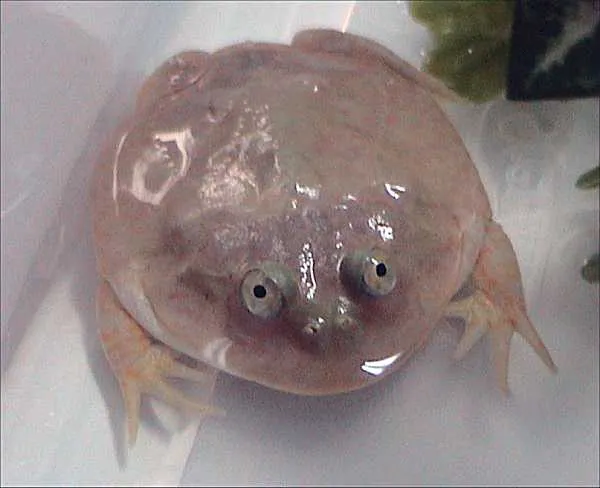
Lepidobatrachus laevis, Budgett’s frog, is a flattened, wide-mouthed frog of the genus Lepidobatrachus. It is native to the Gran Chaco region of South America, commonly observed in Paraguay and Bolivia, and less frequently in Argentina. Its squat body and oversized mouth give it a near-cartoonish look, earning it the common names hippo frog and Freddy Krueger frog, alongside the Spanish name escuerzo de agua. It is still a capable ambush predator, spending most of its life half-buried and waiting for something to swim within reach. The species was first described by the naturalist Budgett in 1899, and its combination of a comical flat shape and alert behaviour has since made it a popular animal in the pet trade.
Identification
The frog has a distinctly flattened appearance, with a large head making up roughly a third of its overall body size. Exact size figures sit in the facts box above; females reach about 100 mm, while males are smaller, sometimes only about half the size of females. The limbs are a small part of the overall picture: they are notably short and stubby, and the forelimbs lack webbing, unlike the hind feet of many pond-dwelling frogs. The mouth is unusually armed for a frog. A row of teeth lines the upper jaw, and two tooth-like projections, often called “fangs,” sit on the lower jaw. Colouring runs dark olive green with darker blotches outlined in orange, and males show a dark blue throat that is not present in females.
Habitat and range
Budgett’s frog lives in the dry and wet Chaco, breeding in shallow temporary pools and artificial ponds. Its range covers the Gran Chaco of South America, most commonly reported in Paraguay and Bolivia and less often in Argentina. When the dry season sets in, it burrows underground and enters a dormant state wrapped in a protective cocoon formed from shed skin, emerging again once seasonal waters return.
As an ambush hunter it is mostly nocturnal, lying submerged up to its nostrils and waiting for prey to pass by before it strikes, then lunging forward to swallow its catch whole rather than tearing it apart first. Reported prey includes other frogs, insects and snails, swallowed whole. Both adults and tadpoles show cannibalistic tendencies when food is scarce, and in practice this extends to anything that fits in the mouth: it will consume any other frog smaller than itself.
Behaviour and breeding
The species has a reputation for aggression well beyond its size. When threatened, it first puffs itself up to look larger than it is, and if that bluff fails it lets out a shrill screech, bites and attempts to corner the threat. That same appetite follows it into the pet trade mentioned above: keepers are advised to house it alone or only with same-species frogs of equal size, since it will eat anything smaller than itself.
Breeding follows the rhythm of the Chaco’s temporary pools: a female can lay up to 1,400 eggs in a single mating, deposited directly into the shallow water that will soon start to dry. Development runs fast, under the same pressure that drives the adult’s dormancy. Embryos develop over about two weeks so tadpoles can metamorphose before their pool disappears. The tadpoles are already predatory by the time they hatch. They are obligate carnivores with jaws nearly as developed as an adult’s, and a gut built for meat rather than algae, and they reach sexual maturity in about a year.
Conservation
The IUCN category is in the facts box above. Wikidata’s assessment places the species at Least Concern, reflecting its wide distribution across the Gran Chaco and a population generally reported as large, though the Chaco does face ongoing habitat loss to agriculture in parts of its range. No evidence points to a rapid population decline, and the species’ tolerance of artificial ponds alongside natural temporary pools likely helps it cope with a changing landscape.
Similar species
The flattened body, enormous mouth and ambush lifestyle recall the horned frogs of genus Ceratophrys, such as Ceratophrys ornata, which shares the same sit-and-wait hunting style and an equally aggressive bite when handled. Budgett’s frog is told apart by its olive-green, dark-blotched colouring with orange outlines and the jaw “fangs” on its lower jaw, rather than the brighter green-and-red patterning typical of Ceratophrys, and by its Gran Chaco range in Paraguay, Bolivia and Argentina rather than the grasslands further east and south.