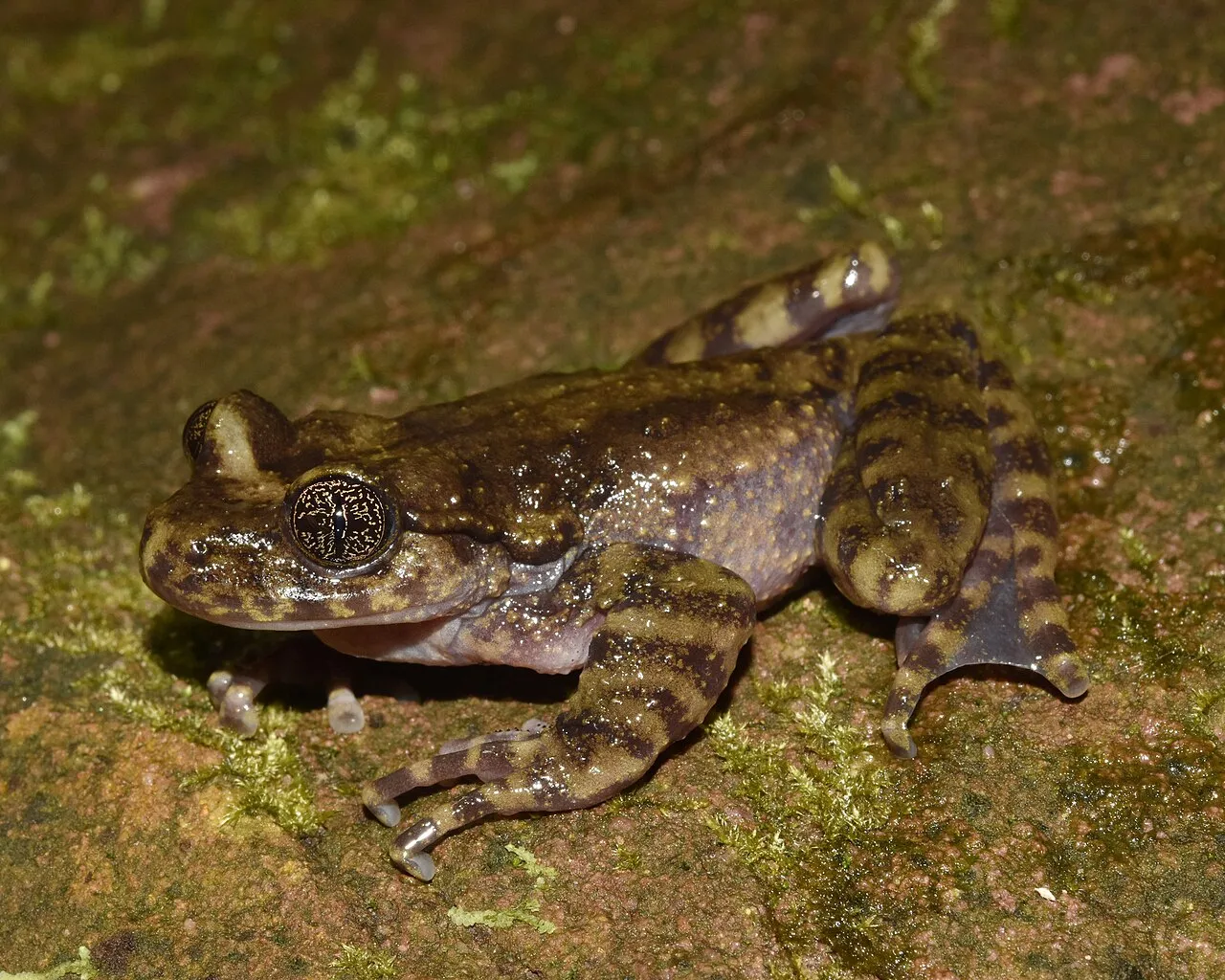
The Natal ghost frog, Hadromophryne natalensis, is a stream-dwelling amphibian of southern Africa’s mountains, first described by the herpetologist John Hewitt in 1913 and now recognised as the only species in the genus Hadromophryne. It is found in Lesotho, South Africa and Eswatini, where it keeps close to the fast water that both it and its tadpoles depend on.
Identification
As the sole member of its genus, H. natalensis is set apart from its relatives in the ghost frog family Heleophrynidae mainly by range and genetics; none of the sources checked for this profile describe one obvious visible feature that does the same. Its larvae are the more distinctive life stage: the tadpoles have broad, suctorial mouthparts and a streamlined body with a muscular tail, letting them feed and hold their position against the current in torrent streams. That sucker-like mouth works much like the specialised mouthparts other torrent-tadpole lineages have evolved elsewhere in the world, an adaptation to clinging to wet rock rather than drifting with the current. No source open to this profile gives a verified adult body length, so that figure is left out of the facts box instead of being guessed at.
Habitat and range
The species lives and breeds in and around fast-flowing, perennial mountain streams, generally above waterfalls that keep fish out; adults shelter in rock crevices in cascades or along the riparian zone, in montane forest and grassland. The waterfalls are not incidental: they form a natural barrier that keeps out fish that would otherwise prey on the slow-developing larvae. Because its larvae take up to two years to complete development, the species depends on permanent streams that never run dry long enough to interrupt that cycle. While feeding, the tadpoles graze on algal films and detritus on the rocks of these torrent streams, a diet that keeps them anchored to the same rock surfaces their mouthparts are built to grip.
Behaviour and breeding
Breeding is tied to the same fast water the tadpoles need to survive: eggs and larvae develop through up to two years in the stream before reaching the land-living adult stage described above, a markedly slower cycle than most frogs’ single wet-season tadpole phase. That extended larval period is also why the species cannot persist in streams that dry up seasonally or are diverted, since any interruption during those two years ends the brood. Adults stay close to the water as they shelter in rock crevices within cascades or the riparian zone along the stream rather than ranging far into the surrounding forest or grassland, a pattern consistent with a species whose whole life cycle is built around a single torrent-stream habitat.
Conservation
The species’ facts box carries its current IUCN Red List category, Least Concern, reflecting its wide range across Lesotho, South Africa and Eswatini. Even so, it faces habitat modification from afforestation, the damming and siltation of streams, and water extraction, and is further harmed by introduced trout that prey on it in its stream habitat. Because its larvae need two full years of uninterrupted, fish-free torrent water, any one of those pressures on a given stream can remove a population even where the species as a whole remains widespread and classified as of least concern.
Similar species
H. natalensis belongs to the ghost frog family Heleophrynidae alongside the genus Heleophryne, a group of similarly torrent-adapted southern African frogs that share the same affinity for fast mountain streams and rock-clinging, suctorial tadpoles. As the only species in its own genus, H. natalensis is distinguished from its Heleophryne relatives mainly by taxonomic placement and geographic range; the sources checked for this profile name no single diagnostic external trait that sets it apart.