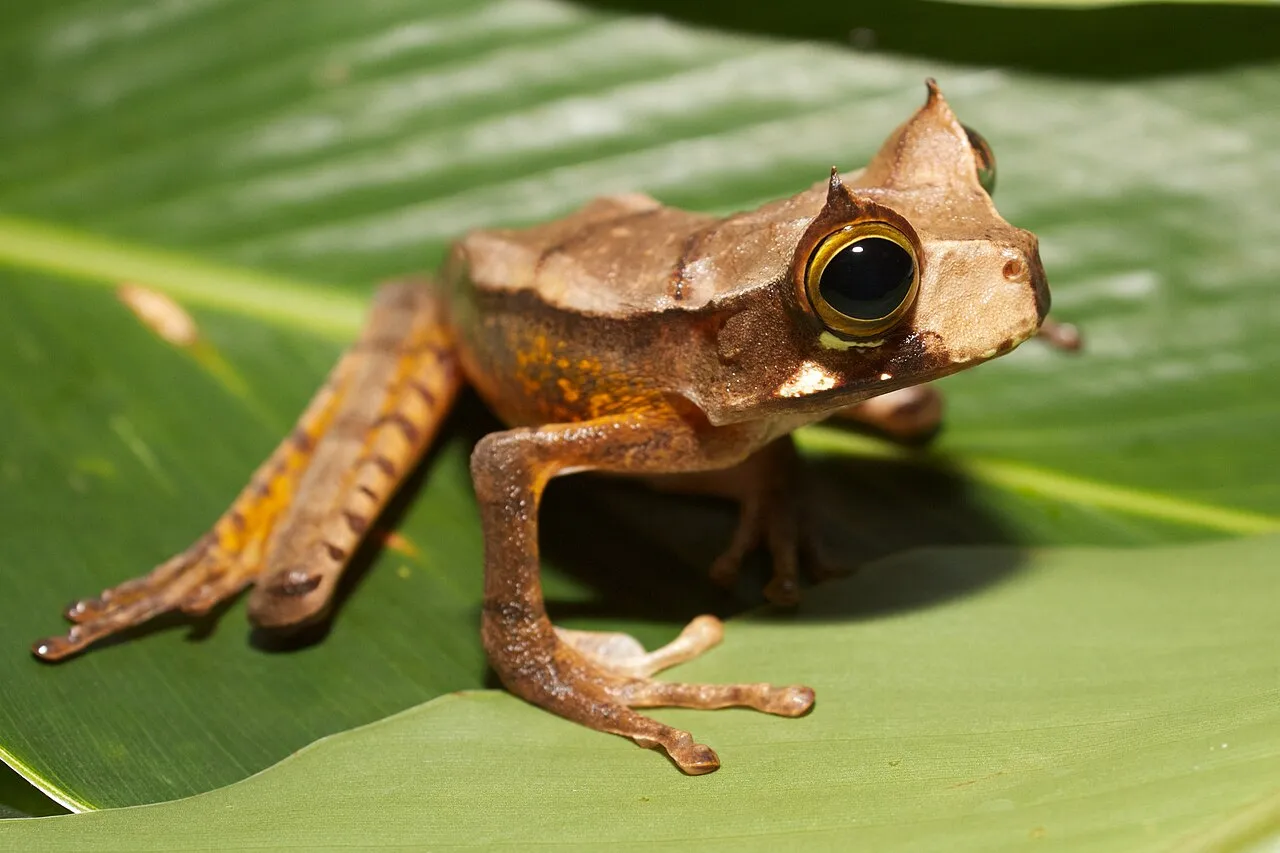
The horned marsupial frog, Gastrotheca cornuta, is a canopy-dwelling tree frog named for the small horn-like projections above its eyes and for the pouch the female carries her eggs in rather than laying them in open water. It occurs in Colombia, Costa Rica, Ecuador and Panama, though it has disappeared from the Atlantic slope of Costa Rica and Panama and declined across much of the rest of its range. Like other members of the genus Gastrotheca, it belongs to the family Hemiphractidae, a group of frogs defined largely by this habit of brooding eggs on or under the back of the female rather than abandoning them to a pond.
Identification
Adults measure about 70–80 mm in length, with a broad head and rounded snout; the facts box carries the exact range. The paired horn-like projections above the eyes are the clearest field mark separating it from other members of its genus, most of which lack them or carry only a low ridge. The skin is rough and warty in typical hemiphractid fashion, an adaptation that, combined with mottled brown and tan tones, helps the frog disappear against bark and lichen-covered branches when it sits motionless by day.
Habitat and range
The species lives high in the canopy of tropical moist lowland forest and montane cloud forest, at 300–700 m on the Atlantic slope of Costa Rica and Panama and 90–1,000 m on the Pacific slope of Colombia, Ecuador and Panama. It is nocturnal, spending the day concealed among epiphytes and foliage well above the forest floor and becoming active after dark. Because it rarely descends to ground level, it is far less often encountered than frogs that breed in streams or pools, and most records of the species come from canopy surveys or chance sightings after storms knock branches down.
Behaviour and breeding
Males call from the canopy with a sound likened to a champagne cork popping, a distinctive advertisement call for a frog rarely seen at ground level. Breeding follows the pattern that gives the genus its common name: females carry fertilised eggs — among the largest known in any amphibian — in a dorsal brood pouch rather than depositing them in a pond or stream. There is no free-living tadpole stage; development runs its full course inside the pouch, and fully formed froglets emerge directly from it, skipping the aquatic larval phase most frogs depend on. That strategy frees the species from any dependence on standing or running water for reproduction, but it also means each clutch is small compared with pond-breeding frogs, since the mother’s back can hold only so many large, yolk-rich eggs at once.
Conservation
The species’ facts box carries its current IUCN Red List category, Critically Endangered, a status consistent with its retreat from the Atlantic slope of Costa Rica and Panama and its broader decline across the rest of its range. Reliance on intact canopy habitat in tropical moist and cloud forest leaves it exposed to deforestation and habitat fragmentation wherever that canopy is cleared or thinned. A frog that depends on continuous, humid canopy cover and breeds without any aquatic larval stage has little capacity to recolonise logged or fragmented forest once it disappears from a site, which helps explain why populations on the Atlantic slope have not recovered even where some forest remains.
Similar species
Other marsupial frogs in the genus Gastrotheca share the same pouch-brooding strategy and direct emergence of froglets, but most lack the paired horn-like projections above the eyes that mark G. cornuta. None of its close relatives yet has a published profile on this site, so it is best distinguished for now by that horned brow, its broad rounded snout and its canopy-dwelling, pouch-brooding biology.