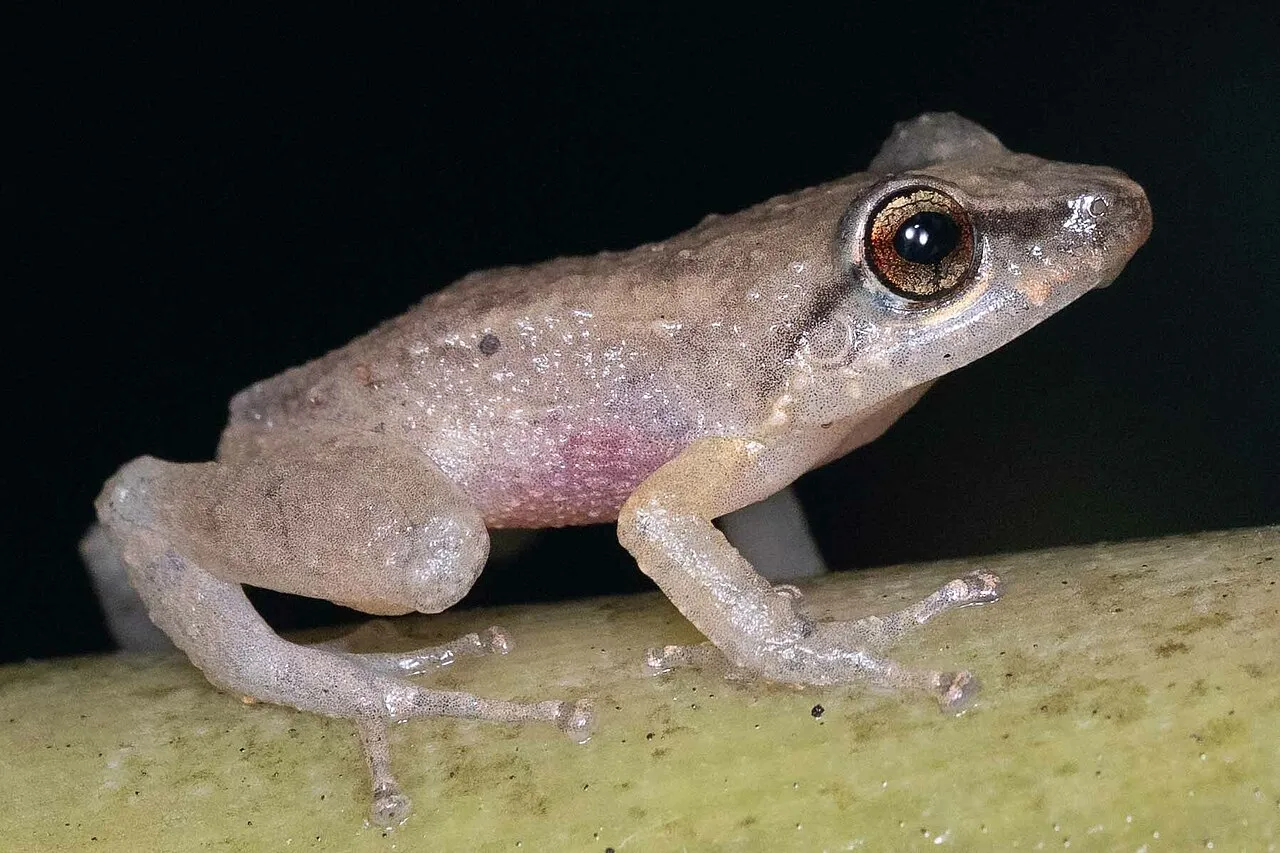
The common coqui, Eleutherodactylus coqui, is native to Puerto Rico and the nearby islands of Vieques and Culebra, where it is the most abundant frog, with densities estimated at 20,000 individuals per hectare. Its name echoes the two-note call of the males, a sound so closely tied to the islands that the frog has become an unofficial cultural symbol there. That call has followed the species well beyond its home range: introduced populations are established in Hawaii, Colombia and the U.S. Virgin Islands, while earlier introductions in the Dominican Republic, Louisiana and Florida have since been eradicated.
Identification
The species shows clear size differences between the sexes: adult males measure 30-37 mm snout-vent length, averaging 34 mm, while females are larger at 36-52 mm, averaging 41 mm; the facts box carries the full range. Body size is not fixed across its range, either: it increases with elevation, so coquis living higher in Puerto Rico’s central mountains tend to grow larger than those found near the coast. That elevation effect, combined with the sexual size difference, means a single population can span most of the species’ known size range, from a small lowland male to a large highland female.
Habitat and range
The common coqui is a habitat generalist, occupying mesic broadleaf forests, mountains and urban areas across its native islands. It shelters by day in bromeliads, tree holes, and under trunks, rocks or trash, tucking into any moist crevice it can find. The species needs moisture but not standing water, which sets it apart from frogs that depend on ponds or streams to complete their life cycle, and helps explain why it turns up in gutters, potted plants and shipping containers as readily as in forest. In Puerto Rico it ranges from sea level up to 1,200 m elevation, a spread that, combined with its tolerance for disturbed and urban ground, helps explain why it reaches such high densities across the island.
Behaviour and breeding
Much of what is best documented about the common coqui concerns its ecology rather than its courtship. Its adaptability as a habitat generalist that needs moisture but not standing water is also what has made it such a successful coloniser outside Puerto Rico, with established populations now breeding in Hawaii, Colombia and the U.S. Virgin Islands. Its signature two-note call carries across forest and neighbourhood alike, audible through the night across the full elevation range the species occupies, from sea level to 1,200 m.
Conservation
The species’ facts box carries its current IUCN Red List category, Least Concern, reflecting its enormous native population and secure status across its range. The same density that makes it common at home, up to 20,000 individuals per hectare, has made it a nuisance species where introduced, notably in Hawaii, where residents and wildlife managers have worked for years to control its spread; the islands it occupies naturally have no comparable native predator pressure to keep numbers in check. Conversely, the eradication of introduced populations in the Dominican Republic, Louisiana and Florida shows that early intervention against new introductions can succeed.
Similar species
Within its native Puerto Rico, the common coqui shares the genus Eleutherodactylus and the family Eleutherodactylidae with several related species, many of which are also small, well-camouflaged frogs of forest leaf litter and foliage. Its two-note call, combined with its sexual size difference — males at 30-37 mm against larger females at 36-52 mm — are the field marks that separate it from relatives of similar build. Where it has been introduced, its call is often the first and clearest sign of its presence, since the frog itself is small and rarely seen by day, sheltered as it is in bromeliads, tree holes or under trunks and rocks.