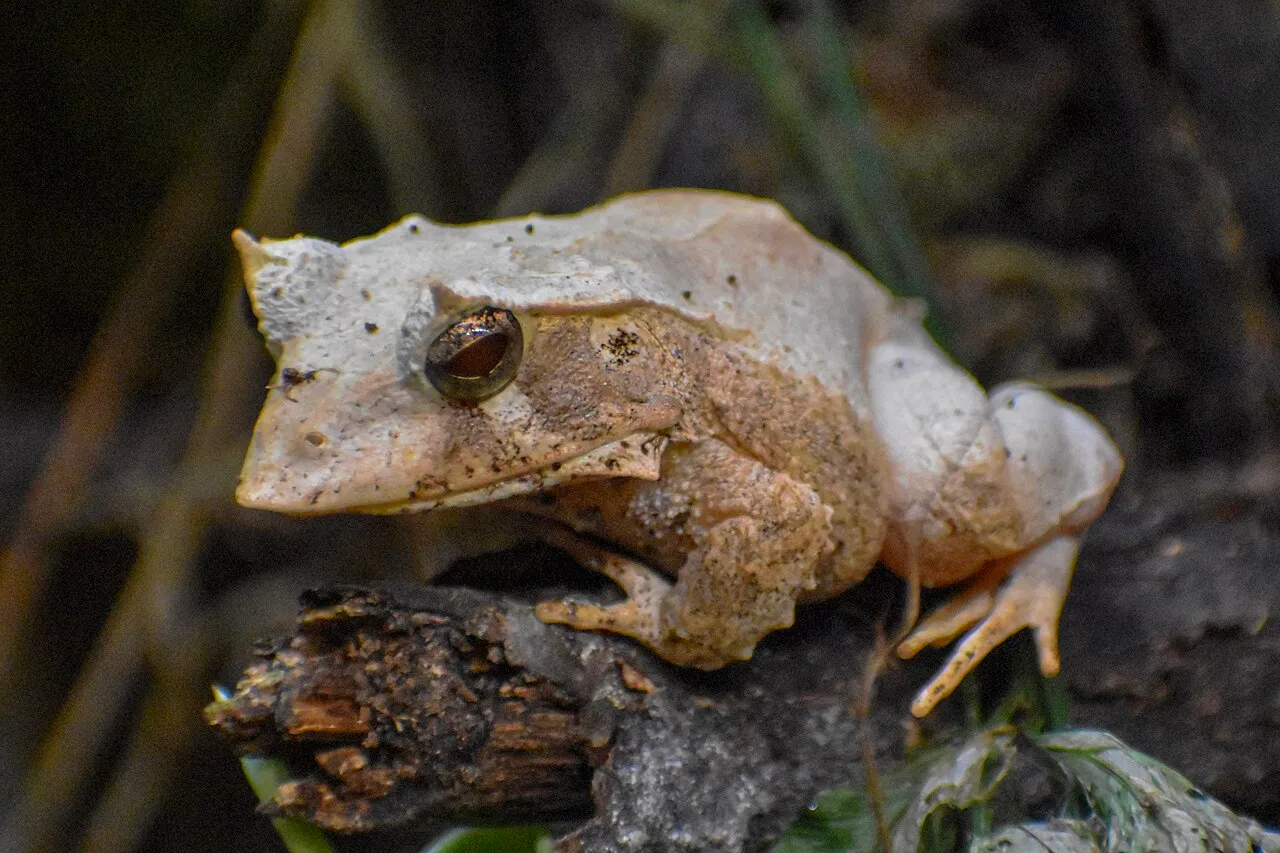
The Solomon Island leaf frog, Cornufer guentheri, is a forest-floor species found throughout the Solomon Islands archipelago, including Bougainville in the Autonomous Region of Bougainville, Papua New Guinea, but absent from San Cristobal, from sea level up to about 830 m elevation. It skips the tadpole stage entirely: eggs hatch directly into fully formed froglets, an adaptation that frees it from needing standing water to breed. Boulenger first described the species in 1884, originally placing it in the genus Ceratobatrachus; it is also known by the common names Solomon Island eyelash frog and Günther’s triangle frog.
Identification
Adults reach about 76–100 mm in length, with females larger than males. Cryptic brown colouring and leaf-shaped folds along the back camouflage the frog among leaf litter on the forest floor, the same markings visible in the live photograph above, taken at Cologne Zoo. The camouflage is effective from the start of life: newly emerged froglets measure only about 3 mm long when they hatch, already shaped like miniature adults rather than passing through a distinct larval body plan. The ridged eyelids and pointed snout visible in the photograph are typical of the species and, together with the mottled dorsal pattern, make it easy to mistake for a curled dead leaf when it sits motionless among litter. The frog belongs to the family Ceratobatrachidae, in the genus Cornufer, and was originally described under the now-synonymous name Ceratobatrachus guentheri before later taxonomic work moved it into Cornufer; the old genus name survives in one of its common names, Günther’s triangle frog, a nod to the pointed, almost horn-like projections above each eye that break up its outline further still.
Habitat and range
The species occupies forest floors of tropical rainforest across the Solomon Islands, and also tolerates secondary forest, rural gardens and other human-modified habitats. It has been described as abundant throughout the Solomon Islands, a breadth of habitat use that spans from undisturbed primary forest to land already cleared or replanted by people. Its camouflage lets it sit still and ambush passing prey rather than actively hunting, and its tolerance of disturbed ground beyond primary forest likely helps it persist across a wide elevation range, from the coast up to roughly 830 m. That range covers most of the archipelago’s forested terrain, from lowland coastal strips to mid-elevation slopes, while the species’ absence from San Cristobal shows that even a wide-ranging, adaptable frog does not necessarily reach every island in a chain. The presence of a population on Bougainville, politically part of Papua New Guinea rather than the Solomon Islands state, is a reminder that the archipelago’s biogeography does not follow modern borders: the island chain forms a single, largely continuous forest system that this frog has colonised from end to end regardless of which country administers a given stretch of it.
Behaviour and breeding
C. guentheri has direct development with no free-living tadpole stage: eggs are laid in small hollows at the base of trees and hatch directly into fully formed froglets, skipping the aquatic larval phase most frogs depend on. That reproductive strategy removes any need for ponds, streams or other standing water nearby, which helps explain why the species can breed successfully in gardens and secondary forest as readily as in untouched rainforest. Diet shifts with age — juveniles eat tiny insects, while adults take insects, other arthropods, smaller amphibians and small reptiles, including other individuals of their own species. Adults are ambush predators that pounce quickly on prey animals rather than pursuing them, relying on camouflage and stillness to let prey approach within striking range. That willingness to eat smaller frogs, cannibalism included, fits a sit-and-wait hunter that takes whatever prey of a suitable size comes within reach, including its own kind when the opportunity arises.
Conservation
The facts box carries the species’ current IUCN Red List category. Its wide distribution across the Solomon Islands archipelago and its tolerance of secondary forest and modified habitats, rather than dependence on undisturbed primary rainforest alone, likely support that status: a frog able to breed without standing water and to forage in gardens as well as forest is less exposed to any single threat than a habitat specialist would be. The most recent IUCN assessment of the species dates to 2020.
Similar species
No other Cornufer species profile is yet published on this site; its leaf-mimicking folds, cryptic brown colouring and direct-development breeding — skipping any free-living tadpole stage — set it apart from frogs that rely on ponds or streams to breed.