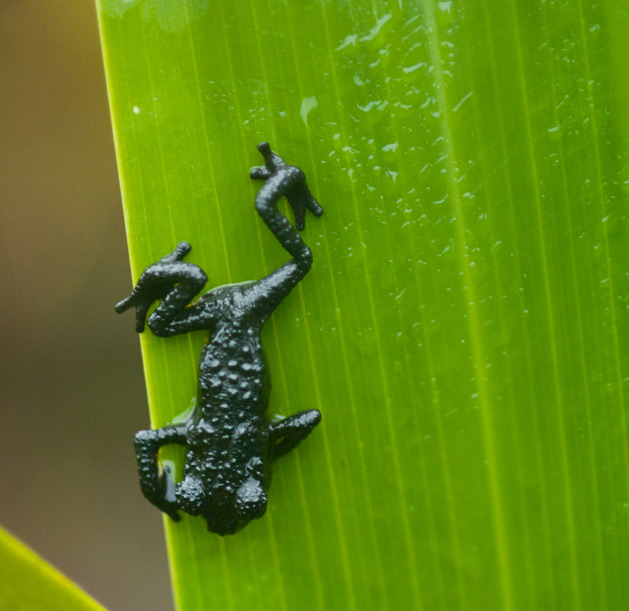
Oreophrynella quelchii: Discovering the Remarkable Pebble Toad of Venezuela’s Lost World#
High atop Venezuela’s ancient flat-topped mountains known as tepuis, shrouded in mist and isolated from the familiar earthly landscapes below, exists one of the most remarkable amphibians on Earth: Oreophrynella quelchii, commonly called the Pebble Toad. Deceptively ordinary at first glance, this extraordinary species harbors an astonishing secret—one so dramatically surprising it seems artfully designed by evolution itself.
When threatened, Oreophrynella quelchii performs an unexpected feat, curling into a ball and tumbling down the rough, rock-strewn cliffs of its mountainous home. Through this extraordinary behavior, the Pebble Toad escapes swiftly from predators, turning defensive strategy into an evolutionary marvel that astounds researchers and nature lovers alike.
Named after the explorer J.J. Quelch, who first documented the species during a pioneering expedition, Oreophrynella quelchii is more than just a curious natural oddity. As we’ll discover, this unassuming amphibian plays a unique, vital role in its ecosystem, facing threats from climate change and habitat disruption that lend urgency to understanding and protecting its hidden life among the clouds.
Taxonomy and Classification#
Within the diverse world of amphibians, Oreophrynella quelchii belongs to the Bufonidae family, widely recognized as the “true toads.” The genus Oreophrynella itself is quite distinctive, home to several uniquely adapted species found exclusively atop the tepuis of the Guiana Highlands of northern South America. These flat-topped plateaus became biological islands over millions of years through intense erosion, creating a perfect evolutionary crucible in which species like Oreophrynella quelchii would evolve independently of their lowland relatives, yielding unusual characteristics that fascinate evolutionary biologists and naturalists alike.
Natural Habitat#
A World Isolated in the Clouds#
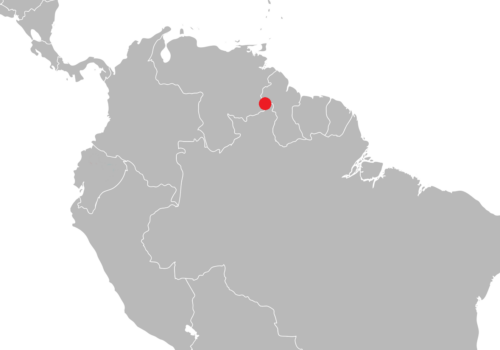
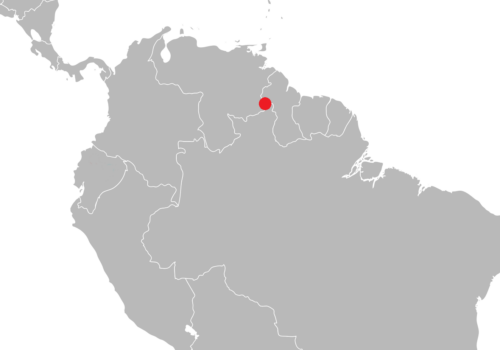
Oreophrynella quelchii makes its home solely on the summits and upper slopes of Mount Roraima and surrounding tepuis—a vast, isolated world surrounded by dramatic cliff faces soaring thousands of feet into perpetually shifting clouds. Straddling the borders of Venezuela, Guyana, and Brazil, Mount Roraima stands like a grand sentinel, a landscape sprinkled with quartz-lined valleys, isolated pools, carnivorous pitcher plants, and miniature mossy forests—the perfect, surreal habitat for an amphibian species this uniquely evolved.
There, amidst this mystical landscape, Oreophrynella quelchii spends its entire life cycle. Its chosen habitats weave seamlessly through rock crevices, moist patches of vegetation, and sheltered, humid microclimates. Adapted superbly to these challenging environments, their presence signals an ecosystem uniquely driven by isolation, moisture, altitude, and temperature stability, conditions found only atop these remarkable tepuis.
Physical Characteristics#
A Living Stone#
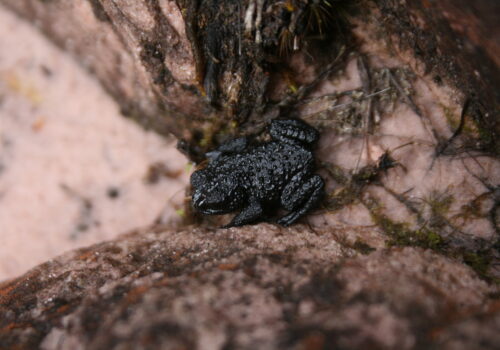
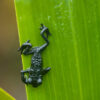
Oreophrynella quelchii would likely go unnoticed by a casual observer were it not for its compelling adaptations. Measuring barely an inch (2-2.5 cm), these tiny toads sport dark, often mottled bodies that blend uncannily into the stone and moss-covered rocks surrounding them. Their rough-textured skin, adorned with pebble-like bumps, mirrors the rugged terrain so precisely that, when stationary, Oreophrynella quelchii visually disappears—effectively camouflaged among the ancient rocks that provided their name and inspiration.
Adaptations for Survival in Extreme Elevation#
Evolution has honed Oreophrynella quelchii’s anatomy perfectly for survival above cloud level. Their short legs and rigid limbs, built for steady gripping of rock surfaces rather than jumping prowess, give rise to their unusual movement choices. The stout build, combined with powerful musculature and extraordinary skin texture, allows them to curl tightly into a defensive pose. This tightly compact body form enables their incredible tumbling escape maneuver, turning them into living stones, bouncing safely down slopes where would-be predators couldn’t dare to follow safely.
Behavior and Life Cycle#
A Spectacular Defensive Strategy#
In what may be one of nature’s most breathtaking defensive adaptations, Oreophrynella quelchii, when faced with danger (such as predatory snakes or birds), immediately curls into a near-perfect sphere, tense muscles pressing firmly for safety. Once secure, it launches itself into a rolling descent, bouncing and tumbling among rocky outcroppings without risk of serious injury. Thanks to their sturdy build and specially adapted skin, these tumbles cause minimal harm, allowing the Pebble Toad to quickly recover and continue its hidden existence.
Feeding Habits and Prey Preferences#
Oreophrynella quelchii feeds primarily on small insects and arthropods, carefully stalking prey within the moist crevices amid the sparse vegetation strips of tepui summits. Their keen perception of vibration and movement aids in prey detection. Ants, springtails, mites, and small flies constitute the usual diet—sustenance modest enough for survival in these nutrient-poor environments.
Breeding and Development Amidst Clouds#
Remarkably, these amphibians have adapted their reproductive strategy to thrive at high altitudes, where permanent water bodies may be rare and nutrient scarcity is common. Unlike many toads and frogs that require standing water, Oreophrynella quelchii lays eggs in moist moss or shallow, ephemeral pools formed from persistent mist and rainfall. This adaptation guarantees a successful lifecycle under the strict conditions imposed by their habitat.
Eggs and subsequent tadpoles benefit from the microhabitats uniquely available atop the tepuis, developing rapidly in cool temperatures amid consistently moist environments. Tadpoles exhibit strikingly small shapes and streamlined body ratios, optimizing their survival in temporary moisture scoops rather than lakes or ponds.
Ecological Role#
Although minuscule in size and rarely seen by human eyes, Oreophrynella quelchii plays notable ecological roles within its isolated habitat. By consuming various small insects, this amphibian helps control populations of arthropods, subtly maintaining ecological balance. Conversely, despite their unique escape strategies, young and adult Pebble Toads occasionally become prey themselves, allowing higher-altitude predators to sustain a balanced ecosystem, linking predator-prey dynamics and forming a complex, thriving high-altitude community.
Moreover, their health and population stability serve as valuable indicators of the local ecological integrity—a catalyst for awareness to climate change impacts and habitat degradation at altitudes most vulnerable to global temperature shifts and moisture fluctuations.
Threats and Conservation Status#
Oreophrynella quelchii’s restricted and isolated habitat leaves it uniquely vulnerable. Listed currently by the IUCN as “Vulnerable,” the species faces sharp threats from habitat disturbance, climate change-induced shifts in cloud cover patterns and moisture distribution, as well as increased human tourism and exploration.
Because the tepuis represent islands of unique biodiversity, slight climate shifts can cascade rapidly through these fragile ecosystems. Variability in rainfall, persistent droughts, and irregular cloud formation can disrupt moisture-dependent lifecycles, jeopardizing reproduction and survival. Furthermore, as ecotourism increases, so does risk of habitat degradation, introduction of invasive species, and environmental contamination.
However, conservation strategies and public awareness campaigns are taking shape, combining scientific research, protection measures, and community education through ecotourism best-practices to ensure the survival of these remarkable creatures.
Cultural and Scientific Significance#
Beyond ecological intrigue, Oreophrynella quelchii holds compelling scientific and cultural significance. As a poster species for the fascinating biodiversity inhabiting the tepuis—often described poetically as “islands in time”—they enable insights into evolutionary biology, species divergence, and speciation.
Species like Oreophrynella quelchii become living laboratories for understanding evolution in action, demonstrating firsthand the processes of adaptation, reproductive specialization, and ecological balance within isolated ecosystems. They symbolize resilience in a rapidly changing world, embodying messages for conservation responsibility and preservation ethics.
Conclusion#
Oreophrynella quelchii exemplifies the marvels of natural selection embedded within the spectacular landscapes of Venezuela’s cloud-crowned tepuis. Their unique survival strategies inspire awe, their ecological role sustains delicate biodiversity balances, and their precarious future signals vital conservation lessons.
Let us celebrate Oreophrynella quelchii for the scientific curiosity it ignites, the ecological significance it underlines, and the urgent conservation it represents. By deepening our knowledge and advocating actively for their protection, we contribute collectively toward safeguarding the wondrous biodiversity hidden among the clouds.