The Secret Life of Nimbaphrynoides occidentalis: West Africa’s Enigmatic Live-bearing Frog#
Hidden amidst the lush, misty cloud forests of Guinea’s Nimba Mountains thrives an inconspicuous but utterly fascinating amphibian—Nimbaphrynoides occidentalis, commonly known as the Western Nimba Toad. Unlike many frogs, this modest creature defies traditional amphibian life cycles, skipping the aquatic tadpole stage completely in favor of live births, earning it a special place in amphibian lore. These tiny inhabitants of the West African highlands are not merely biological curiosities; they symbolize both nature’s immense creativity and its intrinsic vulnerability.
Barely larger than a fingernail and cloaked in subtle patterns that blend seamlessly with their habitat, the story of Nimbaphrynoides occidentalis challenges traditions and inspires awe among biologists and casual nature observers alike. Join us in discovering this remarkable amphibian, uncovering its hidden world, its ecological importance, and the passionate efforts underway to protect its rapidly vanishing environment.
Taxonomy and Classification#
Nimbaphrynoides occidentalis belongs to the order Anura, distinguished by tailless amphibians such as frogs and toads. Within Anura, it finds its family among Bufonidae, traditionally referred to as “true toads.” However, the genus Nimbaphrynoides is anything but traditional. Unique adaptations have set these species apart, making them an exciting area of research within evolutionary biology.
The genus name, Nimbaphrynoides, pays tribute to Mount Nimba, a UNESCO World Heritage site straddling Guinea, Liberia, and Côte d’Ivoire. Considered evolutionary outliers, these frogs diverged significantly from their counterparts, developing fascinating reproductive traits to flourish at higher, isolate altitudes.
Natural Habitat#
A Sanctuary Among the Clouds#
The Western Nimba Toad inhabits a very specific ecological niche—Montane grasslands and subtropical cloud forests above 1,200 meters elevation around the Nimba Mountains. The climate in this mountainous region is characterized by frequent fogs, consistent drizzle, and a delicate interplay of sunlight and shadow, creating an ethereal landscape where moisture sustains a rich mosaic of plant life.
Within this specialty environment, the frog’s survival depends on abundant leaf litter, moss-covered stones, and dense ground vegetation. Deep inside these carpets of green, dampness is constant, and temperatures remain stable—creating an essential microclimate for these sensitive amphibians.
The Importance of Microhabitats#
Carefully adapted to the forest floor’s microhabitats, Nimbaphrynoides occidentalis thrives in relative seclusion, hidden beneath decomposing leaves, mossy logs, and small rocky crevices. This microhabitat supports not only a high humidity necessary for their sensitive skin but also supplies ample insects and small invertebrates—essential prey for these diminutive carnivores.
Physical Characteristics#
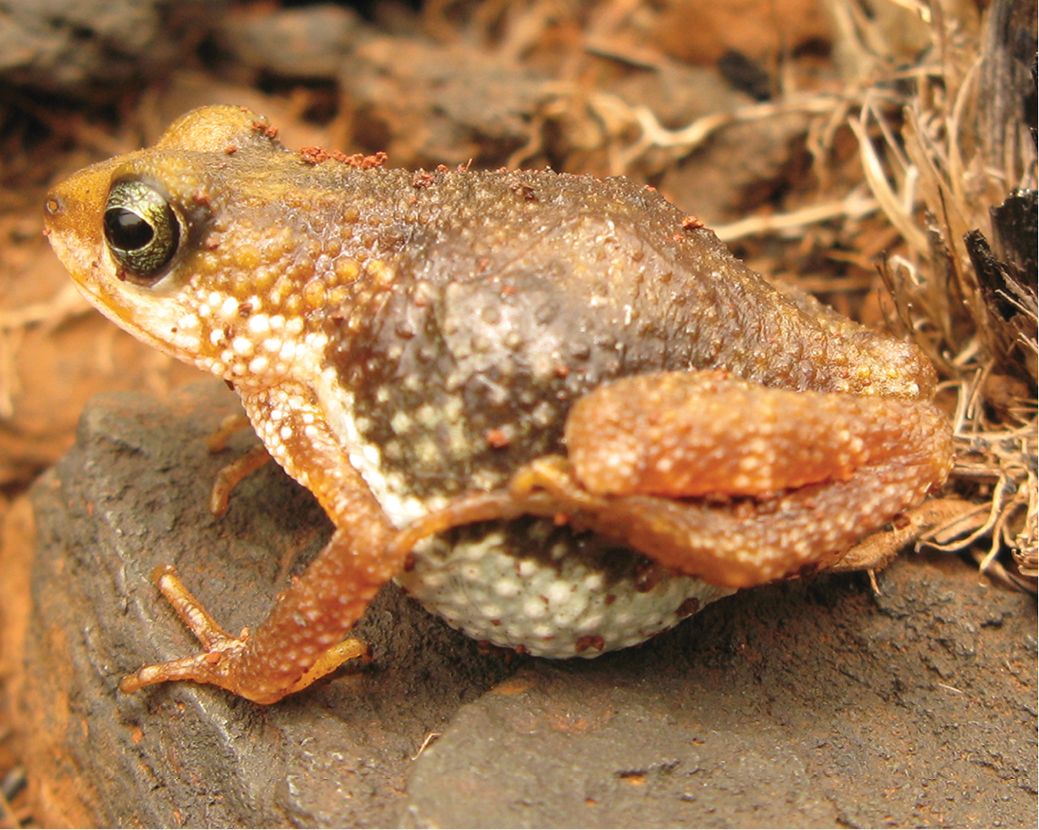
At first glance, the Western Nimba Toad might seem rather unremarkable due to its diminutive size and understated coloration. Individuals generally measure no more than 20 millimeters in total length, easily fitting on the tip of a finger. But a closer inspection reveals subtle beauty. Its body, robust yet delicate, is compact with well-developed limbs appropriate for navigating intricate forest floor habitats.
Covered in shades of golden-brown, olive, and light gray, the frog boasts patterns of speckles and subtle patches perfectly suited for camouflage in their leaf-litter habitat. Slightly rough skin textures complement this propensity for inconspicuousness, seamlessly blending them into their surroundings, making them virtually invisible to predators and researchers alike.
Perhaps their most-riveting characteristic is their thoughtful evolutionary strategy: though tiny and seemingly vulnerable, these amphibians achieve reproductive success through an extraordinary form of viviparity—giving birth to fully developed live young. This unique adaptation transforms their biology into something extraordinary and deeply intriguing.
Behavior and Life Cycle#
The Remarkable World of Live-Bearing Frogs#
Unlike traditional amphibian life cycles, where eggs hatch into aquatic tadpoles which must mature externally, Nimbaphrynoides occidentalis breaks all rules. Females retain their fertilized eggs internally for extended development periods, ultimately producing fully formed froglets capable of terrestrial life from birth—a strategy known as ovoviviparity or viviparity, rare amongst amphibians. This remarkable live-bearing approach allows offspring to bypass vulnerable aquatic stages fraught with predation risks and uncertain water availability.
During breeding seasons—which correspond with local rainfall and humidity peaks—the males signal their presence with a soft but distinctive chirping call, barely audible to human observers. Males attract females with their delicate chorus, and mating takes place in near silence and subtlety in dense understory vegetation.
Females nurture their internally growing offspring through yolk-based nourishment, safeguarding them from the harsh external environment until ready for birth. Each litter generally ranges from four to twelve offspring, each remarkably precocious and immediately independent, ready to feed on minuscule insects and mites right after emerging into the misty cloud forest environment.
Ecological Role#
The Western Nimba Toad’s role within its ecosystem extends beyond its striking reproductive novelty. Amphibians often function as pivotal players in ecological networks, serving simultaneously as predator and prey. These frogs consume significant numbers of able-bodied insects, spiders, mites, and other small arthropods, helping regulate invertebrate populations and contributing to the ecological balance within their compartmentalized forest community.
Conversely, they also represent critical prey species for birds, mammals, and reptiles inhabiting these mountain ranges. Their population health thus indicates overall ecosystem stability, reinforcing their biological status as critical indicator species—ecologically valuable sentinels whose fate mirrors broader environmental conditions.
Threats and Conservation Status#
An Amphibian on the Brink#
Sadly, despite their extraordinary adaptation and specialized habitat, Nimbaphrynoides occidentalis faces substantial threats. Classified by the International Union for Conservation of Nature (IUCN) as Critically Endangered, this species is under severe pressure, primarily due to habitat loss resulting from mining, deforestation, agriculture, and climate change impacts.
Mining operations for iron ore near Mount Nimba have substantially altered habitats, destroying essential cloud forest ecosystems and constricting the already narrow refuge suitable for this highly specialized frog. Increasing agricultural encroachment and wood harvesting compound habitat fragmentation, pushing populations to isolated patches and threatening genetic flow and survival.
Climate Change and Disease Threats#
Moreover, amphibians globally face additional unseen threats, notably with climate disturbance and diseases like amphibian chytridiomycosis. Temperature fluctuations and unpredictable precipitation shifts within cloud forests affect humid niches required for these frogs’ reproductive success and offspring survival—threatening their long-term viability.
Cultural and Scientific Significance#
The distinctiveness of amphibians often places them centrally in local folklore and traditions. Although direct cultural beliefs specifically surrounding Nimbaphrynoides occidentalis are poorly documented, amphibians in West African communities hold symbolic significance, often representing fertility, renewal, and environmental health.in a broader sense Any decline among such remarkable creatures could diminish cultural heritage and tradition-based respect for biodiversity among communities nearby.
Scientifically, this species has deepened our understanding of evolutionary biology, viviparity among vertebrates, and adaptation to extreme ecological niches. Research conducted on these frogs has revealed fascinating insights into evolutionary pressures—forging tangible connections between biodiversity preservation, ecological networks, and evolutionary studies.
Conclusion#
Nimbaphrynoides occidentalis, West Africa’s astonishingly adapted live-bearing amphibian, offers invaluable insights into ecological adaptation and evolutionary marvels. Yet it’s also a poignant symbol for the cascading impacts of habitat destruction, climate change, and biodiversity loss.
By appreciating and understanding the significance of the small but mighty Western Nimba Toad, we are reminded of nature’s fragility and resilience—and our collective responsibility to secure a future where wildlife and human cultures both flourish. Support conservation initiatives protecting cloud forest ecosystems and advocate for sustainable policies, securing habitats for these miraculous frogs and countless other species. Our efforts today determine whether the future holds abundant life or silent forests.