Nectophrynoides vestergaardi: The Fascinating Tale of Tanzania’s Tiny Jewel#
Hidden deep amidst the lush montane forests of Tanzania, nestled quietly beneath tangled vines, moss-covered logs, and layers of fallen leaf litter, thrives one of East Africa’s most remarkable yet obscure amphibians—Nectophrynoides vestergaardi. A miniature jewel of the forest floor, this extraordinary frog species weaves together aspects of biological wonder, ecological significance, and conservation urgency. Its enigmatic presence speaks to nature’s boundless capacity to astonish and inspire us.
Belonging to a remarkable genus of viviparous amphibians, Nectophrynoides vestergaardi harbors fascinating biological secrets worthy of attention and care. Unlike most frogs, its young bypass the typical tadpole stage entirely, entering the world fully formed and ready to embrace their verdant habitat. A tiny titan of biological intrigue, this frog casts a spotlight on the beauty, fragility, and interconnectedness of the forest ecosystem it calls home.
Taxonomy and Classification#
Nectophrynoides vestergaardi belongs to the Bufonidae family, more commonly known as true toads, within the genus Nectophrynoides. As with its close relatives within this genus, including Nectophrynoides asperginis and Nectophrynoides viviparus, it shares the distinctive characteristic of viviparity—bearing live young rather than laying eggs in water.
First scientifically described by herpetologist Jean-Luc Perret in 1980, this diminutive amphibian was named to honor Danish biologist Mogens Vestergaard—a testament to its scientific value and the collaborative spirit of biological research.
Natural Habitat#
This stunning little amphibian is endemic to the lush montane regions of Tanzania, specifically inhabiting the Udzungwa Mountains, part of the renowned Eastern Arc Mountain range—a biodiversity hotspot celebrated for its astonishing array of life-forms. Within this landscape, Nectophrynoides vestergaardi prefers humid, closed-canopy montane forest environments, flourishing in shady areas thick with layers of decomposing foliage, moss cushions, and dense, moisture-retaining vegetation.
These habitats lie between 1,200 and 2,000 meters above sea level, where humidity remains consistently high, and temperatures remain stable. The dense forest undergrowth provides essential protection from predators, ensuring ample concealment and moisture necessary for this delicate species’ survival.
The Ecological Niche: Life beneath the Leaf Litter#
The forest floor, teeming with biodiversity, provides not only shelter but also the necessary microhabitat conditions most suitable for Nectophrynoides vestergaardi. Here, amid decaying leaves and fallen branches, nutrients cycle swiftly, facilitating the growth of fungi, small insects, and arthropods—all pivotal components of this frog’s diet. Their lives proceed quietly, hidden from view, immersed in the continual rhythm of forest life.
Physical Characteristics#
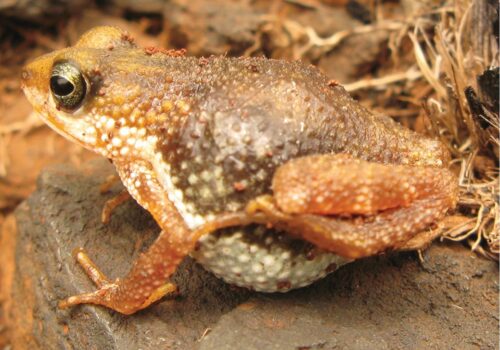
The charm of Nectophrynoides vestergaardi largely stems from its minuscule size. Adult individuals typically measure no more than 20 millimeters in length, barely the size of a human thumbnail. Despite its diminutive stature, its physical appearance is remarkably captivating, with subtly textured skin adorned in earthy shades of browns, greens, and speckled grays. This nuanced coloration lends them incredible camouflage, a crucial adaptation aiding their survival amid the forest floor’s varied shades and shadows.
Their eyes, large and protuberant, gleam like tiny black pearls, designed to detect subtle movements of prey and predators through dense foliage. Interestingly, their limbs are proportionally sturdy, facilitating precise leaps between leaves and logs—a behavior necessary for both predator avoidance and efficient foraging.
Unique Adaptations#
Among their adaptations, the most remarkable is their viviparous reproduction. Rather than laying eggs in ponds as most other frogs do, these amphibians give birth to live offspring directly onto land—thereby eliminating the tadpole stage altogether. This unique reproductive strategy allows them to colonize terrestrial habitats far removed from standing water, granting adaptability in secluded montane environments.
Behavior and Life Cycle#
These diminutive forest dwellers live quiet, secretive lives. Primarily nocturnal, they remain inconspicuously hidden during daylight hours beneath leaf litter or in moss-covered decaying logs—a strategy protecting them from visually oriented predators. Nightfall signals an awakening; under cover of darkness, these frogs carefully navigate through dense undergrowth in search of food, primarily consuming ants, beetles, mites, and other forest-floor invertebrates.
Mating and Reproduction#
During breeding season, males emit soft, melodious calls from concealed locations beneath vegetation, attempting to attract females and ward off rival males. Once a suitable mate approaches, courtship behavior ensues—subtle yet intricate rituals culminating in fertilization.
Embryonic development occurs entirely within the female’s body, providing vital moisture and nutrients necessary for embryo survival. Female Nectophrynoides vestergaardi will then give birth to several fully developed, miniature froglets, each immediately independent and well-equipped for life within their leafy world.
Ecological Role#
In its niche, this remarkable amphibian is both predator and prey; it contributes significantly to regulating insect populations on the forest floor. Simultaneously, it provides sustenance for larger predators, including small reptiles, predatory invertebrates, and occasional birds. Through such interactions, Nectophrynoides vestergaardi remains vital in maintaining ecological balance and ensuring the ongoing biodiversity of their delicate forest ecosystem.
Moreover, being highly sensitive to environmental changes, these tiny frogs serve as vital bioindicators. Their abundance or decline reveals shifts in the overall health of their habitats, echoing louder ecological messages about the state of the natural world.
Threats and Conservation Status#
Regrettably, Nectophrynoides vestergaardi faces an uncertain future. Listed by the International Union for Conservation of Nature (IUCN) as Critically Endangered, the species suffers significantly from habitat destruction, largely driven by deforestation for agriculture and timber extraction, and from increasingly evident effects of climate change. Restricted to a narrow geographic range, habitat disturbances pose severe threats to their very survival.
Conservation Efforts and Initiatives#
Recognizing these threats, conservationists and researchers are active in local and regional efforts. Several protected areas, such as the Udzungwa Mountains National Park, provide crucial refuges where forests remain intact and safeguarded. Active monitoring, research endeavors, local community engagements, and conservation education are essential aspects of ongoing conservation strategies.
Conserving this species requires broader ecosystem-level interventions—for protecting frogs equates to protecting entire forests, preserving watersheds, and securing biodiversity. Their survival ultimately reinforces the intricate interconnection between human communities and the natural world around them.
Cultural and Scientific Significance#
Locally, amphibians like Nectophrynoides vestergaardi hold subtle yet symbolic importance. While perhaps small and easily overlooked, in many local narratives these frogs symbolize nature’s quiet persistence, intensified through their remarkable resilience and adaptability in challenging environments.
Scientifically, the species excites researchers keenly studying amphibian reproductive biology, viviparity evolution, and the effects of climate on biodiversity. Furthermore, studies conducted on their population dynamics serve as valuable lenses by which conservationists worldwide assess ecosystem health amidst ongoing ecological threats.
Conclusion#
In its humble existence, Nectophrynoides vestergaardi embodies nature’s delicate wonder, a species whose life cycle fascinates science and enriches biodiversity. Their perilous state calls not only for immediate conservation efforts but also for broader ecological awareness among us all.
Let the quiet voice of Tanzania’s diminutive forest gem echo louder—inspiring action, responsibility, and respect toward the world’s fragile ecosystems. A newfound appreciation and renewed stewardship can secure futures not merely for this remarkable frog, but for countless interconnected species, habitats, and indeed, our very selves.
“`