- Nectophryne afra: The Enigmatic African Tree Toad and Its Vanishing World
- Taxonomy and Classification: Placing the African Tree Toad Among Amphibians
- Natural Habitat: Life within West Africa’s Rainforest Canopies
- Physical Characteristics: Quiet Beauty in Subtle Camouflage
- Behavior and Life Cycle: A Secretive Symphony above the Forest Floor
- Ecological Role: The Subtle Threads of Rainforest Biodiversity
- Threats and Conservation Status: A Fragile Existence in a Changing World
- Cultural and Scientific Significance: Connecting Communities and Researchers
- Conclusion: Embracing a Small Species with Big Ecological Significance
Nectophryne afra: The Enigmatic African Tree Toad and Its Vanishing World#
Within the dense, humid embrace of West and Central Africa’s lush rainforests hides an elusive, captivating creature, often overlooked yet immensely significant: Nectophryne afra. Known colloquially as the African tree toad, this small amphibian offers an extraordinary glimpse into nature’s bewildering canvas, where even small creatures embody complex evolutionary adaptations. Though often overshadowed by larger and more charismatic species, the story of Nectophryne afra reminds us of nature’s subtle artistry and resilience.
Measuring merely centimeters but bursting with delightful aberrations, this amphibian’s peculiar presence underscores important ecological truths. Imagine a creature, adorned subtly yet exquisitely in earth-toned patterns, living secretively among tropical foliage, calmly traversing leafy canopies far above the eyes of casual observers. With fingers perfectly adapted for strolling delicate tree branches and calling quietly through rain-damp nights, this species creates a tiny chapter in the grand, interconnected story of its rainforest home.
Taxonomy and Classification: Placing the African Tree Toad Among Amphibians#
Scientifically termed Nectophryne afra, this enchanting species is classified within the Bufonidae family. Though its family is best known for true and often terrestrial toads, Nectophryne afra remarkably diverges with its arboreal niche, presenting understated uniqueness that underscores nature’s boundless creativity. Classified within the genus Nectophryne, a group distinguished by their preference for arboreal habitats and distinctive breeding behaviors, Nectophryne afra aligns closely with select species of forest-adapted frogs and toads sharing similar traits and lifestyles.
Among the modest yet diverse assemblage of species in the genus Nectophryne, the African tree toad presents a distinctive case due to its notable distribution and well-documented status compared to congeners. As a member of the Bufonidae, it holds intriguing evolutionary connections with terrestrial counterparts, highlighting a fascinating ecological divergence as a tree-dwelling amphibian adapted specifically for canopy life.
Natural Habitat: Life within West Africa’s Rainforest Canopies#
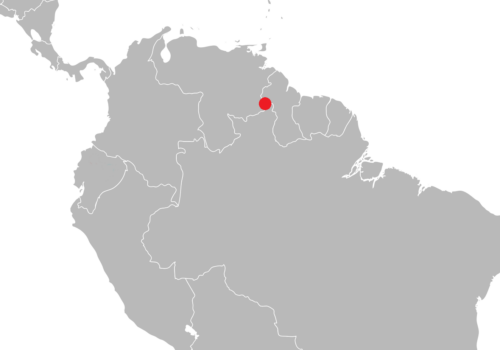
The African tree toad occurs primarily across the tropical reaches of West and Central Africa, notably in regions from Nigeria to Cameroon, Gabon, Equatorial Guinea, and the Democratic Republic of Congo. Within this expansive and diverse range, the species exclusively inhabits lowland rainforests, places profoundly marked by verdant vegetation, high humidity, and a relentless, life-sustaining rainfall. Here, the tree toad remains relatively concealed, thriving amidst complex vegetation comprising twisting vines, sprawling epiphytes, ferns, dense leaves, and thousands of plant species that build this labyrinthine ecosystem.
The microhabitats preferred by Nectophryne afra center around shaded, moisture-rich zones—often in proximity to small streams or temporary pools on the forest floor. Exceptional as an arboreal-dwelling toad, it is typically encountered perched quietly on broad leaves or creeper vines just above moist habitats during rainy periods. Its adaptability melds perfectly with canopy life, exploiting niches delicately balanced by rainfall rhythms, humidity, and meticulously woven plant networks providing shelter, sustenance, and breeding grounds.
Physical Characteristics: Quiet Beauty in Subtle Camouflage#
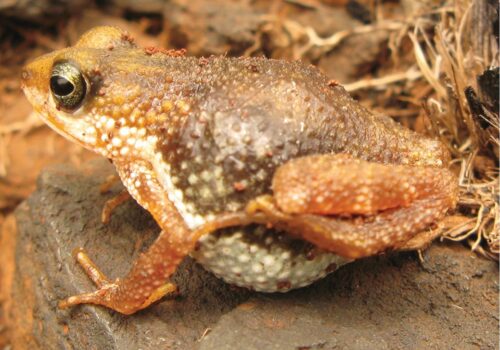
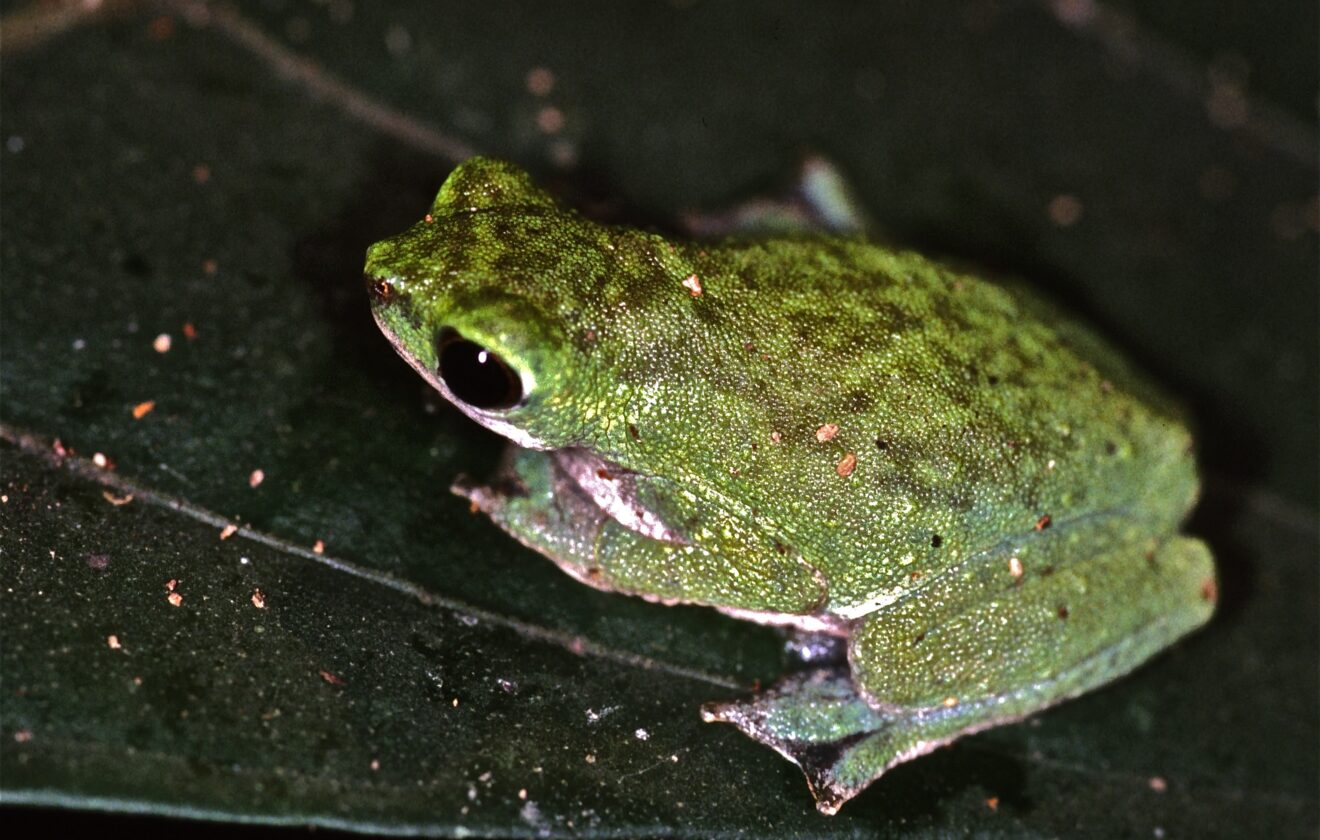
The subtlety of the African tree toad’s physical appearance aligns harmoniously with its secretive lifestyle. Typically modest in size—averaging around 30-40 millimeters in adult length—Nectophryne afra strikes a delicate balance between discretion and charm. Its coloration remarkably matches the rainforest background: shades of brown, tan, or dark green interlaced with speckles or mottling appear carefully coordinated to blend seamlessly amid foliage and stems. The toad’s skin texture, somewhat rough and uneven, further facilitates concealment among veined leaves and moss-covered branches.
Perhaps the most notable physical adaptation of this species is its set of expanded discs on the tips of its slender fingers and toes, which afford exceptional grip as it navigates its arboreal homes. This adaptation distinguishes its behaviorally unique ecological niche. Unlike terrestrial toads, which exhibit powerful hind limbs suitable for hopping across soil or dense leaf litter, Nectophryne afra relies on delicate, deliberate climbing maneuvers enabled by these specialized digits—highlighting an incredible evolutionary trade-off forged amid temperate foliage.
Behavior and Life Cycle: A Secretive Symphony above the Forest Floor#
Feeding Habits and Foraging Behavior#
The African tree toad, inherently nocturnal, emerges cautiously from hiding spots after sunset in pursuit of a diet primarily consisting of small insects and arthropods. Its large, expressive eyes are vastly more adept at absorbing limited light than human vision, allowing expert detection of prey movements even in dim nocturnal vistas. Using stealthy, deliberate advances along branches, leaves, and trunks, it secures meals through quick flicks of its specialized tongue. Its calm, patient hunting strategy underscores its energy-efficient lifestyle, necessary within an environment abundant in competition yet delicate in prey availability.
Reproduction and Parental Strategies#
Reproduction in the African tree toad intensifies during the wet season, as scenes of courtship accentuate the humid tropical nights. Male Nectophryne afra subtly serenade potential female mates with gentle calls, emitted rhythmically from concealed leaf perches, creating an intricate auditory layer enveloping the forest canopy. These mating calls, softer and less intrusive than some of their amphibian counterparts, encourage brief but meaningful interactions in leaf-covered, private micro-ecosystems above flowing streams and ponds.
Females deposit small clutches of eggs typically attached securely on leaves hanging just above sheltered pools, dew-covered leaves, or shallow streams. When larvae are ready, rainfall diligently aids their descent into waiting aquatic nurseries. The ensuing tadpoles progress quickly, demonstrating an adaptive acceleration to complete their development and metamorphosis before ephemeral pools vanish. Once mature, emergent juveniles cautiously ascend back into their arboreal territories, perpetuating this remarkable cyclical renewal within the rainforest canopy.
Ecological Role: The Subtle Threads of Rainforest Biodiversity#
While small in stature—a mere arboreal resident quietly eking out existence amidst more charismatic wildlife—the ecological functionality performed by Nectophryne afra takes on immense meaning. Serving both as predator and prey, it participates significantly in controlling insect populations, consequently benefiting vegetation and indirectly supporting crop protection for people residing near forest boundaries. Birds, snakes, and small mammals find nourishment in these amphibians, inserting the tree toad crucially into diverse food webs sustaining complex rainforest diversity.
Moreover, due to its sensitivity to environmental shifts—particularly humidity, rainfall patterns, and habitat quality—this toad serves as a sensitive biological indicator. Through its abundance, distribution, and health, conservationists gain valuable insights into environmental stability and early warnings for broader ecological disruptions within vulnerable tropical ecosystems.
Threats and Conservation Status: A Fragile Existence in a Changing World#
The current conservation outlook for Nectophryne afra echoes broader ecological concerns haunting forests in tropical Africa. While still relatively common across suitable habitats, the species faces direct threats from deforestation, habitat fragmentation, and pollution of freshwater habitats. Logging operations, agriculture expansion, and human settlements progressively encroach upon pristine rainforests, shrinking and fragmenting territories essential for its survival.
The IUCN Red List currently classifies Nectophryne afra as Least Concern due to its widespread distribution; however, localized populations confront increasing pressures. Habitat disruption renders breeding pools scarce or contaminated, thus jeopardizing successful reproduction cycles. Climate change exacerbates these challenges, altering rainfall patterns and humidity levels critical to the species’ ecological strategy. Conservation actions centered around habitat protection, careful ecosystem monitoring, and community awareness become urgently necessary.
Cultural and Scientific Significance: Connecting Communities and Researchers#
While less renowned culturally than more visually spectacular or charismatic animals, Nectophryne afra subtly enchants local human communities. Many indigenous groups perceive small frogs and toads as important rainmakers or harbingers of fortune, underscoring symbolic interconnections between nature and local cultural heritage. Scientifically, researchers increasingly study its physiology, behavior, and ecological interactions, contributing priceless data for understanding rainforest dynamics and climatic responses.
Conclusion: Embracing a Small Species with Big Ecological Significance#
The gentle, quiet life of the African tree toad, Nectophryne afra, symbolizes myriad subtle intersections of forest biodiversity, emphasizing delicate ecological balances dictated entirely by nature’s nuanced wisdom. Safeguarding this species—and the habitats supporting it—matters profoundly in protecting tropical ecosystems vital for biodiversity, scientific discovery, and cultural vitality. Every advocacy action, conservation choice, or sustained awareness—no matter how small—makes a difference, echoing louder in nature’s magnificent but fragile rainforest symphony.