- Mertensophryne Usambarae: The Secretive Jewel of Tanzania's Rainforests
- Taxonomy and Classification: Understanding Its Scientific Identity
- Natural Habitat: A Misty Mountain Refuge
- Physical Characteristics: Camouflaged Wonders of the Forest Floor
- Behavior and Life Cycle: A Secretive Existence Revealed
- Ecological Significance: Keystone Indicators of Forest Health
- Threats and Conservation Status: A Fragile Future
- Cultural and Scientific Significance: From Hidden Symbol to Scientific Insight
- Conclusion: Protecting a Biodiversity Gem
Mertensophryne Usambarae: The Secretive Jewel of Tanzania’s Rainforests#
Hidden in the verdant mountains of Eastern Tanzania, cloaked in misty forests and resonant with the gentle whispers of passing streams, lives a small, enigmatic amphibian known to science as Mertensophryne usambarae. This seldom-seen yet fascinating frog, belonging to the Bufonidae family, embodies the intricate beauty and delicate balance of East Africa’s unique mountainous ecosystems. Despite its elusive nature, the Usambara forest toad serves as a vital ecological indicator, reminding us of the fragility and complexity inherent within Tanzania’s biodiversity-rich habitats.
Did you know that this petite amphibian’s secretive lifestyle and highly specific habitat preferences make it exceptionally sensitive to environmental change? Such subtle creatures often carry huge ecological significance and can provide early warnings of wider ecosystem health.
Taxonomy and Classification: Understanding Its Scientific Identity#
Mertensophryne usambarae, or Usambara forest toad, belongs to the Bufonidae, commonly termed the true toads. Bufonidae frogs encompass a staggering diversity, spread globally, each possessing unique adaptations to specific habitats. Within this rich family, the genus Mertensophryne, named after the distinguished German herpetologist Robert Mertens, represents an especially intriguing group largely confined to Eastern Africa.
This genus is characterized by small-sized toads exhibiting cryptic coloration and highly specialized habitat requirements. M. usambarae was scientifically described relatively recently, underscoring the careful nature required to discover such cryptic species. Its close relatives, each equally fascinating, share similar habitat preferences, living concealed amid damp forest leaf-litter and mosses, quietly narrating their evolutionary journeys through subtle biological details.
Natural Habitat: A Misty Mountain Refuge#
The Eastern Arc Mountains: Tanzania’s Biodiversity Hotspot#
High in the Eastern Arc Mountains, among the rolling clouds of the Usambara mountain range, the habitat preferred by Mertensophryne usambarae unfolds like pages in an ancient storybook. Recognized worldwide for their exceptional biodiversity, these montane rainforests shelter countless species found nowhere else on Earth, thriving on steep slopes rich in humidity and perpetually drenched by gentle rains. Among the moss-covered boulders and thick vegetation, the Usambara forest toad finds refuge, protected from the harsher conditions common in neighboring lower altitudes.
This ecosystem’s structural complexity—a mosaic of fallen logs, tangled plants, and rich decomposing vegetation—provides both shelter and sustenance. The forest understory, shadowed by towering ancient trees draped in epiphytes and orchids, acts like a biological haven, ensuring that smaller residents such as Mertensophryne usambarae can flourish. Temperature, humidity, and shade all collide harmoniously, offering the perfect microclimate to sustain this exceptional amphibian.
The Role of Moisture and Microhabitat#
Unlike many other amphibians known for their versatility, the Usambara forest toad requires a finely-tuned habitat—places kept continually damp by mountain mists and frequent rain showers. Rainfall seeps into every layer of organic debris, forming shallow puddles and slow-moving trickles ideal for breeding and shelter. Leaf litter provides essential hiding spots from aerial predators and dangerous terrestrial insects, thereby assisting the toad’s survival strategy of concealment and cautious activity.
The delicate balance of this mountainous rainforest ecology makes the species particularly vulnerable. Minor shifts in temperature or rainfall patterns resulting from global climate change can profoundly affect their survival, emphasizing their sensitivity and underlining the importance of safeguarding such habitats.
Physical Characteristics: Camouflaged Wonders of the Forest Floor#
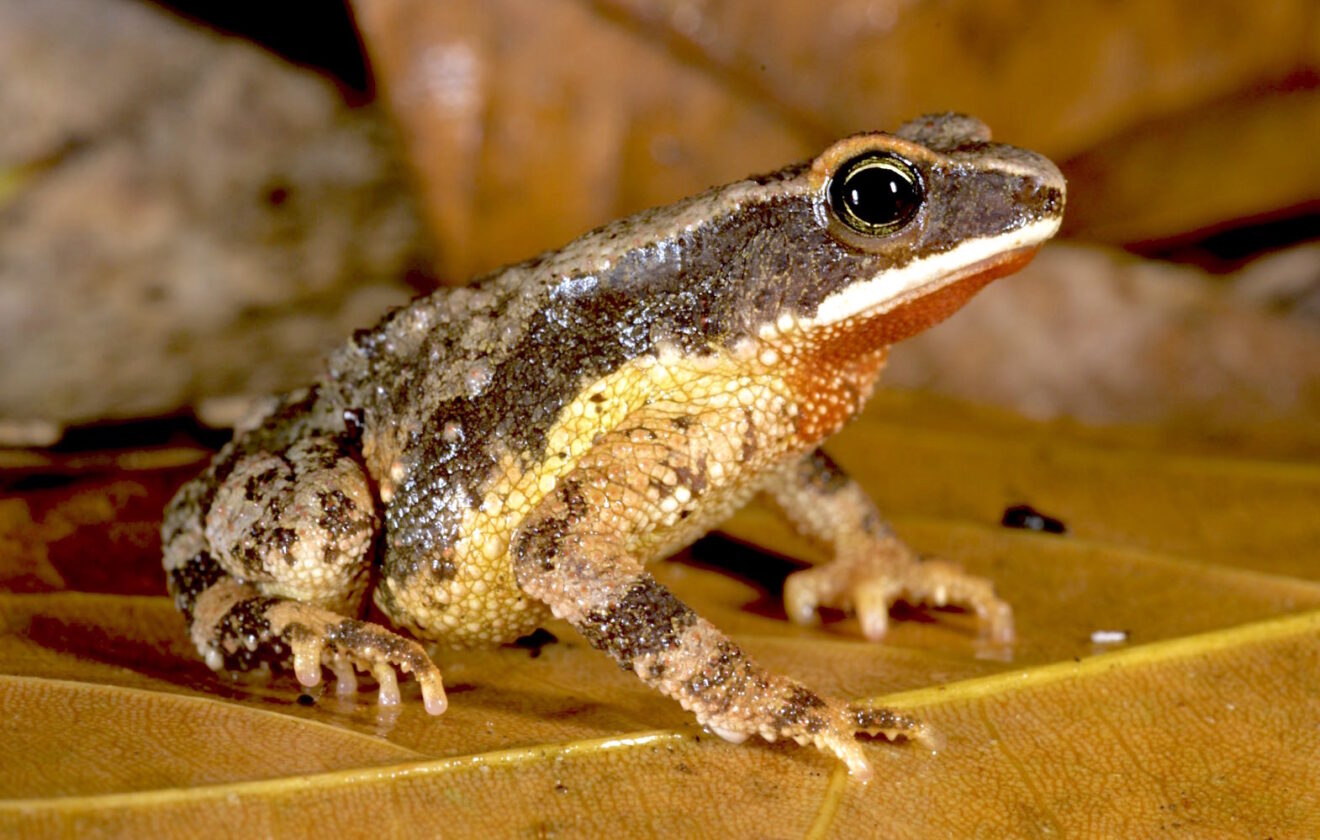
Observing Mertensophryne usambarae in its natural habitat demands patience and keen eyesight, for its physical traits grant it an almost ghostly ability to blend seamlessly into its surroundings. Mature individuals measure approximately 20-30 millimeters, their compact and robust bodies well-adapted to their lifestyle on the forest floor.
The skin texture alone is an ecological marvel—rugose, intricately marked by bumps and ridges that mimic the irregular outlines of moss, bark fragments, or moist leaf litter. Subtle earth-tones predominate their coloration, varying from muted greys and browns to rich, mossy greens. This mimetic camouflage allows them to remain unnoticed, even to a vigilant predator scanning closely through the leaf litter for a meal.
Powerful yet small limbs support their delicate frame, assisting them in careful, deliberate movement through dense vegetation and detritus. Particularly intriguing are their relatively large eyes, equipped to gather the minimal available light penetrating the dense canopy above. This nocturnal visual adaptation allows keen awareness of their surroundings, critical when movements must be limited during daylight hours.
Behavior and Life Cycle: A Secretive Existence Revealed#
Nocturnal Hunters Under Moonlit Skies#
The life of the Usambara forest toad unfolds primarily beneath the protective cloak of darkness. Nightfall sees them emerging cautiously from under dense vegetation to hunt their favorite prey: small insects, spiders, and arthropods abundant on the forest floor. Silent ambush and patient waiting rather than active pursuit dominate their hunting methodologies. Their large, sensitive eyes, adapted to low-light conditions, grant them an advantage by allowing them to accurately detect even the subtlest prey movements.
Reproductive Behaviors: Small Streams and Quiet Romance#
The breeding strategy of this species, although elusive, aligns closely with other montane amphibians. Courtship typically follows seasonal rains, initiating a gentle chorus of subdued calls, softly resonating through the evening mist. Males specifically, concealed near shallow freshwater streams or small forest pools, issue these calls to attract mates.
Egg-laying occurs in these pristine freshwater habitats. Females deposit delicate strings or clusters of eggs carefully attached to submerged vegetation or rocks. Tadpole development aligns with seasonal changes, ensuring larvae can exploit temporal pond habitats freshly replenished through rains.
Ecological Significance: Keystone Indicators of Forest Health#
The complex ecosystems of the Eastern Arc Mountains intimately integrate each creature, intricately linked through a delicate food web. Small amphibians like Mertensophryne usambarae embody vital trophic-level participants, controlling insect populations while providing sustenance to higher predators, including birds and small mammals. Most significantly, as indicator species, these amphibians reflect broader ecosystem health. Diminished amphibian populations often signal underlying environmental problems, including pollution, deforestation, climate change, or disease outbreaks.
Their ecological value extends beyond their small, localized habitats. Monitoring their population stability or shifts provides invaluable insights, thus guiding broader ecological conservation strategies.
Threats and Conservation Status: A Fragile Future#
As with many amphibians worldwide, Mertensophryne usambarae faces numerous anthropogenic threats. Habitat loss and fragmentation due to agriculture, logging, and human encroachment significantly endanger their limited mountainous environments. Climate variability further compounds these pressures, altering rainfall patterns and jeopardizing the species’ life cycle rhythm.
The International Union for the Conservation of Nature has yet to extensively assess this cryptic species, but related species in similar habitats frequently carry vulnerable statuses, underscoring the need for targeted conservation attention. Dedicated habitat restoration efforts, sustainable land-use planning, and targeted research remain paramount for securing viable future populations.
Cultural and Scientific Significance: From Hidden Symbol to Scientific Insight#
Beyond ecology, species like Mertensophryne usambarae often carry cultural symbolism within local communities. While definitive cultural references specific to this species are sparse, amphibians in general symbolize fertility, renewal, and environmental harmony in many cultures—a powerful notion that resonates globally amid ecological crises.
Scientifically, cryptic species like this forest toad illuminate evolutionary biology principles, revealing adaptation mechanisms, mimicry strategies, and ecological specialization. Scientists continuously study these creatures to glean insights into the mechanisms necessary for survival in challenging, rapidly changing environments.
Conclusion: Protecting a Biodiversity Gem#
Mertensophryne usambarae, though hidden and humble, carries profound ecological and scientific weight. Conserving its habitat secures not only this unique species but a complex web of biodiversity and ecosystem services critical for both nature and humanity. Let their quiet, cryptic lives remind us of the responsibilities we have toward stewardship, inspiring us to protect and cherish the incredible biodiversity within Tanzania’s mountain forests—before it is too late.