- Mertensophryne schmidti: Discovering the Secretive Life of Schmidt's Forest Toad
Mertensophryne schmidti: Discovering the Secretive Life of Schmidt’s Forest Toad#
Beneath a vibrant canopy of lush foliage, nestled among the verdant hills and humid river valleys of East African forests, lies a creature so modest and mysterious that even keen-eyed naturalists might pass it by unnoticed. Meet Mertensophryne schmidti, commonly known as Schmidt’s forest toad—a modest amphibian species bound by the delicate threads of its forest ecosystems. Though small and unassuming at first glance, this creature harbors profound ecological significance, serving as both an indicator of environmental health and a custodian of biological secrets scientists are still unraveling.
You may have never heard of this toad before, but Schmidt’s forest toad quietly plays a crucial role beneath the dense foliage of East Africa’s woodlands. With habitats growing increasingly fragile due to human influence, the story of this amphibian takes on a new urgency, a powerful testament to the interconnected web we share with other organisms, whether noticeable or not.
Taxonomy and Classification#
Mertensophryne schmidti is a member of the Bufonidae family—the “true toads”—comprising nearly 600 species across the globe. Within this vast family, its genus, Mertensophryne, represents a cluster of specialized, primarily forest-dwelling amphibians, adapted uniquely to the microhabitats of Eastern Africa.
Though sometimes confused with similar toads due to subtle outward appearances, Schmidt’s forest toad is identified through detailed morphological analysis by experts. The classification highlights intricate evolutionary distinctions shaped by millions of years of geographic isolation and ecological specialization. Its closest relatives include other members of the genus, notably the forest-adapted toads of Tanzania and Kenya, sharing similar lifecycles and habitat preferences.
Natural Habitat#
Geographic Range#
Native primarily to the east African regions, Schmidt’s forest toad inhabits an ecological belt ranging from Tanzania through portions of Kenya. Their range might appear deceptively broad until you observe the strict reliance these creatures have on particular microhabitats within this region.
Habitat Preferences#
Unlike their more adaptable cousins, Schmidt’s forest toads thrive exclusively within moist, shaded forests and woodland edges. Their presence signifies habitats maintaining high humidity and relatively stable temperatures. A mosaic landscape of leaf litter, fallen branches, scattered moss, and fern-covered grottos constructs the perfect sanctuary for their delicate, porous skin.
These toads are rarely encountered in overly exposed areas or in severely degraded habitats. Instead, they hide amongst fallen leaves or take refuge in moist crevices, quietly abiding beneath expansive leafy coverings that keep their skin damp and protected. This specialized habitat preference underscores their vulnerability to habitat fragmentation and environmental disturbances.
Physical Characteristics#
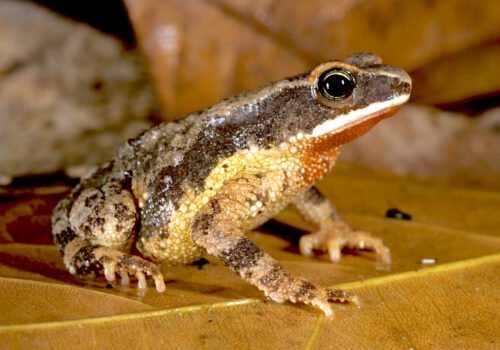
At first glance, Schmidt’s forest toad might seem unremarkable: small-bodied, cryptic in coloration, barely noticeable among the lush greenery that surrounds it. Typically measuring between 20 to 40 millimeters in length, their small size belies their fascinating biological traits and adaptations. They feature earthy colorations—usually shades of brown, gray, or olive-green—that allow seamless camouflage within forest litter and humid duff layers.
The subtlety of their appearance, however, holds an evolutionary masterpiece. Intricate patterns of darker patches or freckles create cryptic designs, aiding them against predators—mainly birds, snakes, and larger amphibians. Their dorsal surface exhibits rough, wart-like textures, enhancing their appearance of dead leaves or soil debris. Even their eyes, usually dark bronze or muted gold hues, blend seamlessly into their surroundings.
Beneath their humble façade, Schmidt’s toad bears adaptations such as skin glands that produce mild toxins, deterring predators while posing no harm to cautious human observers. Their limbs—short yet powerful—allow agile burrowing and leaf litter navigation. Carefully adapted for a hidden life, Schmidt’s forest toads remind observers that nature favors resilience and adaptability in even the smallest creatures.
Behavior and Life Cycle#
Feeding and Foraging Habits#
Life concealed beneath leaf litter and shadows requires patience and cunning. Schmidt’s forest toads employ a “sit-and-wait” predation strategy. Demonstrating phenomenal patience, they remain motionless among scattered leaves or in humid hiding places, vigilantly waiting for tiny prey to wander within striking distance. Their diet primarily includes ants, termites, small beetles, springtails, and other tiny arthropods common to the forest floor ecosystem.
This efficient hunting method conserves energy, essential in environments where resources fluctuate seasonally, allowing the toad to maintain metabolic balance. Additionally, their keen eyesight and acute senses ensure effective predation, making them an overlooked yet integral predator of ground-dwelling invertebrates.
Mating and Reproduction#
Schmidt’s forest toad orchestrates its reproductive rituals around seasonal rains, waiting patiently for optimal moisture conditions. With the onset of the rainy season, males congregate around temporary pools, puddles, or slowly flowing streams. Hidden within shadows, males produce gentle yet distinctive calls—low-pitched trills designed to attract females while minimizing danger from predators attracted to louder choruses.
After finding mates, females deposit masses of gelatinous eggs in transient pools or flooded leaf litter depressions. The eggs hatch rapidly into aquatic tadpoles, finely adapting to shallow, temporary water bodies. These tadpoles shelter among submerged vegetation and detritus, consuming algae and tiny organic matter suspended in water. After several weeks to months, depending on temperature and rainfall availability, well-developed juveniles emerge from their watery nurseries to assume adult terrestrial lives—foretelling the continuation of their elusive lineage.
Ecological Role#
While quietly camouflaged in shaded habitats, Schmidt’s forest toads significantly influence forest ecosystems’ ecological balance. Serving both as predator and prey, these amphibians occupy an intermediate rung within the intricate trophic web formed beneath forest canopies.
Due to their diet primarily including pest insects—ants, termites, small beetles—they assist in controlling insect populations and, consequently, impact nutrient cycling and soil health. As indicators of forest ecosystem health, their sensitivity to environmental changes offers crucial insight into habitat integrity and local biodiversity. Their loss or diminished abundance can signal underlying ecological disruptions—often invisible to human observers until it’s too late.
Threats and Conservation Status#
While currently classified as Least Concern by the International Union for Conservation of Nature (IUCN), Schmidt’s forest toad faces silent, mounting pressures. Habitat destruction remains the most pressing threat: logging, agriculture, expanding human settlements, and uncontrolled fires progressively chip away at their specialized habitats. Climate change adds tension, altering rainfall patterns, temperature regimes, and seasonal cycles to which these toads remain finely attuned.
The fragmentation of their habitat threatens the delicate choreography of their breeding routines, potentially reducing available mates and suitable breeding pools. Proactive conservation actions, including habitat preservation, sustainable forestry practices, and environmental education, continue to counteract these pressures.
Cultural and Scientific Significance#
Beyond the ecological aspect, Schmidt’s forest toads possess subtle cultural importance within rural communities. They serve as messengers indicating healthy ecological balance and are occasionally featured—albeit indirectly—in local folklore regarding rain patterns and forest health.
From a scientific standpoint, amphibians like Mertensophryne schmidti play crucial roles as indicator species. Scientists rely on their presence or absence as indicators of healthy, functional ecosystems—early warning systems in a rapidly changing world.
Conclusion: Embracing the Hidden Wonders of Schmidt’s Forest Toad#
Mertensophryne schmidti may never capture mainstream spotlight; its subtle charm and ecosystem contributions quietly persist beneath shadowed forest canopies, largely unnoticed. Yet, its story, if appreciated fully, reveals profound ecological scenarios mirrored globally—in disappearing frogs, changing climates, and threatened habitats.
Our awareness and appreciation of such modest creatures underscore the interconnectedness among species, habitat, and humanity. To protect Schmidt’s forest toad is not merely to safeguard a small amphibian; it is to uphold the health and stability of entire ecosystems upon which we ultimately depend. May this knowledge trigger deeper appreciation, thoughtful conservation advocacy, and inspiring stewardship for generations to come.