Mertensophryne mocquardi: Unraveling the Secrets of Africa’s Lesser-Known Toad#
Hidden within the lush, tropical forests and savannas of East Africa, a small, inconspicuous amphibian captures the imagination of conservationists and nature enthusiasts alike. Meet Mertensophryne mocquardi, Mocquard’s toad: a species that may appear unassuming at first glance, yet embodies a profound ecological narrative intertwined with fragile habitats and complex interactions. This fascinating creature, named after the eminent French herpetologist François Mocquard, possesses a suite of distinctive features and behaviors that set it apart among African toads. Its subtle presence is a living testament to the quiet yet indispensable roles amphibians play within their ecosystems.
Taxonomy and Classification#
Mertensophryne mocquardi falls within the kingdom Animalia and the phylum Chordata, placing it among vertebrates with backbones. Classified within the family Bufonidae, it belongs to the group commonly referred to as “true toads.” True toads typically exhibit warty, textured skins and tend to have robust and squat bodies adapted for terrestrial life. The genus Mertensophryne itself is intriguing, consisting of a small number of species primarily restricted geographically to sub-Saharan Africa, each adapted distinctly to their regional ecosystems. Mertensophryne mocquardi shares a close kinship with species such as Mertensophryne micranotis and Mertensophryne taitana, demonstrating a fascinating evolutionary lineage shaped by the unique challenges of East African landscapes.
Natural Habitat#
Journey with me now into the heart of East Africa, specifically within the borders of Kenya, Tanzania, and parts of southern Somalia, where this species naturally thrives. Here lies a mosaic of varied ecosystems ranging from coastal forests to savanna woodlands and shrublands, and it is precisely in this environmental patchwork that Mocquard’s toad carves out its ecological niche. These toads have been observed primarily inhabiting relatively damp and shaded microhabitats, often nestled beneath decaying leaf litter, concealed among the roots or fallen logs, and near small temporary water pans and wetlands.
For these toads, moisture is life. Their choice habitats are not arbitrary; rather, they reflect the species’ biological imperative for hydration. The humid leaf litter and discreet soil depressions provide the ideal microclimate and protection necessary from predators and the intense equatorial heat. Here, beneath the dense canopy or within coastal bushlands, humidity remains relatively constant year-round, enabling the frogs to regulate moisture through their permeable skin. This habitat selection demonstrates a finely tuned ecological preference crafted over millennia of adaptation and resilience.
Physical Characteristics#
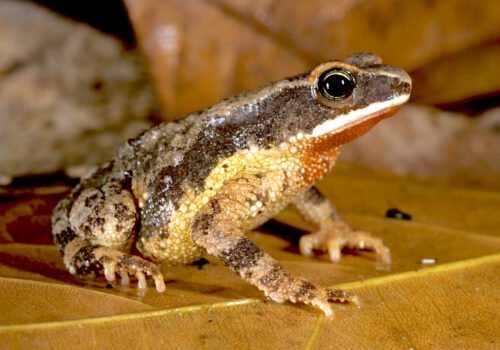
Admittedly, the first glimpse of Mertensophryne mocquardi doesn’t immediately dazzle in terms of flamboyant coloration. However, a closer examination reveals a riveting story. Typically reaching length between 20 and 35 millimeters, these diminutive toads bear a body well-suited to their humble, secretive existence. Their skins are granular, textured to blend effortlessly into leaf litter, a near-perfect camouflage in muted shades of brown, gray, or olive green interspersed with irregular patterns—nature’s gift to this savvy amphibian in evading predators.
A distinct characteristic of Mocquard’s toad and its relatives within the genus is the presence of pronounced, glandular ridges behind the eyes and along the upper limbs. These glands secrete a mildly toxic substance, a chemical cocktail adapted over generations to deter would-be predators—an essential survival adaptation. Additionally, their limbs are modestly developed but powerful enough for short bursts of hopping, essential for escape and navigation within their densely vegetated habitat.
One cannot speak fondly enough of their mesmerizing eyes, golden to copper-colored rings encircling dark pupils that seem endlessly curious and observant. Amidst the camouflage of leaf litter, these eyes provide sharp vision to hunt effectively for small prey items such as insects and arachnids.
Behavior and Life Cycle#
As twilight gently bathes the East African landscape, Mertensophryne mocquardi stirs from its daytime refuge. Nocturnal by necessity, evening triggers its nightly foraging adventures. As insect activity heightens, these toads patiently ambush their prey, employing stealth rather than speed to catch unsuspecting ants, termites, and small beetles. Equipped with a sticky tongue of remarkable precision, it quickly neutralizes prey with decisive accuracy.
The rainy season signals the onset of their reproductive rituals in earnest. Male Mocquard’s toads begin making subtle yet persistent calls—soft rhythmic trills heard subtly among the chorus of nocturnal insects—attracting females with melodious determination. Upon successful attraction, female Mocquard’s toads select temporary pools of shallow water or moist depressions within vegetation to deposit their gelatinous egg clutches. Each egg clutch is carefully placed in these shallow aquatic nurseries, away from direct sunlight yet sufficiently warm to incubate successfully.
From these humble beginnings hatch delicate tadpoles, which rapidly begin their transformation. The tadpoles graze ravenously upon organic detritus, algae, and microscopic organisms, growing quickly under favorable conditions. Within several weeks, these young tadpoles metamorphose into miniature versions of their terrestrial parents, gradually adopting a lifestyle predicated upon stealth, moisture retention, and conservation of energy.
Ecological Role#
Though small and inconspicuous, Mocquard’s toad fulfills several significant ecological roles within its habitat. As voracious predator of insects, it contributes substantially toward controlling pest insect populations, assisting in safeguarding local flora from potential insect-related damage or disease vectors. Consequently, this humble amphibian indirectly supports plant vitality, promoting a balanced and resilient forest ecosystem—perhaps disproportionately so, given its small size and modest demeanor.
However, its significance extends beyond predation. Mocquard’s toads, as prey themselves, become a vital nutrient link for reptiles, birds, and mammals, ensuring energy and nutrient flow through complex food webs. Critically, amphibians like Mertensophryne mocquardi also serve as environmental indicators of ecosystem health. Their permeable skin renders them particularly sensitive to subtle changes in the environment, alerting scientists instantly to ecosystem degradation, chemical pollutants, or habitat alterations.
Threats and Conservation Status#
Across much of its natural range, Mertensophryne mocquardi faces increasing threat due to anthropogenic pressures. Habitat loss remains the most pressing concern, driven primarily by large-scale agricultural expansion, logging, and urban development. The destruction and fragmentation of its forest home substantially reduces the suitability of habitats, limiting dispersal opportunities essential for genetic mixing and long-term population sustainability.
Climate change further compounds such threats. Shifting rainfall patterns and increased temperatures threaten crucial breeding pools, drying habitats critical for successful reproduction. Despite these pressures, the International Union for Conservation of Nature (IUCN) currently lists Mocquard’s toad as Least Concern, recognizing its relative adaptability. Yet conservationists caution vigilance; without concerted habitat protection and adequate monitoring, the outlook could quickly deteriorate.
Locally, conservation efforts aim to preserve vital habitats, integrate amphibian conservation into protected areas management, and raise community awareness. Promoting environmental education and sustainable land-use practices are paramount strategies toward ensuring this species’ enduring presence in the delicate ecosystems it inhabits.
Cultural and Scientific Significance#
While not as famed symbolically as larger, more charismatic species, Mocquard’s toad holds implicit cultural value as an emblem of biodiversity, environmental sensitivity, and ecological interconnectedness. Scientifically, further study on its life history, population genetics, and physiology could yield valuable insights into amphibian evolution, adaptation, and responses to environmental stressors.
Conclusion: A Call for Conservation Commitment#
The subtle elegance and compelling life cycle of Mertensophryne mocquardi serve as poignant reminders of nature’s interconnected beauty and fragility. It is imperative that we appreciate and protect even the humblest creatures that quietly maintain ecological balance. We invite you to join conservation efforts, spread awareness, and celebrate the quiet resilience of Mocquard’s toad. Through collective action, education, and passionate commitment, we can ensure this fascinating amphibian thrives for generations, continuing its unspoken but invaluable contributions to the wondrous biodiversity of East Africa.